

The Trump administration’s approval rating has reached a record low. What does that mean for the midterms, and what should we be keeping a close eye on as the Democrats attempt to take back Congress?
Mondoweiss U.S. correspondent Michael Arria spoke with political consultant Peter Feld about the primary results, AIPAC’s role in the elections, the centrist obsession with Hasan Piker, and what to expect in November.
Let’s start with the primaries, where we saw some big progressive wins across the country in races where Israel and AIPAC became flashpoint issues.
Before we started recording, you said you thought the primaries were a mixed bag for progressives: there were some big wins, but centrists held their ground in many places. Can you talk about that?
Well, sure, it was really exhilarating, the primary season that we just had, for those of us who support Palestine and are looking to see some kind of change in policy and particularly within the Democratic Party. We had three major wins in New York with Claire Valdez, Darializa Avila Chevalier, and Brad Lander. In Colorado, we had Milat Kiros, Chris Rabb in Pennsylvania, Dr. Adam Hamawi in New Jersey.
We did very well, but we also fell short, in areas that fall under the category of unforced errors. And we also had some bare scrapes, like Abdul El-Sayed, who was supposed to be winning by 12 or 15 points, scraping by by less than one. Of course a win is a win, and he goes on to the general election.
But I think the primary season left the establishment holding cards that they think they can deal with. They can push back on us and have been pushing back very hard, including the demonization of Piker as part of it. They understand, right now, that they’re in a death match with us.
And they won some important races. They just won the Senate nomination in New Hampshire with Chris Pappas. Progressives were somewhat hopeful that our candidate Karishma Manzur was cresting, but obviously not enough. And maybe if there’d been more investment we would have won that one. Several of the real villains, like Richie Torres, Jared Moskowitz, Greg Stanton, all skated by.
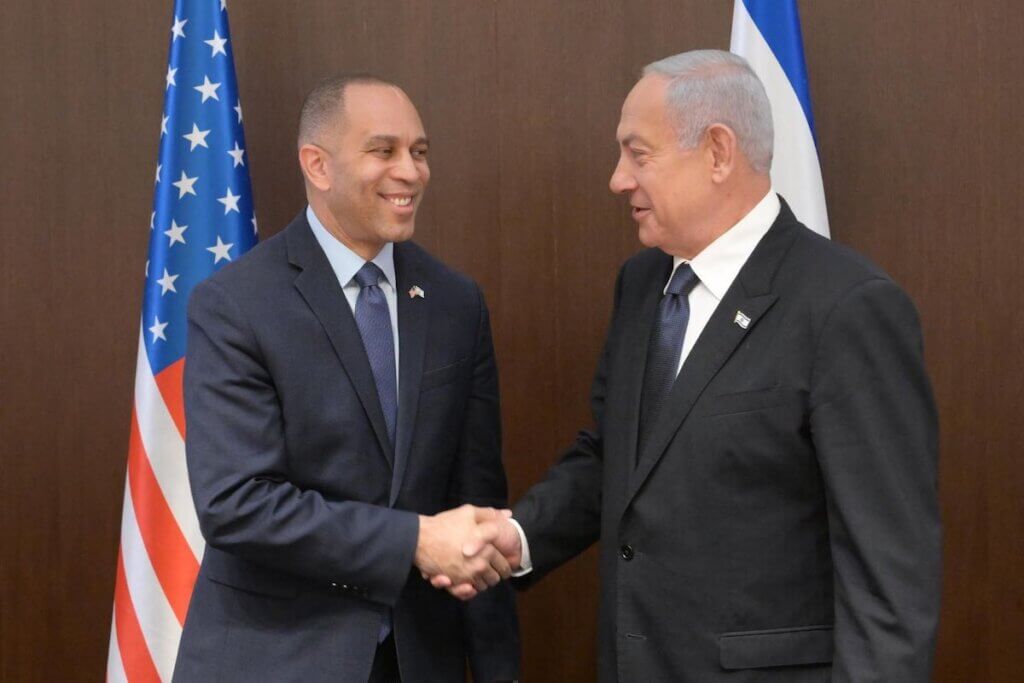
And then we have this new retrenchment by Hakeem Jeffries and the Democratic establishment to double down on their rejection of Medicare for All, double down on their support for Israel, put key people on Middle Eastern foreign policy committees who are the worst supporters of Israel that we have. They’re looking to elect Hakeem Jeffries as Speaker after what a lot of people expect will be a big Democratic win in the midterms. And when they do that, our position may not be as strong as we would like.
Let’s talk about the midterms. I think there’s an expectation that the Democrats will do well based on Trump’s low approval ratings, a bad economy, and an unpopular war. What are you looking at closely here, in terms of the Democratic Party, and do you expect them to take back Congress?
We really don’t know, and it’s going to be one of the most interesting things that we see. Right now it looks like Trump is really on the ropes. The war in Iran is a big part of it. The convention he just held seems like a flop. And the Republicans are demoralized.
What usually happens in a midterm is that very few swing voters take part. People often assume that persuasion drives these swings from Republican to Democrat or Democrat to Republican. But what’s really happening is differential turnout. The enthusiasm gap drives that. So you could say, all right, Republicans are demoralized, they may be likely to stay home. The Democrats may be energized, and they may turn out. And that’s why I think some of the very established and sober analysts are moving their forecasts and making it look like this could be a big Democratic sweep.
The other scenario is that some of this Democratic infighting catches up with the party. That the pro-Palestine base continues to be disenchanted, and that the enthusiasm gap comes back down to earth sometime between now and November. Maybe Trump pulls a rabbit out of the hat in Iran — I mean, he probably should because they’re kicking his butt. There is a scenario where things snap back. If you want to go back, we saw that in 2022 when Republicans were expecting a big blowout midterm because Biden was weak. And then Democratic chances mostly returned to normal, and Democrats had a better-than-expected night. You could go all the way back to 1982, which is before probably a lot of people watching were born. Reagan was supposed to have a really terrible midterm. He ended up pulling a lot of rabbits out of the hat, and the Democrats did well indeed, but not nearly as well as they had been expected to do.
An interesting situation for progressives is that there are bright spots under both scenarios. If the Democrats have a blowout year, I think a lot of our progressives who might be in difficult districts, like Bill Lawrence in Michigan 7, or Angie Nixon and her statewide race in Florida for the Senate — a rising tide could lift those boats. And we could end up seeing a lot of our champions going to Congress, along with a lot of Democrats who are more mainstream and establishment.
But in the other scenario, if the Democrats have a weak night, to some extent I think that’s going to be blamed on Jeffries. Because the leader of the party in Congress usually takes that blame. And you get, maybe, a narrow Democratic majority in the House that is smaller than the progressive contingent, old and new — so you have the Squad with AOC and Rashida Tlaib and Ilhan, etc., and then you have all these new people coming in, some of whom are very radical.
And if that bloc is bigger than the Democratic majority, they have the kind of leverage over Jeffries that The Freedom Caucus had several years on the Republican side. And they can use that leverage to force different things if they want to. If they’re strategic enough.
We don’t know what’s going to happen. It’s certainly going to be an interesting seven weeks.
I’d like to talk about the Israel Lobby, specifically AIPAC, which has spent big in the primaries as usual and is expected to spend even more in the midterms.
Recently, Axios reported that Mike Rogers, the GOP nominee for Senate in Michigan, was wary about AIPAC’s name being all over his ads, presumably because the organization has become deeply unpopular with the American people.
What do you make of AIPAC’s current situation, and how do you expect them to adapt to that political reality?
AIPAC certainly had some very, very spectacular failures this cycle, and I think that’s where this all comes to a head, particularly in Michigan, which Mike Rogers is looking at because $60 million was spent on Haley Stevens’s behalf. I think the largest chunk of that came from AIPAC. And she lost.
Now, she only lost by one point instead of the double digits. It could have been a win. So we can’t say they had no power, and if they had won the election by one percent instead of losing it by one percent they would have been out there the next day saying, “See? Supporting Israel as good policy and good politics” like they always do. So we have to recognize that, on the one hand, they failed; on the other hand, it’s a near miss.
There’s been tremendous work, including by Track AIPAC to really make AIPAC toxic. And they are. I did a lot of polling for Corbin Trent’s PAC, A Fight Worth Having, this cycle, where we over and over again showed that AIPAC was incredibly unpopular with Democratic voters — even in districts that were in the process of re-electing more mainstream, pro-Israel incumbents. Even in Richie Torres’ district. His renomination was taken as a sign that, well, people don’t care so much about Israel up in the Bronx. It’s not true. We found in our message testing that it wasn’t true. It’s just that they weren’t really aware of his background [on Israel]. But AIPAC itself was hugely unpopular, and we saw that in Missouri 1 where Cori Bush ended up unfortunately losing to Wesley Bell, but AIPAC was still radioactive and hugely unpopular. We saw this in Arizona 4, where Greg Stanton beat a progressive challenger, Kai Newkirk. But AIPAC was 65% unfavorable. And a lot of the rest are people who are just unsure and haven’t heard of them.
So has it disabled them? I don’t think so. They certainly spent big in the California special election against Aisha Wahab, and they lost. They have to be taking a step back and realizing that Israel is just incredibly unpopular, especially in Democratic primaries, and as I think we’re going to see, among independents and Republicans in the general election. Will that stop them? No, they have a huge amount of money to spend, and they are gifted at shape-shifting and setting up ancillary organizations with money that’s hard to trace.
And I think we also have to say that AIPAC is pretty effective in their messaging. In some ways, more so than the progressive left when it comes to paid messaging. Because they know how to stay away from Israel. They know how to attack people on other issues, like they didn’t support Kamala Harris or they voted against Biden’s infrastructure bill and other things that we’ve seen.
I just come back to this point: AIPAC and Jeffries and all these people understand that they’re in a death match right now. And this is the reason they’re leaning into the infighting: because they feel like they can’t afford to lose. So I don’t think that AIPAC is going to shrivel up. But I do think that they’ve been damaged, and they’re going to have fewer options for how they intervene in some of these contexts.
I’m going to ask you a cynical and direct question here: Does any of this AIPAC backlash ultimately matter?
Obviously, they don’t represent the entire lobby. There are other ways for people like Jeffrey Yass, or whoever, to spend big money on electoral races, but also wondering whether the rejection of AIPAC means anything in terms of the U.S./Israel relationship. We see lawmakers talk about AIPAC money like that’s the problem, as opposed to the wider issue of U.S. military support for the country, or Zionism more broadly. It sometimes reminds me of lawmakers, like Bernie Sanders, talking about “Netanyahu’s Israel” as if there’s some sort of distinction to be made there.
Do you think this runs the risk of becoming a situation lawmakers can reject AIPAC rhetorically and draw in voters that way, but continue to back Israel? We saw similar things happen during the BLM protests, where politicians were voicing their support for change and then continuing to back the same policies, so one would understand why activists would be wary.
I agree that there is a danger in having too much of it hung onto AIPAC. You and Mondoweiss have been warning about this because it’s not just AIPAC. But on the other side of the equation, we know that the ratings for Israel are also poor, and they’re falling across the board among Democrats. And not just younger but also older Democrats. That they’re falling among independents, that they’re falling among Republicans. We’ve seen races where AIPAC itself wasn’t really the factor, like Mamdani’s race last year in New York, where they tried to use Israel talking points against him, and they just didn’t work. People are smart, and they know that the issue is with Israel, not just AIPAC, and not just Netanyahu. We’ll see what happens with the Israeli elections next month.
I would also say that other pro-Israel groups have also been falling short. Democratic Majority for Israel’s candidate Maura Sullivan lost a congressional primary to Stefany Shaheen, Jeanne Shaheen’s daughter, in the New Hampshire primary two nights ago.
The Israel arguments don’t work, and they’re really not going to work. with the voters. The problem is really accountability. Can the Israel lobby and the AIPAC establishment and the politicians who support them get away with it?
There were a couple of posts a couple of days ago by Adam Johnson, very gloomy posts considering all the great news that we’ve seen in the primary, saying that the Zionist establishment is reasserting its control through Jeffries, the fake antisemitism smear of Hasan Piker is working, and Palestine has been driven off the agenda.
What they’re trying to do is they’re trying to make us radioactive. They’re trying to make Abdul radioactive and call him an antisemite because of his connection to Piker. They’re trying to make Mamdani radioactive, hyping this idea that he should not go to the 9/11 25th memorial commemoration in New York City. They’re doing everything they can.
Hakeem Jeffries’s moves in the last few weeks are part of this. He went on television and doubled down on aid to Israel and no Medicare for All. Then it turns out that he’s met with Jared Kushner. And then the next day, instead of trying to do damage control over the Kushner story, which was so damaging that even centrists like James Carville attacked Jeffries and said, “What are you doing?” — the very next day, they announced Moskowitz and Wasserman Schultz in key positions on the Foreign Affairs Committee. If they were trying to mollify the base, they wouldn’t do that. Instead, they’re picking a very intentional fight with the base because they need to win this, and they need to win this fight more than they need gains in the midterm.
I heard you and Yumna last week asking, why are they doing this? They’re doing this because it’s existential for them. And we’re seeing it in other ways. In the ban on federal aid to universities who “boycott Israel” that they passed, with 33 Democrats breaking off, and voting to condemn socialism, and other Israel votes.
What they’re saying is this: This is what it’s going to be. Get used to it. We’re being tone policed on criticizing Jeffries. But to me, the meeting with Jared Kushner is everything. We have to realize that the differences between Jeffries and Kushner over Israel are microscopic. I’m not aware of any difference of opinion that either of them has ever had with each other.
For all purposes regarding Israel, Hakeem Jeffries becoming Speaker might as well be Speaker Jared Kushner. That’s what we’re going to have next year. And they’re telling us that in the immediate wake of all of our victories.
Jeffries is there in the first place because of Israel. He is there in the first place because he won the 2018 contest against Barbara Lee for number two to Pelosi in the House leadership after AOC had defeated Crowley in the primaries that year. And Barbara Lee, though she’s not the most progressive Democrat we’ve ever seen, was notable for being the only one who voted against the authorization for the use of military force in Afghanistan right after 9/11. So she was considered unacceptable, and they put Jeffries in there, and they protected him all along. And now he’s poised to become Speaker as a result. And it all traces back to Israel.
So I think we have to look at our strategy and say, how are we going to fight back against this? It may not be enough to send our champions to Washington as a contingent of 10 or 20. What is the strategy going to be? Many of [the incoming progressives] have preemptively endorsed Hakeem Jeffries for Speaker. Certainly Brad Lander has, and a number of the others. Mamdani and AOC did a tremendous amount of work to clear obstacles from Hakeem Jeffries’ path. And to me this is a horrible thing because, apart from anything that we could say about Israel, he’s a terrible leader and communicator. And he did a terrible job of holding his caucus in line to prevent two Democrats from defecting and giving Republicans a procedural win.
If Hakeem Jeffries becomes Speaker, it will be a generational catastrophe. I don’t see a way to dislodge him without a Democratic wipeout, which I don’t think any of us wants to see. He’s going to be the first Black speaker, and anybody who attacks him is going to be attacking “the first Black speaker.” So to get back to your original question, this is how AIPAC is going to deploy its power, through these people — through Moskowitz and Wasserman Schultz and Greg Meeks, and other strongly pro-Israel supporters who are going to be in key positions. They’re saying they don’t care about public opinion, and don’t care what the Democratic base wants. And they think they can take their electability theories and bully progressives into getting behind whoever they push through the 2028 primaries. And so I think that you know Adam Johnson and others are right to sound the alarm. And it’s right to make it not just be about AIPAC, it’s about this whole constellation.
Let’s talk about Hasan Piker. I don’t know that there’s much to say that hasn’t already been said, but he’s become this Bogeyman on the right, and he’s also been attacked by a number of prominent Democrats, including people like Governor Gavin Newsom and Senator Jon Ossoff, who probably have presidential aspirations.
Another issue we haven’t addressed yet is the 2028 presidential campaign, and I’m wondering if you think these two things are connected. Are Democrats trying to pave the way for a centrist nominee by punching left on figures like Piker?
Well, I think they’re more than just connected. I think that’s what the attacks are all about. And Vox just ran an article saying Democratic moderates have one goal right now: not winning the midterms by the biggest possible margin, but making Piker a liability for 2028.
So the Democratic establishment and the Republicans were putting Piker up on the Jumbotron last night, they’re actually very closely allied in their way. Or at least they’re working in tandem. The Neera Tandens of the world, the head of the Center for American Progress, who’s very, very aggressive in fighting progressives, will take this thing on the Republican Jumbotron and say, See, if we stick with Piker, we’re going to be opening ourselves up to these kinds of criticisms. And of course, that was never said about Democrats associating with Charlie Kirk or Mike Savage, or any of the ones that Gavin Newsom was talking to. And it does show the hypocrisy, but they don’t really care about it. What they really care about is bullying us.
So, to your question: do these [2028 presidential] candidates think they’re helping themselves by attacking Piker? I think they’re soldiers in the fight. I think that Gavin Newsom and John Ossoff potentially feel threatened by a candidate who does have support from Piker. Say if Piker decides to support AOC, who herself has been a little bit muddled in how she’s addressed all of this. But they want to remove a progressive asset.
And you’ll remember that from 2024 and earlier, the Democratic establishment was shaking their heads and moaning about “how are we going to get a Joe Rogan of the left?” Well, they got Joe Rogan of the left, and all they want to do is suppress him and ostracize him and make him unfit to take part in any campaign. They’re saying, “Why don’t you stay away from Abdul’s race? Don’t you know any better? Just be quiet.”
Well, the thing is, what he’s saying is very, very popular, and I don’t think he is going to shut up. I think Newsom and Ossoff are really making themselves unacceptable to the progressive left.
This is all what it’s about. They want to win this fight more than they want to win a big margin in the 2026 midterms. And that’s why they’re focusing on it now.
And they would love to see the progressives lose and all these moderate, “central casting” candidates that the Democratic Congressional Campaign Committee has come up with — all the ones that are like, “I served six tours of duty in Iraq and Afghanistan” — they want those people to win. And their theory of electability is to be proven in these midterms.
And the progressive theory of electability holds that El-Sayed, Bill Lawrence, and Angie Nixon could win, and a few of the others, Amish Shah in Arizona, and a few Bernie Sanders is supporting in some swing districts — Rebecca Cooke in Wisconsin and Sam Forstag in Montana.
So in the ideal scenario for the establishment, they would win the midterms without any of these progressives coming through. Then they can say, see. We’ve got to pull together and focus on electability. And of course they want Piker to be completely disarmed and disabled during this whole process. And that’s what we’re seeing right now.
How much does Israel factor into the concerns about Piker? He’s a very public anti-Zionist. Is that where the establishment’s anxiety comes from?
I think almost all of it comes from that, with the remaining small percentage coming from private health insurance. Avoiding Medicare for All, which they’re also desperate to do.
Basically, Jeffries and Schumer and the Democratic leadership answer only to the donor class. And Israel is not the only part of the donor class, but it overlaps with other parts, like real estate and private health insurance, the Democratic side of the tech world and the gig economy. Of course, we saw that after Obama left office, his top aides went to work for places like Uber and DoorDash. All of those are very few degrees of separation from Israel anyway — I mean, the Silicon Valley tech world is very aligned with Israel. And so sometimes it’s hard to know where one of these ends and the next one picks up.
But I think Israel is the 800-pound gorilla. It’s why they want to beat El-Sayed. It’s why they wanted to beat Mamdani. It’s why they wanted to beat Darializa and Claire Valdez. We won’t ever see the end of it.
But the Iran war is a big challenge for them. And I think that we’ve just got to gather our momentum. Frankly, I think what we have to do in response to all this is lean into Hasan Piker. “Piker now more than ever!” We have to not give in to them, and not accept the bullying, and push back. And if we don’t, we’re going to be on our heels.
So, when voters go to the polls during midterms, what do you think will be the central issues they’re basing their choices on?
David Hogg made a really interesting point about what’s going on. We basically have three levels of issues that have really energized the progressive Democratic base. At the local level, it’s the cameras and surveillance that people can see in their communities.
At the state levels, it’s data centers, and of course, data centers have really transformed a lot of these contests in the primaries and, I think, still in the general election.
At the global level, it’s blocking aid to Israel. It’s the genocide in Gaza. It’s the Iran war. It’s everything that goes along with that.
So I think we have to be sober about the setbacks that we’ve had in several places, but I think we also have to lean into our strengths. And find these alliances and commonalities. And I think the progressives can and should still win.
I don’t want to be gloomy and negativistic. But I think we can’t claim bigger victories than we’ve had. This is just a step along the way. The Empire always strikes back.
And the Empire knows they’re in a death match with us, and they want to win it more than they want to win a big victory for Democrats in the midterms.

I think Hakeem Jeffries needs to be reminded every day between now and November that his secret meeting with Jared Kushner was and is totally unacceptable to the base of the Democratic Party.
Jeffries is a snake.
Cont:
Senator Sanders no matter what people think has led many of the young progressive Reps down the “level the playing field path”
As my now deceased (passed at 93) die hard Dem, card carrying union member mother would remind me whenever she would hear Bernie or Warren on the news. “They are just like FDR and Eleanor on domestic issues. All Democrats used to talk like that and pushed hard for “leveling the playing field” She would repeat this every time she would hear them speaking.
The likes of HRC, Jeffries, Emmanuel, Kamala etc…just really do not get this core value. They all play footsies with the economic elite (the multi millionaire and billionaire class) way too much. The American public sees and feels this phenomena and its consequences of multi billion (Wal Mart, Krogers, Dollar Tree, Amazon etc) paying pathetic wages.
40-80 years ago all Dems used to talk like what many would call Democratic socialist thinking and actions of Sanders. Not radical at all. The way Dem’s used to be!
RE: “Let’s talk about Hasan Piker… he’s become this Bogeyman on the right”
MY COMMENT: Hasan Piker is the right’s latter-day Willie Horton!
Willie Horton ~ https://en.wikipedia.org/wiki/Willie_Horton
Jeffries and Kushner are one and the same. The Democratic Party does not care about the voters one iota, that’s why they lost in 2024. They have the same paymasters. All of these electoral games about progressives, centrists, etc. is just the excellent sideshow to keep people from asserting independence from the corruption of American politics. Left and right are irrelevant. Commentators like Arria and Feld are part of the problem that prevents any real alternatives from emerging.