

As the UK prepared the announcement of sanctions on Israeli settlements last week, the Israeli government announced yet another settlement expansion project east of Jerusalem. The timing, according to observers, is not coincidental, and the scale of what was announced is unlike most settlement expansion decisions that have come before it.
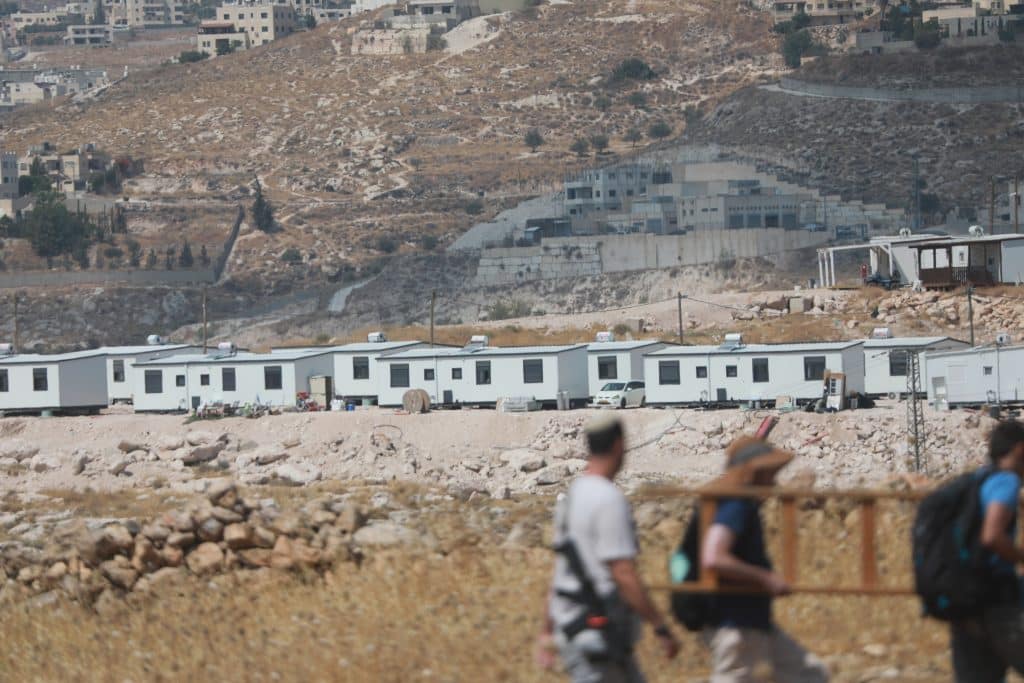
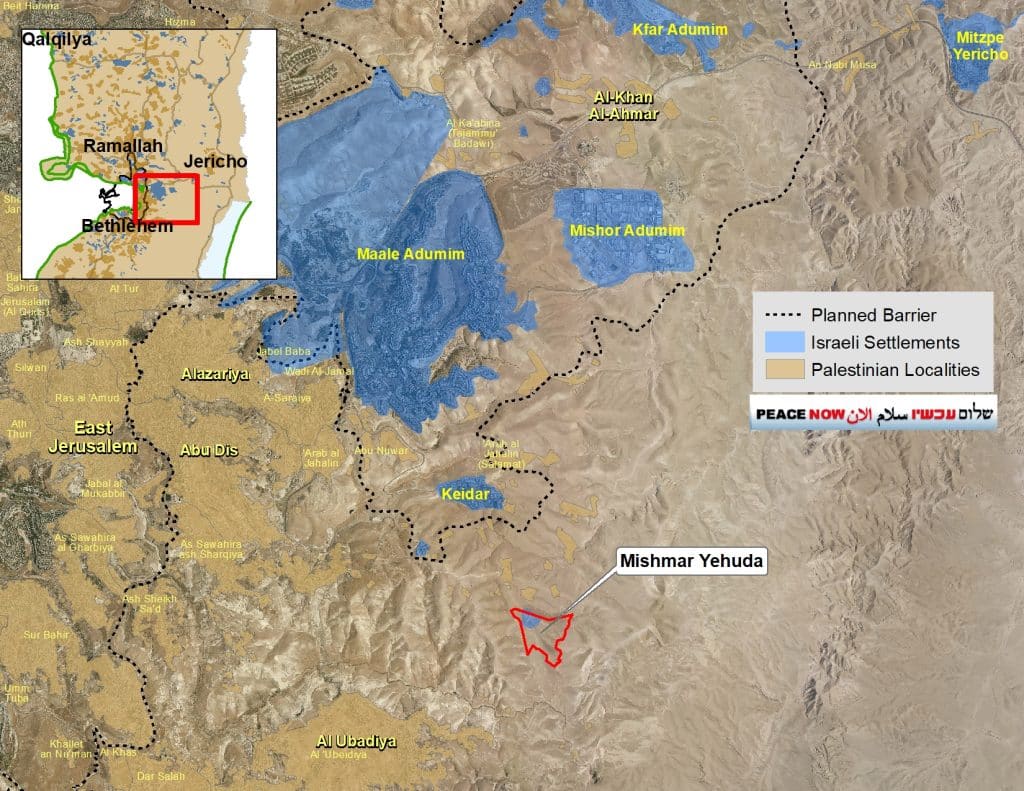
On September 4, the Israeli government announced the confiscation of 1,522 dunams (152.2 hectares) from the lands of the Palestinian town of Abu Dis, southeast of Jerusalem, declaring them as “state property.” The confiscated land includes an illegal Israeli outpost called Keidar South, which is to be attached to the nearby Israeli settlement of Mishmar Yehuda, effectively turning an illegal outpost into an extension of what is planned to be a full-fledged Israeli city.
The planned city is located on the southeast side of Jerusalem, between the large Israeli settlement block of Gush Etzion to the south and the Ma’ale Adumim settlement block to the east. It also straddles the node separating the northern West Bank from its southern half, making it a strategic section of the West Bank’s “Area C” — the over 60 percent of the territory that falls under full Israeli administrative and military control in accordance with the 1993 Oslo Accords.
The significance of this move lies in Israel’s broader plans to sever the West Bank’s northern and southern halves, effectively splitting the territory in two. By turning two illegal settler outposts into a single Israeli city between Jerusalem and Bethlehem, last week’s announcement dovetails with another cornerstone of Israel’s plan to bifurcate the West Bank, known as the E-1 settlement project, which also aims to fragment the territory.
The E-1 project is a decades-old Israeli plan to take over the expanse of Palestinian land east of Jerusalem that stretches toward the Jordan Valley, encircling Jerusalem with a continuous belt of Israeli settlements that would isolate it from the rest of the West Bank while expanding Israeli control deep into the center-south of the territory.
Flouting international condemnation
The timing of the Israeli announcement to expand Mishmar Yehuda came directly after the UK’s sanctions announcement and a separate joint statement last Tuesday from the foreign ministers of 12 countries — including France, the UK, Canada, Spain, Ireland, Norway, Denmark, Finland, Iceland, Poland, Portugal, and Sweden — declaring their countries’ intentions to restrict or ban trade with Israeli settlements in the occupied West Bank, which they deem illegal under international law.
But the Israeli announcement is only the latest in a string of decisions that have led to the seizure of more and more Palestinian land for Mishmar Yehuda’s expansion, starting in February 2023. Before that date, Mishmar Yehuda was an outpost, originally called Mitzpeh Yehuda, which was later retroactively legalized.
A year later, in February 2024, the Israeli army’s central commander signed an order delineating Mishmar Yehuda’s boundaries, giving it some 417 dunams (41.7 hectares) that extended far beyond Israel’s separation wall east of Jerusalem. At the time, hardline Israeli Finance Minister Bezalel Smotrich celebrated the delineation of the settlement, which came after “diligent work” by the Settlements Administration within the Defense Ministry over the course of a year, adding: “We came to this land to build and to be built up in it. We will continue the settlement momentum throughout the land.”
A year later, in December 2025, the Israeli government announced plans to add up to 3,750 dunams (375 hectares) to the settlement.
Last week’s announcement added yet another 370 dunams (37 hectares), which included the Keidar South outpost.
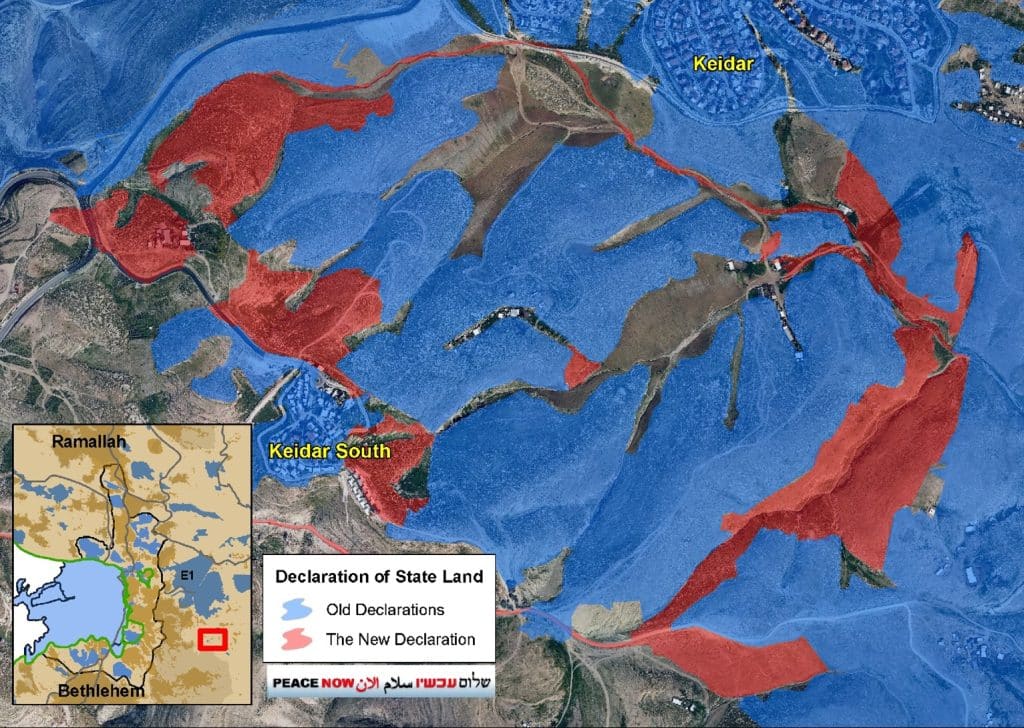
Since late 2022, the Israeli government has approved over 103 settlements, including the retroactive legalization of illegal settler outposts, resulting in Israel’s takeover of more than 109,000 dunams (10,900 hectares) of Palestinian land in the West Bank in just four years, according to the Palestinian Settlements and Wall Resistance Commission. Often, the first step in this process involves the confiscation of Palestinian land in Area C and declaring it “state property.”
According to the Israeli anti-occupation group Peace Now, the plan for the first phase of the Mishmar Yehuda settlement calls for building 3,600 housing units on about 417 dunams (41.7 hectares), intended for the religious-nationalist public. In the second phase, the settlement is planned to expand by an additional 2,000 dunams (200 hectares) and to include another 10,000 housing units for the ultra-Orthodox Haredi population.
Strangling Jerusalem
According to Palestinian geographer and settlements expert Khalil Tafakji, the Mishmar Yehuda plan is “part of the larger Israeli settlement project to isolate Jerusalem from the rest of the West Bank, just like E-1.”
The E-1 project has been a central focus of Western criticism in recent months. It consists of a new Israeli settlement block east of Jerusalem that would expand Israeli settlements in the eastern desert of the city to the edge of the Jordan Valley, splitting the West Bank in two and making Palestinian territorial contiguity impossible. The E-1 project has long been described as the settlement initiative that would definitively end the possibility of a two-state solution.
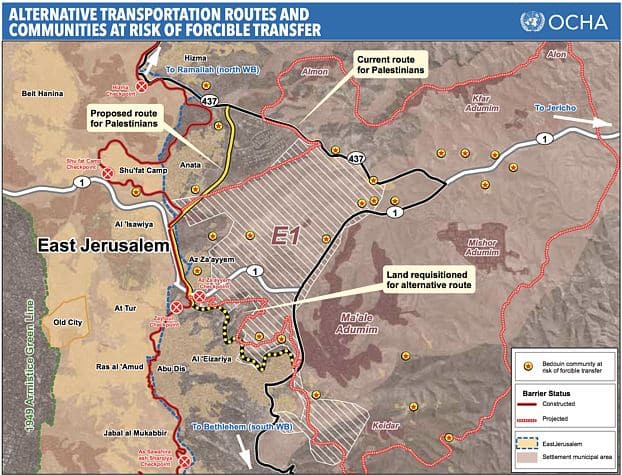
But just south of the E-1 area, Israel continues the same strategy through other projects.
“Mishmar Yehuda serves the same purpose as the E-1 project in the sense that it extends the Israeli settlement presence to the edges of the Jordan Valley,” Tafakji told Mondowiss. “It practically blocks Palestinians from accessing the entire Jerusalem and Bethlehem eastern desert area, which has historically been the seasonal grazing pastures of Palestinian Bedouin and shepherd communities.”
According to Tafakji, “Mishmar Yehuda also adds to the Israeli settlement belt along the edge of the Jordan Valley along the Allon road project, which establishes Israeli settlements along the Jordan Valley from north to south,” he explained. “Mishmar Yehuda adds to this belt, actually trapping Palestinian cities behind the edge of the Jordan Valley.”
“In the case of Mishmar Yehuda, it also adds to the isolation of Jerusalem,” Tafakji added.
The combined effect, he argues, is the physical fragmentation of a Palestinian territory, to impede the mere possibility of its formation — not through a single dramatic announcement, but through the accumulation of decisions that, taken together, close off the geographic possibility of Palestinian sovereignty.
It’s all part of the Elimination Project – Israel’s systematic dismantling of Palestinian collective life in the West Bank. That’s the name of a new 249 page report by Btselem:
202609_the_elimination_project_eng.pdf
At the time of this report’s publication, a broad Israeli assault is underway in the West Bank, rapidly and systematically dismantling all the foundations of Palestinian existence. Since the formation of the current government at the end of 2022, and with even greater intensity since October 2023, Israel has dramatically escalated its assault on all areas of life for Palestinians in the West Bank. The ability to get to work, take children to school, attend university, receive medical care or municipal services, meet with family and acquaintances, cultivate one’s land, go on vacation, or attend cultural events, along with hundreds of other ordinary activities that make up daily life, are all under constant Israeli attack and are sometimes denied altogether.
Here’s the 16 page summary:
202609_the_elimination_project_summary_eng.pdf
This report shows how Israel is implementing this mechanism of elimination through five main domains: violence and intimidation, movement restrictions, economic strangulation, social and political destruction, and ethnic cleansing and territorial takeover….The Zionist-Israeli project demonstrates the key features of settler colonialism: establishing Jewish-Israeli sovereignty in a space inhabited by an Indigenous Palestinian population, while undermining Palestinian existence through marginalization, expulsion, dispossession and fragmentation. Defining the Zionist-Israeli project as settler colonialism does not deny Jewish historical, religious and cultural connections to the space, the continuous presence of a Jewish community in it, or the long history of persecution, displacement and violence against Jews. The question it poses regarding the Zionist-Israeli project is not whether a Jewish connection to the space exists, but concerns the ways in which the Zionist project sought to establish exclusive Jewish-Israeli sovereignty in a space where Palestinians lived and continue to live
And the NYT has just posted an editorial by Yuli Novak, executive director of Btselem, titled “Israel’s Elimination Project”.
Opinion | Israel’s Elimination Project – The New York Times
About a year ago, at B’Tselem, the Israeli human rights organization I lead, we realized we were struggling to explain what was happening in the West Bank. The problem was not a lack of information. Quite the opposite: By then, for almost three years, day after day, we had documented homes being burned and demolished, communities being expelled, children being shot and killed, roads being blocked and humiliating assertions of Jewish supremacy by settlers and by the Israeli government alike.…On Monday, B’Tselem is publishing a report on the process unfolding in the West Bank. It tells a story with deep roots. From the mass expulsion and displacement of Palestinians during the Nakba in 1948, when hundreds of thousands of Palestinians were displaced or expelled and the subsequent refusal of refugees’ right to return, through occupation, settlements and apartheid, Israeli policy has repeatedly worked to entrench Jewish sovereignty while making Palestinian presence and political life more precarious.
Zionist have always had an “Elimination Project’ part of their original plan.
Not being discussed much is how U.S. military equipment etc being moved to Israel as Iran destroys U.S. military presence in the UAE, Kuwait, Bahrain etc
Are U.S. military forces, equipment being moved into Israel to protect Israel’s violent, genocidal expansion of illegal Israel? Sure as hell appears to be so
https://www.businessinsider.com/iranian-strikes-damaged-hundreds-buildings-us-bases-middle-east-report-2026-9
https://www.jpost.com/middle-east/article-901210