

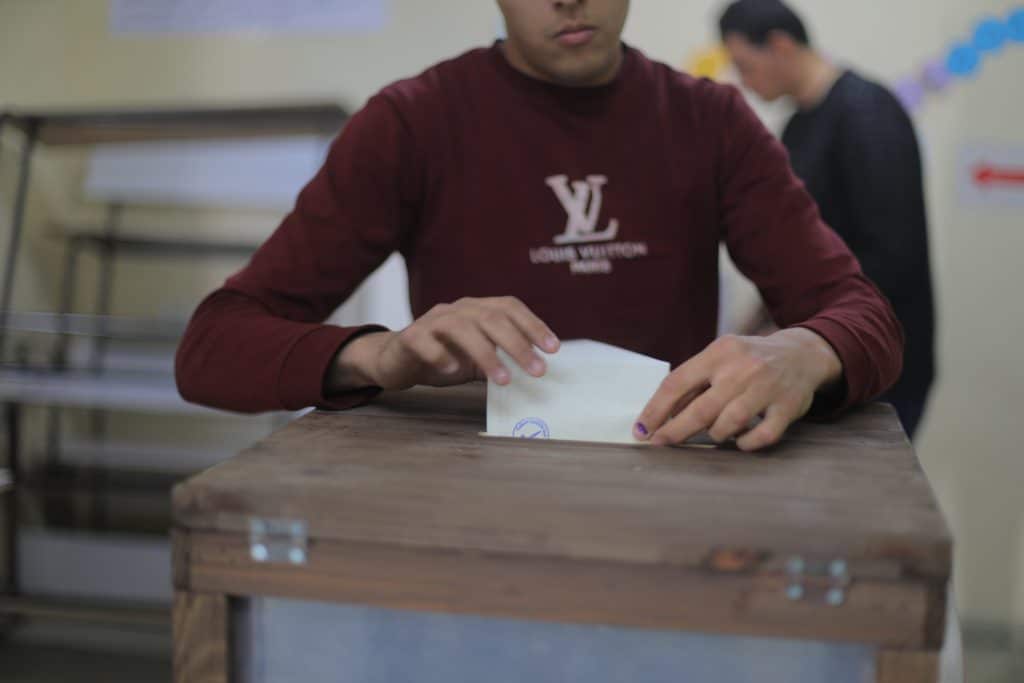
Palestinians in the West Bank and the Gaza Strip are scheduled to vote on November 28 for the first time in 20 years. For most of the electorate, it will be their first time at the ballot box. And for many of them, it may not matter.
Palestinian factions that have spent two decades in bitter — and at times violent — division are joining forces ahead of the upcoming legislative election, forming the broadest political coalition seen in the occupied territories in years. The Alliance of National Forces (ANF), formed following a series of talks in Cairo, includes Hamas, the two main dissident currents of Fatah led by Muhammad Dahlan and Nasser al-Qudwah, the Gaza-based paramilitary Popular Resistance Committees (PRC), which was never interested in politics, and the Palestinian Islamic Jihad (PIJ), a faction that has historically opposed elections in principle. The Palestinian left-wing factions, the Popular Front for the Liberation of Palestine (PFLP) and the Democratic Front for the Liberation of Palestine (DFLP), are still considering whether to join.
Fatah, led by President Mahmoud Abbas, has said it will run independently and rejected the possibility of running on a joint list with Hamas.
In the background, Abbas has amended the elections law to require that any candidate subscribe to the official PLO political program, including all signed agreements with Israel — a condition that civil and legal groups have denounced as undermining political diversity and freedom. But the amended law also raises the number of legislative council seats from 132 to 200 and lowers the age of candidacy to 20 years. The Palestinian Authority (PA) says that these changes are designed to encourage broader participation.
According to the Palestinian Central Bureau of Statistics, 64 percent of Palestinians in the West Bank and Gaza are under the age of 30. The majority of the electorate was either not born or too young to vote when the last elections took place in 2006. They are now being asked to choose between factions founded decades ago that are largely led by the same figures and run on programs that have not changed in years, divided along disputes that trace back to the Fatah-Hamas split of 2007 — decades before most of today’s first-time voters were old enough to understand what was at stake.
The energy of 2021
When Abbas announced legislative elections in January 2021, before calling them off a month before the vote, the West Bank and the Gaza Strip were briefly swept by a surge of political energy. Thirty-six electoral lists were announced and began campaigning. Of those, only seven represented traditional factions. Five were explicitly youth lists, seen at the time as evidence of a generation hungry for participation and frustrated by the options available to them.
One, named “Karamati” — Arabic for “My Dignity” — included young professionals from both Gaza and the West Bank, and campaigned on democratic participation, opportunities for young people, and care for vulnerable sectors.
Another, the Generation of Democratic Reform, known by its Arabic acronym JAD, included intellectuals, professionals, and activists. JAD launched a virtual shadow parliament as an alternative to the official electoral process, campaigning — among other things — against the legal requirement of a $10,000 deposit as a condition for candidate registration.
The most outspoken and independent list was called Freedom and Dignity, headed by Palestinian activist Nizar Banat, a carpenter with a graduate degree in the Arabic Language and Law, and who had become an online political commentator known for his blunt, often scathing criticism of the PA. His list campaigned on fighting PA corruption, rejecting the Oslo-based order of negotiations with Israel, and opposing politically-conditioned European funding.
Then, in April of that year, Abbas canceled the elections. Nizar Banat criticized the decision and called on donor countries to cut off funding to the PA until it abided by the popular demand to hold legislative elections. A few months later, PA security personnel abducted and killed him, beating him to death while in custody.
Demonstrations broke out across the West Bank in protest over his killing, galvanizing a wave of popular outrage that was met with a swift PA crackdown. The assassination of Banat marked the denouement of political engagement in the Palestinian street, and with it the brief period of political enthusiasm around the legislative elections.
The scar of cancellation
The 2021 call for elections brought to light figures, ideas, and trends that were invisible in the Palestinian political mainstream, a far cry from the level of engagement demonstrated since the 2026 announcement of legislative elections. So far, only party lists have been announced, and the majority of Palestinians remain skeptical.
Much of the current detachment goes back to 2021 — not just to what the elections promised, but to what their cancellation cost.
Zein Abu Daqqa, Senior Fellow at The Institute for Social and Economic Progress, where he researches trends in Palestinian society, told Mondoweiss that “the cancellation of the 2021 elections had a deep and negative impact on how Palestinians think about elections.”
“Psychologically, the cancellation functions as an anchoring event which people remember vividly,” Abu Daqqa, who participated in the JAD initiative in 2021, said. “They also remember that some candidates sacrificed money, jobs, and other livelihoods to stand, only for the elections to be canceled shortly thereafter.” Abu Daqqa described the cancellation as “a real scar on the Palestinian psyche, which anyone considering forming a list now will have to reckon with.”
But Abu Daqqa also points to the compressed timeline. Elections were announced in late August with a vote scheduled on November 28, leaving barely three months for candidates to organize, register, and campaign. “Even in an open political environment, this would be a short window,” he explained, “and we have not had an open political environment or an active political life for many years.”
Haneen Abu Omar, a Palestinian in her early thirties who also participated in the JAD initiative, goes further, stating that many youth who showed enthusiasm in 2021, including herself, “have lost trust in the idea that Palestinian elections would fix things.”
“After a genocide in Gaza, and the ethnic cleansing in the West Bank, we saw a wholesale acceptance by Palestinian leaders from all factions of U.S. conditions, especially to the condition of creating a technocratic committee to run Gaza outside of the Palestinian political institutions, as if accepting the disintegration of Palestine,” she explained. “New elections seem designed to give legitimacy to this new order of things. I personally don’t trust this political system anymore, and I don’t trust that elections can fix it.”
She also points to the shock of the past three years. “Before October 2023, things weren’t rosy, and there were large Israeli raids in the West Bank, and people were arrested for no reason, but today things are on a whole different level,” she said. “Today, Palestinians feel that there is an existential attack on their presence in their country, and if I were a Bedouin who was expelled from his home and was still looking for a place to stay, or a mother from Gaza who is living under a tent and looking for food for her children, I don’t think that democratic participation in Palestinian institutions would be my first priority.”
As for Abu Daqqa, he sees this shift in attitudes reflected in his research. “Priorities have moved toward the economy and stability,” he said, drawing a historical parallel with the aftermath of the Second Intifada, during which stability and security also dominated Palestinian concerns. Yet, when elections were announced in 2005, Palestinians still participated in large numbers, with both presidential candidates, Mustafa Barghouthi and Mahmoud Abbas, campaigning on job opportunities, reconstruction, and fighting corruption, alongside national liberation goals.
“Attitudes toward the present elections are shaped by three perceptions,” Abu Daqqa noted. “Whether the elections will actually take place; whether they will be free and fair; and, following from these, whether they will have any bearing on people’s lives. If all three conditions are satisfied, the same hope and interest recorded in earlier questions on reform, democracy, and governance can be expected to return.”
‘Will it bring back our lost homes?’
In Gaza, the outlook for elections is grimmer still.
Razan Abdel Raheem, 26, is a children’s writer from al-Shati’ refugee camp in eastern Gaza. She has lived all the episodes of Israel’s genocidal war on the Strip, been displaced twice with her family, and lost her home to an Israeli airstrike. She now lives with multiple other families in a relative’s house.
In 2021, at 21, she also considered casting her first-ever vote for an independent youth list. Today, she told Mondweiss that she has no interest in the upcoming elections.
“I find it difficult to believe in anything at all after all that we have gone through,” Razan said. “What will a new legislative council do with the wholesale destruction here in Gaza? Will new elections fix all the injustices that we have been forced to live through since Hamas took over in 2007? Will it give us back the youthful years that we lost to Israel’s bombing campaigns? Will it bring us back our lost homes or our lost friends and family?”
Razan raises the questions that animate Gaza’s post-genocide politics with particular precision. “Will a newly elected council push back the Yellow Line that the occupation keeps moving toward us?” she said, describing Israel’s progressive expansion of the invisible line demarcating the Israeli-controlled part of the Strip. “Will it bring justice for Hind Rajab and the thousands of children like her who were killed? Will it make it possible for the people of Beit Hanoun, Rafah, and Khan Younis to go back to their land? Will it pursue cases to hold the occupying state accountable worldwide? Will it rebuild my parents’ house?”
“If the answer is ‘yes,’ then I will be the first to vote, and even demonstrate and campaign, too,” she said. “But I don’t think it is.”
Razan also points to a quieter demographic shift that she says is draining Gaza of the generation most likely to drive political change. “Most young people in Gaza who had a chance of leaving have left through scholarships or artistic residencies — I’m talking about the intellectual elite of Gaza’s youth who survived the genocide,” she explained. “Most of our friends from Gaza’s small Christian community also left, leaving a void in the city.”
Gaza, Raheem concludes, “is not what it used to be, and new elections are not enough to repair what has been broken.”
According to Abu Daqqa, the dark shadow that the Israeli genocide casts on elections is related to the precise moment Palestinians now experience. “Hope itself rises and falls with political events and with the political horizon,” Abu Daqqa explained. He believes it is “likely temporary, and will lift once people come to believe in a new process or new leadership.”
A generation disengaged
In mid-August, the Palestinian daily newspaper Al-Quds reported findings from the latest youth poll by the Palestinian Center for Polls and Survey Research, which surveyed 1,281 Palestinians aged 18 to 29 across Gaza, the West Bank, and East Jerusalem.
According to the findings, 72.4 percent of young Palestinians in Gaza aged 18 to 29, alongside 26.7 percent of the same cohort in the West Bank, did not follow the municipal elections held last April.
Up to 45 percent of those surveyed said they weren’t interested in internal Palestinian politics, 15.3 percent said they had lost trust in Palestinian elections, and 13 percent said they found no convincing candidate.
According to the report, 64.1 percent said they often or seriously think about leaving their country.
Yet Abu Daqqa’s research points to another aspect of the Palestinian youth’s outlook on their country’s politics. “When Palestinians are asked how they expect change to come about, they consistently point to elections,” Abu Daqqa said. “When asked about reform, most understand reform to mean elections. What people want is an electoral process through which they can choose their representatives. Elections, in short, remain both credible and a priority.”
The gap between the political energy of 2021 — with its youth lists, independent candidacies, and public debate — and the near-silence of 2026 reflects something beyond disillusionment with any particular party. It reflects a generation that watched elections canceled in 2021, a genocide unfold in 2023 and after, and a political class unable or unwilling to respond to either.
Abu Daqqa believes that the opportunity isn’t entirely lost for the current generation of Palestinian youth. “Each generation must develop the tools, tactics, and strategies through which it builds its own approach to liberation, and I am confident that the current generation will develop its own set of tools, principles, and strategies to do exactly that,” he said. “Innovation, creativity, and determination are everywhere in Palestine.”
Gershon Baskin on Palestinian elections
https://gershonbaskin.substack.com/p/dont-cancel-the-palestinian-elections.
Respond to? The Palestinian political class was entirely responsible for both the cancelled elections and the non-genocidal war. And yet, both Hamas and Fatah are likely to succeed electorally – the real political tragedy would be returning both to power.