

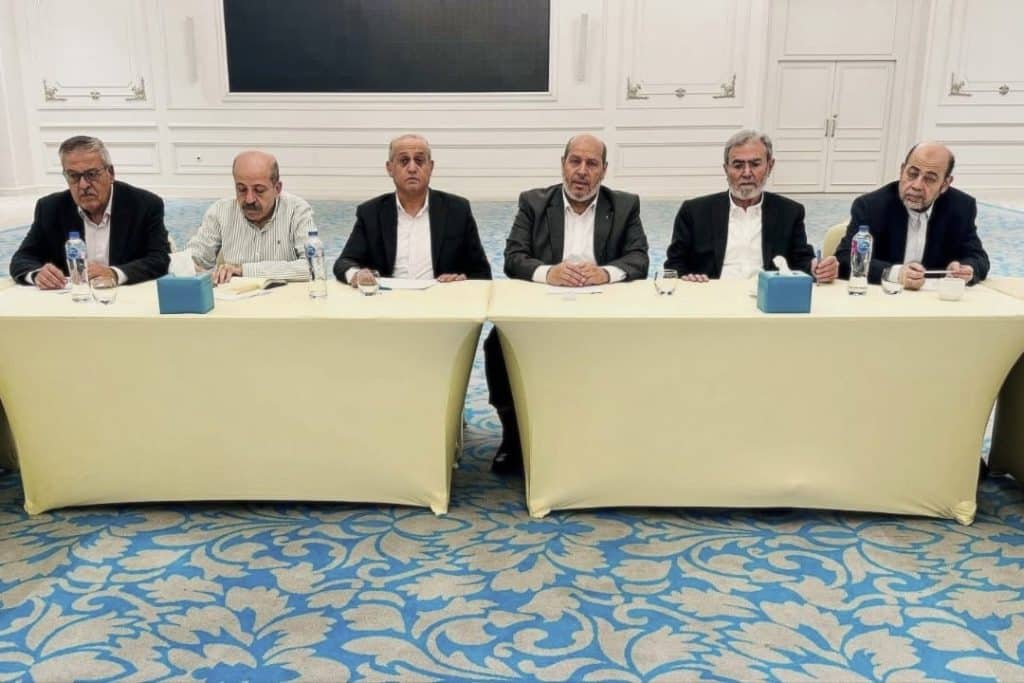
Palestinian factions that have spent two decades in bitter — and at times violent — division are joining forces ahead of elections announced for November, forming the broadest political coalition seen in the occupied territories in years.
Following a series of talks in Cairo, the “Alliance of National Forces” was formed with the specific objective of running together in the next Palestinian legislative elections. This coalition includes Hamas, the Palestinian Islamic Jihad (PIJ), the Democratic Reform Current (a dissident Fatah current led by the UAE-based former Fatah Gaza leader, Mohammad Dahlan), the National Democratic Forum (another dissident Fatah current led by Yasser Arafat’s nephew, Nasser Al-Qudwah), and the Popular Resistance Committees (a Gaza-based organization founded by former Fatah member Jamal Abu Samhadana in 2001).
Palestinian left-wing factions, namely the Popular Front for the Liberation of Palestine and the Democratic Front for the Liberation of Palestine, are expected to announce in the coming days whether they will join.
The alliance, set in motion by a decree from Palestinian Authority (PA) President Mahmoud Abbas calling for new elections in late November, disrupts two decades of political stagnation that have weakened Palestinian political leverage at a moment of accelerating Israeli annexation.
According to the Palestinian Central Bureau of Statistics (PCBS), about 64% of Palestinians in the West Bank and Gaza are under the age of 30 – for most, this would be their first voting experience.
For many Palestinians, the mere prospect of elections is in itself a chance to reunite Palestinian politics and more efficiently confront Israel’s destruction of Gaza and annexation of the West Bank under a united national leadership. The fact that the coalition itself is so diverse proves the point: Palestinians across the board have a desire for change after two decades of Palestinian politics being reduced to the division between the mainstream Fatah leadership and Hamas.
However, neither elections nor political alliances guarantee a united Palestinian leadership or a repaired Palestinian political system. Whatever outcome emerges will face serious internal and external challenges, including private interests that have accumulated over years of stagnant politics, international pressures to limit Palestinian political expression, and the fundamental constraints of democratic reforms under military occupation.
All of this is taking shape in a political climate that has never been more hostile to Palestinian political life. Since October 7, 2023, Israel has de facto banned organized Palestinian politics — through mass arrests, administrative detention, the targeting of community leaders, and the criminalization of political expression — even as elections are being announced and coalitions formed. A new legislative council, if it ever convenes, would need to produce a united Palestinian vision and project to unite the West Bank and Gaza, at precisely the moment when the conditions for doing so have been most severely undermined.
Repressed politics
Political activity has always been a risk for Palestinians under Israeli occupation. Most Palestinian political groups were born in the context of resistance to occupation, and have been targeted with arrest, even in the social branches, student movements, and unions affiliated with those parties — including parties that have never engaged in armed resistance, such as the Palestinian People’s Party (formerly the Communist Party).
The First Intifada, between 1987 and 1993, produced an irreversible outburst of political activism, creating a space for political expression within Palestinian politics, even under the Palestinian Authority, which was founded in the wake of the Oslo Accords. Even Hamas, which opposed the Accords, joined this framework in 2006, running for seats in the PA’s legislative council.
Following October 7, 2023, Israel’s crackdown on Palestinian politics spiked dramatically. The number of Palestinian detainees in Israeli prisons doubled – from 5,000 on the eve of October 7 to more than 10,000 by the end of 2025, half of them held without charges under “administrative detention orders.”
“Arrests extended to former detainees, social activists, community leaders, and basically anybody with a leading role in their community,” Ayah Shreiteh, from the Palestinian Prisoners’ Club, told Mondoweiss. “Before October 7, the detention conditions of Palestinian prisoners had already been deteriorating, but then everything deteriorated.”
Shreiteh details that in Israeli jails, “food quantity and quality deteriorated, Israeli prison guards raided cells on a weekly, sometimes daily basis, medical neglect became widespread, and cells with an average surface of five or six square meters that usually held up to six prisoners were now being crammed with nine to 12 prisoners.” This, added to reports of sexual assault on Palestinian prisoners in Israeli jails, raised the stakes on doing any kind of politics in Palestinian society, especially under the label of parties or groups.
This impact was palpable in the weak participation in the April municipal elections earlier this year. During the previous local elections in 2022, Nablus had six electoral lists, Hebron had six, and Ramallah had five. This year, only two lists competed in Hebron, while in Nablus and Ramallah, there was no contest at all, since only one list registered for each city.
The competing forces
Hamas, which led the attack on October 7, has come under the most direct pressure from Israel’s crackdown and the devastation of Gaza. The wiping out of Gaza, and the pounding of Hamas’s fighting force, subsequently leading to its acceptance of the once-unacceptable principle of disarming under the urgency of reconstruction, the group has lost much of its capacity to advocate for its traditional program centered around armed resistance. Through its alliance with other forces — including dissident Fatah currents with strong support bases within Fatah itself — Hamas is attempting to stage a comeback as an opposition force to the dominant Abbas leadership.
The PRC has remained outside electoral politics since its formation as an armed resistance group in 2001, while the PIJ has historically been disinterested in elections across its 40-year existence. Both groups have their main social base in Gaza and a legacy of resistance independent from Hamas. Their alliance with Hamas signals building a political case for resistance that extends beyond Hamas alone.
The most surprising aspect of this alliance is the inclusion of Muhammad Dahlan’s “Democratic Reform Current.” The former Gaza Fatah leader built his reputation as a former Palestinian intelligence officer whose crackdown on Hamas in Gaza in the late 1990s and early 2000s made him the main internal nemesis of the Islamic group at the time. He retains strong support within Gaza’s Fatah base.
Naser al-Qudwah’s National Democratic Forum rounds out the alliance. A former diplomat, physician, and nephew of the late Palestinian leader Yasser Arafat, he presents himself as a statesman holding an institutionalist and legalist line, with support among the Palestinian upper-middle classes.
Together, these forces pose a serious challenge to the dominant leadership of Fatah’s Mahmoud Abbas and his deputy-president, Hussein al-Sheikh, who have monopolized Palestinian representation for the past two decades. If the left-wing PFLP and the DFLP join the coalition, the challenge would be overwhelming. This could produce one of two familiar scenarios: Abbas could call off elections as he did in 2021, or if elections proceed, a coalition government forms, and Western countries boycott it because Hamas and the PIJ are a part of it. That’s what happened in 2006.
But if a new legislative council gets to form a new government and exercise its legislative and oversight authority, it would confront a whole other set of challenges.
International pressure and private interests
These elections do not unfold in a vacuum. The U.S. and European countries have been pushing the PA to reform. Two years later, Trump’s peace plan included the same demand.
In November 2025, a European Commission spokesperson said that the PA needs to “implement reforms” to continue receiving EU aid.
In responding to these demands, the PA has already revoked its financial support program to families of those killed or imprisoned by Israeli forces. The PA also agreed in 2024 to remove content referring to historical Palestine or to the history of the Palestinian struggle from school books.
This pressure appears to be one driver behind the most significant amendment to the Palestinian elections law, passed by presidential decree last month: any candidate or group running for elections must adhere to the political platform of the Palestine Liberation Organization (PLO), which means they accept all agreements signed with Israel and adhere to a two-state solution framework through U.S.-mediated negotiations as the sole path to Palestinian statehood. The condition is already generating controversy.
Limits of free politics under occupation
A new legislative council would also face challenges that go beyond internal politics. The status of the Gaza Strip and its relationship to U.S. President Donald Trump’s so-called “Board of Peace,” Israel’s violations of signed agreements through expanding settlement activities into areas of the West Bank supposedly under PA control, and changes to land and building permits laws facilitating annexation — all of these are political questions any new elected body would have to address. All would be subject to pressure by the U.S., the EU, and Arab countries with the leverage and interest to contain any new Palestinian political stance.
“The new legislative council might have to clash with internal private Palestinian interests, but also with the Israeli occupation, and possibly with Western countries who are pushing for reforms, and who would set the limits and the direction of these reforms,” Isam Abdeen, a lawyer and human rights advocate, told Mondoweiss.
For Mustafa Barghouthi, the new elections are more than a political competition. “These elections are about the Palestinian people’s right to democratic participation, which they have been denied for many years, and therefore they need to be free, without political conditions,” the General Secretary of the Palestinian National Initiative told Mondoweiss. “The coming elections need to be a tool, not only to reunite Palestinians, but also to serve as a tool to resist Israeli plans, the first of which is the separation of Gaza and the West Bank.”
Barghouthi added that “there needs to be a national dialogue to agree on these basics, to guarantee that the elections will fulfill their goal.”
Although Palestinian elections are a genuine and longstanding demand of Palestinians, their effectiveness and the scope of change remain bound to Palestine’s capacity to sustain a free, independent, and inclusive political life – a basic condition made very difficult under the continuity of Israeli occupation, and the threat of full annexation and displacement.
Ahmed Fouad Alkhatib
August 21, 2026
https://x.com/afalkhatib?s=20
“ A new legislative council, if it ever convenes, would need to produce a united Palestinian vision and project to unite the West Bank and Gaza, at precisely the moment when the conditions for doing so have been most severely undermined….The U.S. and European countries have been pushing the PA to reform. Two years later, Trump’s peace plan included the same demand.”___________________________________________________________
An important and timely article. A united vision can significantly advance Palestinian interests.