

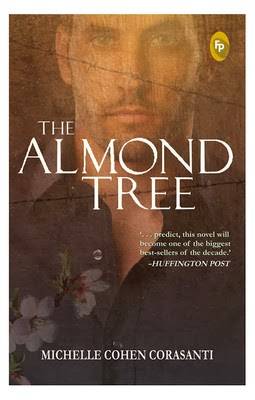
We have run several pieces about the novel, The Almond Tree, by Michelle Cohen Corasanti, including criticism of her perspective. The book has now been published in Asian markets; and it is garnering favorable reviews.
Last month The Times of India published an interview with the author, and interviewer Ipshita Mitra recently released the full transcript on her personal blog, “It’s only words…”
In that interview, Corasanti reveals the inspiration for the story of the book that she had not disclosed before–her former marriage to a Palestinian. The two were married in his village, she says, and her former husband provided the “seed” for her protagonist in her book.
Qs. Significance of the almond tree in the book: it’s witness to the atrocities but stands mute and silent. Could silence be ever an answer to violence?
Ans. For me, this conflict is not about one’s skin color, nationality, or religion. It’s about being human. I am the almond tree. I wrote about the burden that comes with awareness that I carry with me every day. I am a witness and I wrote this novel because silence should never be an answer to violence. I put myself in the shoes of the many Palestinians I grew up with and loved during the seven years I lived in Israel and the years afterwards. I witnessed and heard their stories. I have never forgotten their voices; their stories are a part of my story and helped me to write ‘The Almond Tree’.
I returned to the US after living in Israel for seven years during high school and college, my innocence shattered, desperate to stop the needless suffering caused by the Israeli/Palestinian conflict. At the time, no one cared or even believed me. I thought, as an American, I would re-acclimate easily into US life, but that wasn’t the case. Having witnessed what I had, it was hard to talk about guys, what to wear and what parties to attend. After a year in graduate school, I still hadn’t met a friend I could relate to until I met Ahmed (not his real name). We had graduated from the same college in Jerusalem. We knew many of the same people and had lived in the same dorms. I was doing my masters and he, his post-doctorate in chemical physics jointly with a Nobel Prize winner and his Israeli professor. I finally felt at home. We had come from the same world, or so it felt at the time.
Ahmed, whose father went to prison when he was a child and wasn’t released until he was in graduate school, became the breadwinner at an early age, picking fruit to support his family. He was the oldest of nine and so brilliant that he could attend school infrequently and still graduate and receive a needs-based scholarship to Hebrew University. Yes, Israel does give scholarships to Palestinians inside Israel. In fact, the Koenig Report that was leaked to the press in 1976 revealed recommendations to encourage Palestinian intellectuals in Israel to study the sciences so they would have less time to dabble in nationalism. With degrees in science, it would be easier for them to find work abroad and nearly impossible for them to find high-level scientific jobs in Israel since military service is almost always a prerequisite. In fact, I met and was friends with many Palestinian post-docs from Israel both in the US and in Europe.
Ahmed was from a world far different than the one I grew up in, but it was a world I understood, that continues to shape the woman I am today. We were married in Ahmed’s village and lived there for the summer. I had been to many Palestinian villages before, but as his wife I was one of the family.
In writing The Almond Tree, I focused on the glimmer of hope in his story: Ahmed and his Israeli professor who worked together. I didn’t write Ahmed, my former husband’s story, but it was a seed for my novel. The Almond Tree is influenced by the many Palestinians lives I witnessed and stories I heard. I didn’t write about the West Bank. I never lived there. I lived inside of Israel like my characters.
From past experience, I knew that if I told the truth, that it would sound too incredible. People would say I was making it up. I needed to be able to show, yes that really did happen. It is a story I carried in my heart for over a decade before I found the strength and the way to tell it. During the seven years it took me to write the novel, I revisited my days in Israel during the first Intifada, my marriage, the stories my Palestinian friends had shared with me and those I had seen, I drew from all of these real events for the novel.
President Obama told an auditorium of Jewish Israelis that the conflict would not be resolved until they could put themselves in Palestinian shoes. Why? I believe because he knows it creates empathy. And in writing The Almond Tree, I have tried to walk in their shoes so as to help my readers do the same.
Qs. Was it a deliberate attempt on the author’s part to represent the two brothers Ahmed and Abbas in stark contrast in terms of their political ideas? Was it a case of the ‘Good’ Palestinian (Ahmed- the math prodigy who wins the Nobel) vs the ‘Bad’ Palestinian (Abbas- the freedom fighter and lives in abject poverty)? Ahmed’s easy acceptance of the oppressor’s society is hailed but Abbas’ rejection to be part of the same is criticized. Why?
Ans. The brothers, though very different in character, were virtually inseparable until an Israeli cripples twelve-year-old Abbas, leaving him in chronic pain – and angry at the people who caused his disabilities. Abbas fills an important role in The Almond Tree, providing a context for why some Palestinians choose a life of resistance, risking death, injury, torture and imprisonment. I have not written about abstract ideas in Palestinian families’ lives. They are facts of life that touch and have touched every family. Abbas is not a bad person. He’s a freedom fighter as opposed to Ahmed whose genius opened doors for him that were not available to Abbas. Ahmed chooses another path, partly out of a moral indebtedness to his father, which is established early in the story and runs throughout the novel, and partly because he naturally possessed something that could act as a bridge between him and the world beyond his Palestinian village.
Of the two brothers Abbas is much more dedicated to the cause of resistance and freeing his people. Ahmed is more concerned with his immediate family’s survival and fulfilling his promise to his father. Neither of the brothers is bad and their relationship is crucial to the story.
As far as “easy acceptance of the oppressor’s society,” I wouldn’t call life in the diaspora easy even for those Palestinians who have lived and prospered in it. No one with a conscience can forget what he knows, where he comes from or the people left behind. I don’t think those burdens will lessen until the conflict is over. I neither hail nor criticize my characters’ choices in the book, I simply show how humans may behave in real life, and at times how brothers can grow apart, when each is convinced of his “truth.”.
Qs. Nora vs Yasmine: Who makes the better wife according to you and why?
Ans. There are actually three loves of Ahmed’s life.The counterpart for Nora in The Almond Tree wasn’t Yasmine, but rather his first love, Amani, a beautiful and brilliant Palestinian woman……
To learn Corasanti’s views on peace, justice and a one or two state solution, read the rest of the interview.
Thanks for making me aware of this novel. Corasanti seems like a good force. I don’t dismiss Susan Abuhalwa’s perspective, but my first thought was that Cry the Beloved Country was a great and important book, which played a large role in setting the American consciousness about apartheid.
Cry, Thy Beloved Country which was written by a white man in the voice of a black man did create awareness for Apartheid just like The Almond Tree creates awareness of the Palestinians’ plight. Have you read her book? If you did, you would understand why Abulhawa’s inaccurate review should be dismissed. Here’s a link to all the inaccuracies in Abulhawa’s review that she wrote and Aljazeera refused to print: http://thealmondtreebook.com/2014/02/04/readers-deserve-truth-almond-tree/