

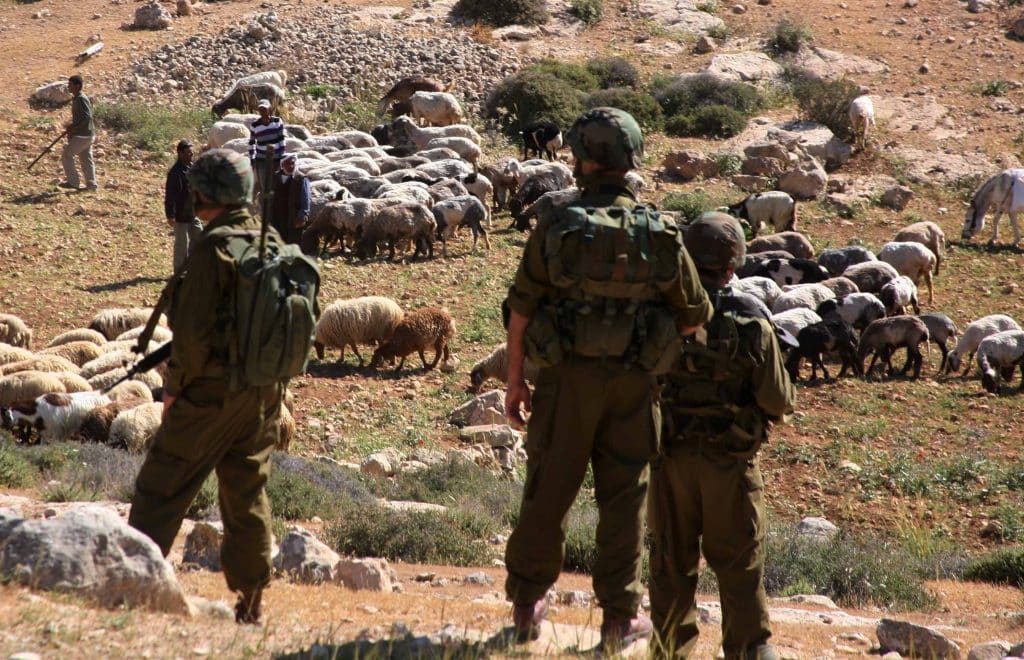
In May 1943, David Ben-Gurion described the failure to settle Hauran, a geographic region spanning southern Syria and northern Jordan, as “a dream that had stayed a dream.” Almost a century later, locals of that region say a new push is underway to make that Zionist dream a reality. The dream may be coming to life at the expense of local pastoralists at Wadi Toemm, on the western edge of the Hauran plain, where a group of Israeli settlers, supported by the Israeli military, have spent the past six months fencing off thousands of dunams of Syrian grazing land for an Israeli cattle colony.
In the village of Ma’ariyah, one of three major villages in the region, 44 kilometers from Daraa’s urban center, Muhammad al-Hafri, a Syrian farmer who relied on the valley’s natural pasture to graze his herds, says that in recent months, the Israeli military and Israeli settlers have effectively cut him and his fellow villagers off from their land.
“The economy of our village depends entirely on herding and early-season crops,” al-Hafri explained. “Ever since the settlers showed up, they have been firing live rounds at anyone who comes near the valley.”
Ma’ariyah is located near the official “buffer zone” that sits on the border of Syria and the Israeli-occupied Syrian Golan Heights. Under the 1974 disengagement agreement, the buffer zone is a demilitarized strip inside Syrian territory, under Syrian civil administration and UN supervision, where no forces other than UN peacekeepers are permitted. Two lines bound it: Alpha, to the west, is the limit Israeli forces may not cross, and Bravo, to the east, is the limit for Syrian forces.
Wadi Toemm runs outside the zone, marking the divide between the occupied Golan and Daraa, though the ground seized for the cattle colony lies within it. Since the fall of the Assad regime in 2024, Israeli forces have pushed past the Alpha line and taken control of Syrian land inside the zone.
Seven months ago, the Israeli military moved 140 head of cattle into the valley floor in Wadi Toemm, pushing Syrian farmers like al-Hafri from their historic pastureland. The land has now been effectively occupied by an Israeli settler named Yoel Zilberman, founder of HaShomer HaHadash, or the New Guard, the movement that pioneered the doctrine of “presence” as territorial control. The Israeli army is aiding him with a reconnaissance unit and nearly 22 kilometers of livestock fencing, parts of it electrified and running alongside minefields.
HaShomer HaHadash was founded in 2007 with the stated aim of reconnecting Jewish Israelis to agricultural land. Under Zilberman’s leadership, it has increasingly functioned as a vehicle for settler land seizure, deploying herds and farming operations to establish a presence in contested areas.
According to the Syrian monitor Sijil, HaShomer HaHadash’s appearance in the region marks the most significant of three attempts to establish outposts there over the past 18 months.
This method of colonization has been exhaustively documented in the occupied West Bank, where so-called “shepherding” or pastoral outposts, composed of small herds that can cover maximal terrain with minimal people under military protection, have helped settlers take over more than 1.1 million dunams (110,000 hectares) of land — close to a fifth of the entire West Bank. Of that, roughly 750,000 dunams (75,000 hectares) have been effectively seized by settlers since December 2022.
This practice of using herds to take over land, coupled with violent settler attacks and restrictions placed on Palestinians to access their own property, has displaced Palestinians across 97 communities and areas since January 2023, most of them Bedouin and herding communities.
Residents of southern Syria now say that Israel is using the same West Bank model to displace them from their land.

The most dangerous attempt yet
Since Israeli forces seized the demilitarized buffer zone in Syria after the fall of the Assad government in December 2024, Israeli forces have been documented seizing and demolishing homes, razing forests, and firing on Syrian herders approaching their own land. Since June 2025, there’s been an average of 17.5 Israeli ground incursions per week, according to Syria monitor Karam Shaar Advisory.
Khaled al-Asaad, who heads the farmers’ association in Ma’ariyah, says the land Israeli forces have seized contains around 40 dunams (4 hectares) of olive groves and 140 (14 hectares) dunams of early-season vegetable fields that produce zucchini, cucumbers, and tomatoes.
“Another 1,200 dunams [120 hectares] of irrigated land are gone, and of the 6,800 dunams [680 hectares] the village once grazed in the valley, 2,000 [200 hectares] remain. Israeli forces have also seized 200 goats and 50 cattle,” he adds.
The economic impacts on farmers and the local community have already been devastating. FEWS NET, the famine early warning network, reported in April that Israeli incursions into Quneitra and Daraa involving checkpoints, detentions, livestock losses, and the destruction of agricultural assets had undermined household livelihoods and pushed families into greater dependence on borrowing. After this farming season was lost to the land seizures, residents were left carrying accumulated debt. Farmers have had to borrow cash flow from agricultural supply offices — local entities that distribute essential farming inputs — to cover lost income.
“I had to sell my car to pay off what I owed,” al-Hafri says. “Others have sold much of their livestock.”
In addition to the loss of land and income, farmers in Quneitra and Daraa said they face mounting restrictions on water sources used to irrigate crops and provide drinking water for livestock. They have also faced an increase in settler gunfire, nighttime military raids, shelling around their villages, road closures, and deliberately damaged electricity infrastructure, including cut power lines and disabled transformers – obstacles which residents say Israeli settlers enforce to make life miserable.
Khaled Khalil, an expert on Syrian-Israeli relations, describes the pastoral cattle colony as the most dangerous settling effort yet in Syria, a product of the growing dominance of Israel’s far right.
“The trio of Prime Minister Benjamin Netanyahu, Finance Minister Bezalel Smotrich, and National Security Minister Itamar Ben-Gvir has driven vertical splits inside Israel and energized the extreme religious current, represented by Bashan Pioneers and the New Guard organization, both of which are working to build settlements in the West Bank and southern Syria under the protection of the Israeli army,” he told Mondoweiss.
Founded in April 2025, Bashan Pioneers is a group of Israeli activists named after the biblical region that covers what is now Quneitra, Daraa, and Sweida in Syria. Amos Azaria, a computer science professor at Ariel University — the largest Israeli settlement university located in the West Bank — who leads the group, has said it wants a corridor running from Israel to the Druze areas of Sweida, with the Sunni-majority districts in between emptied and settled by Jews.
The group’s most recent incursions have intensified in recent weeks. In July, members of the Bashan Pioneers repeatedly crossed into southern Syria, including through Mount Hermon, with some remaining inside Syrian territory for hours before being detained and returned by Israeli forces.

The cattle unit
According to a Yedioth Ahronoth report in July, the Israeli army had brought in the cattle to create a reality on the ground as a prelude to settlement. Khalil argues that Israel is replicating the West Bank model in southern Syria through land confiscation, arrests, abuse of residents, and the enclosure of farmland, and that this is underway in every village in the south, from northern Quneitra to western Daraa.
The model, approved in January 2026 by Brig. Gen. Yair Palai and Col. Benny Kata, was deployed by Zilberman, who told Yedioth Ahronoth that the army handed him an operational plan marking the ground it wanted held, and that officers pressed him to “seize the ground faster and restore sovereignty to the area.” The Israel Land Authority is now working with the military to develop procedures regulating civilian use of what remains a closed military zone.
Bassam Alyan, a researcher at the Center for Palestinian Studies, tells Mondoweiss the introduction of cattle herds in the Wadi Toemm area cannot be read as pastoral activity isolated from the political and security context in the West Bank. “Multiple reports,” he says, “have documented how grazing and farming have been used in the West Bank in recent years as a means of entrenching an Israeli presence, particularly in open rural areas that Palestinians find difficult to reach freely.”
One example from Nablus shows how these methods effectively empty villages. In late December 2025, the last six families in the hamlet of Khirbet Yanoun left the village after more than 60 years there, according to the UN Office for the Coordination of Humanitarian Affairs (OCHA). OCHA attributed the ethnic cleansing of Yanoun to Israeli settlers from the Itamar settlement and nearby outposts that blocked grazing areas, stopped Palestinian residents from planting fodder, and cut off access to olive groves. Seven days before, on December 21, settlers had taken over two abandoned houses in the village and plowed 130 dunams of Sahel Yanoun, the community’s own cultivated plain.
The last family was given a few short hours to leave, as reported by Mondoweiss in January 2026. Once Khirbet Yanoun was empty, Israeli forces installed a gate across the road, effectively putting an end to the existence of an entire village.
With settler incursions and attacks on Palestinian communities in the West Bank on the rise, Alyan adds, steps like the introduction of a cattle unit raise fears of effective control expanding over further tracts of land in Syria, whether through the establishment of pastoral outposts or by limiting the ability of farmers and herders to make use of their own land.
Tracking the mounting violations by occupation forces in southern Syria, the Sijjil center documented 187 violations in July and 239 in June, ranging from ground incursions and checkpoints to raids, detentions, and air sorties. In one striking escalation in the humiliation of residents, a patrol at a temporary checkpoint on al-Rafid road stopped a group of passers-by and ordered them to remove their clothes.
All of this, according to Mahmoud Ismail, head of the farmers’ association in al-Rafid, a village abutting the border strip in Quneitra, is meant to create “an environment that drives people out.”
“Residents of the border strip feel no stability, and what they fear most is conditions that push them to leave by indirect means,” he told Mondoweiss. “What is needed is an end to the incursions and a return to security, so that people can stay on their land. If present circumstances do not allow for that, then residents must at least be enabled to remain through aid and compensation for the losses the occupation has inflicted on them”

Not the West Bank yet
Yet, Alyan draws a distinction between the Syrian and Palestinian cases.
“In Palestine, and especially the West Bank and East Jerusalem, millions of Palestinians live on the land itself, and settlement interlocks directly with their communities, their towns, and their villages. Its effect on territorial contiguity and on the establishment of a connected Palestinian state is therefore far greater,” Alyan explained.
“Can what is happening in southern Syria turn into a model resembling settlement in Palestine?” he added. “I’d say the danger exists, but it is not correct to say the outcome is settled.”
“First, we sold the animals. If things stay as they are, the land goes next.”
Muhammad al-Hafri
Khalil disagrees. He believes Israel is carrying out the same occupation measures in southern Syria that it is carrying out in the West Bank. But he places his hopes in legitimacy, international law, and Syria’s diplomatic efforts, crediting Syrian negotiators with shifting the confrontation from the battlefield to the area of international law — a success he says was reflected in the UN Secretary-General’s visit to Damascus in July.

However, he notes that Guterres’s affirmations regarding Syria’s security and stability, and his emphasis on the international resolutions bearing on the conflict with Israel, “count for little against Israel’s defiance of international legitimacy” and the repeated statements by senior Israeli leaders that they will not withdraw from southern Syria.
Damascus has repeatedly condemned the incursions into Quneitra and Daraa as a violation of Syrian sovereignty. Syrian President Ahmad al-Sharaa said in July that Syria was working toward a U.S.-mediated security agreement with Israel, avoiding confrontation in the meantime, and pressing for a withdrawal to the 1974 disengagement lines.
For farmers, this debate does not matter. What matters is that they are seeing their land being taken before their very eyes, with seemingly no way to stop it.
In Ma’ariyah, the village has lost around two-thirds of its livestock, al-Hafri says, sold off as fodder prices climbed and the animals died of thirst. Residents can no longer move between the last house on the valley’s edge and the al-Jazeera base, taken after Assad fell.
“First, we sold the animals,” he says. “If things stay as they are, the land goes next.”
Residents of the southern villages insist, however, that they will not let these attempts succeed.
“They are holding on to their land despite their meager means,” Ismail from al-Rafid told Mondoweiss.
This article was produced in collaboration with Egab.
Hudda Mattar
Hudda Mattar is a Syrian journalist, children’s program producer, and documentary filmmaker, with a focus on cultural and political affairs.
Re: In May 1943, David Ben-Gurion described the failure to settle Hauran, a geographic region spanning southern Syria and northern Jordan, as “a dream that had stayed a dream.”
See: *Study of 3,000-year-old animal teeth from Tel Hazor in the Upper Galilee shows herds moved between warring Israel and Aram, shedding light on ancient [Golan] boundaries’ permeability, April 2026: “Animal Sacrifice Powered Ancient Jerusalem’s Economy”, showed bone collagen isotopes from goats and sheep in the ancient Jerusalem garbage dump had chemical signatures that established a massive portion of the livestock originated in hyper-arid desert regions, including Idumea (modern-day southern Israel/Negev), Transjordan, and Arabia: and the journal PLOS One article by researchers from Ben-Gurion University that identified at least 28 additional large stone circles in the region surrounding Rujm el-Hiri in the Golan Heights pointing to seasonal assembly sites for the movement of the ancient herding communities.
Ben-Gurion Looks At The Bible, By David Ben-Gurion (Author), Jonathan Kolatch (Translator) is available as a Kindle Edition book, The synopsis says “The illuminating addresses presented in this volume were delivered by the first Prime Minister of the State of Israel to a select group of students who comprised the “Prime Minister’s Bible Study Circle.” Ben-Gurion was very agitated about the failure of Joshua to conqueror places like Shechem, and the rest of Greater Israel.
That Circle of experts included many atheists and believers who disagreed with Spinoza about the written terms and conditions he explained had invalidated their myths about a fictional “eternal” covenant. See for example: It was Promised 3,000 years ago: History’s Biggest Con Job.
The Joshua Generation: Israeli Occupation and the Bible by Rachel Havrelock, Kindle Edition discusses the lengths Ben-Gurion’s Bible Study Group took to justify myths in order to confiscate and settle in Palestine, Lebanon, and Syria. Chaim Bar-Daroma (Schermeister) was a participant in Ben-Gurion’s Bible Study Group (Chug HaTanakh) He won the Israel Prize for “And This Is the Boundary of the Land”, a biblical geographical monograph, published in 1958, He cited ancient Jewish cartographers who claimed God said the borders of the promised Land of Canaan included all of Lebanon, Syria and the coasts of the entire “Sea of Philistia” from the southern wilderness as far north as the Euphrates.