On May 19, 15-year-old Omar al-Ajraf had walked with his friend, Sanad al-Mousa, to collect his exam card. Neither returned that afternoon, disappearing somewhere on the road between their school and their homes in Rasm al-Ajraf, a hamlet attached to the village of Koudana in Syria’s Quneitra governorate.
Omar’s mother filed a report with local authorities, posted in local Facebook groups, and waited through dreadful hours, fearing what might have gone wrong.
The boys came back the next day with the bruises of a beating still fresh on them, dumped by Israeli forces on the outskirts of al-Hamidiya, where the army recently built a military base. A third youth, picked up in the same operation as he ran across the fields, did not come back at all.
Omar and Sanad are two names on a daily-growing list in Quneitra. After Bashar al-Assad’s fall in December 2024, Israel declared the 1974 Disengagement Agreement, brokered after the 1973 war, void and rolled into the buffer zone, taking Mount Hermon and grabbing control of the entire strip of land near the border up to the Yarmouk basin in Daraa governorate.
“They asked me if I belonged to Hezbollah and if I carried any weapons, and showed me pictures of people I didn’t know,” al-Ajraf told Mondoweiss. “Then they beat us.”
For Omar’s parents, the questions came as a shock. The Lebanese resistance movement, Hezbollah, has little popular support in Quneitra, and is widely rejected across Syria, particularly because of its role fighting alongside the former government.
His family added that the areas where Israeli forces are conducting sweeps were once strongholds of the armed opposition, which battled the government, Iran, and Hezbollah throughout the civil war.
“The pattern of arrests, night raids, bulldozer convoys, chemical spraying of farmland, settler incursions, and cold-blooded killings has unfolded under a silence from the international system that has functioned, in practice, as permission,” said Fadel Abdul Ghani, head of the Syrian Network for Human Rights.
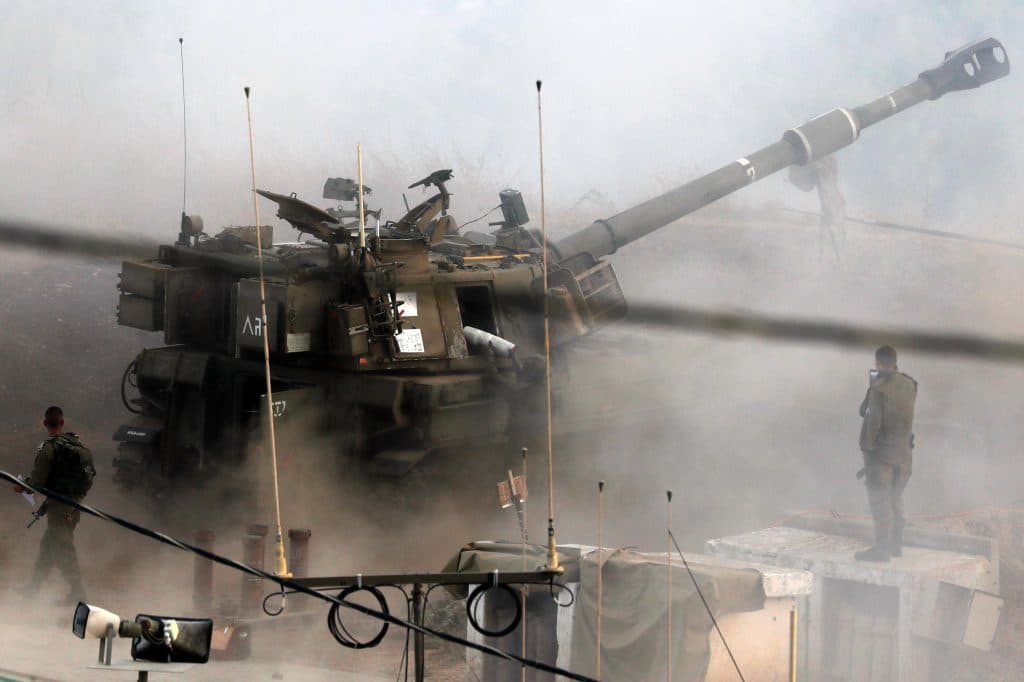
Over the past year, Israel has launched more than 600 air, drone, or artillery attacks across Syria, averaging nearly two attacks a day, according to a tally by the Armed Conflict Location and Event Data project.
Syria’s southern regions, including Quneitra, have long witnessed Israeli territorial violations, sowing fear, detaining civilians, erecting checkpoints and gates, and destroying farmland, but the pace of detention since December 2024 has no precedent in the area’s modern history.
The detentions no one is counting
Hayam al-Aryan, a schoolteacher in Ghadir al-Bustan in Quneitra, is still being treated for wounds she sustained when Israeli forces broke down her door after midnight in February, releasing an attack dog that climbed onto her bed and bit her face as she slept.
“I woke up terrified, with the dog standing over me,” she said. “It was biting my face while I was still in bed.”
The same dog also mauled her 19-year-old son, Hamza, a student at a vocational institute, as he was forced to kneel naked toward the wall. Her older son, Ali, in his final school year, was taken to another room.
“Hamza was screaming, telling them to take the dog off him,” she said. “I was screaming, too. The neighbors came out, but no one had any weapons. They [Israeli forces] took both boys and drove them away.”
Both sons were detained. Their family has had no contact with them since February.
“The state is silent,” she told Mondoweiss. “The media is silent. We are the only ones still asking where our children are.”
Detentions are extremely commonplace. On May 20, two young men from the villages of Bassala and Umm al-Luqus were detained at Israeli flying checkpoints. On the morning of May 24, university student Muhammad Tareq Mariwid was taken from Jubatha al-Khashab.
According to Ahmad al-Hassan, a local teacher, author, and researcher with a particular interest in documenting the history and heritage of the Golan region, there is no official tally of those held. No office accepts inquiries. No international body, neither the International Committee of the Red Cross, nor the Syrian Arab Red Crescent, nor the UN Disengagement Observer Force, has been allowed access.
Syria’s post-Assad government has condemned Israel’s actions in and around Quneitra on several occasions, though always through words rather than force. After an Israeli strike killed three people in the south, the country’s new leader, Ahmad al-Sharaa, said Israel had pushed into the UN buffer zone under the pretext of confronting Iranian militias, an excuse he argued no longer held once Damascus was liberated, and declared Syria ready to welcome international forces into the zone. In August 2025, the Foreign Ministry condemned a fresh incursion in the southwestern Damascus countryside near Quneitra, accusing Israel of violating the 1974 disengagement agreement to advance its “expansionist and partition plans” and calling it a grave threat to regional peace.
The ministry issued similar protests over the Beit Jinn operation, while repeatedly affirming Syria’s own commitment to the 1974 accord. Yet for residents of Quneitra’s frontline villages, who have watched Israeli forces raze homes, dig fortifications, and seal off roads since December 2024, the statements ring hollow. Many say the government’s condemnations have changed nothing on the ground, and that words from Damascus are no substitute for an end to the incursions reshaping their daily lives.
Fadel Abdul Ghani, head of the Syrian Network for Human Rights, said his organization has approached the UN High Commissioner for Human Rights and the Independent International Commission of Inquiry on Syria.
“The problem we face is that Israel does not fall within the High Commissioner’s Syria mandate as an occupying power,” he said. “In practice, the most effective channel remains coordination with the International Committee of the Red Cross, as the only body with a traditional mandate to access detainees. But access to detainees is effectively suspended because of non-response from the Israeli authorities.”
Detention is one method. Killing is another.
In April, 17-year-old Osama Ahmad, who requested anonymity for fear of retaliation, was driving along an agricultural road between Ras al-Zaarura and the village of al-Rafid, checking on his family’s livestock, when an artillery shell struck the car and burned him inside it. His father has not been able to leave the grief of his son’s death.
Bassel al-Khatib, 15, was hit by a sniper’s bullet through the windscreen of a car as he traveled with his uncle to work near al-Hamidiya. He survived, but the bullet took his sight. He has undergone a series of expensive operations to fit a glass eye, with his family selling their sawmill and moving to find work farther from the Israeli line.
These incidents have not faced any accountability, according to al-Aryan, the schoolteacher, who, along with the mothers of other detainees, protested outside the UN office in Damascus on April 19 to no avail.
An Amnesty International report issued in May described the demolition of homes in Quneitra as a grave violation of the Fourth Geneva Convention and called for an investigation of Israeli actions as war crimes – but Abdul Ghani said the report stopped short of where it needed to go.
“The report addressed the violations as standalone acts, without framing them as consequences of a prior violation, the unlawful entry into the buffer zone itself,” he said. “Proving the earlier violation reframes every subsequent act, including the demolitions, as the downstream consequence of an illegal occupation.”
A poisoned land and stolen water
Earlier this year, Israeli forces sprayed chemical agents across farmland along the border strip. Soil tests carried out by Quneitra’s agricultural directorate, headed by Muhammad Rahhal, identified the substances as toxic pesticides that have collapsed ground cover, killed pasture, and forced livestock farmers to sell off part of their herds because fodder costs have become unbearable.
“The soil analysis showed these are toxic pesticides,” Rahhal told Mondoweiss. “They eliminated ground vegetation and killed off the pasture, which forced herders to sell part of their livestock.”
Roughly 4,000 dunams (988 acres) of orchard land have been damaged, affecting 255 farmers. Olive tree leaves have dried out, threatening flowering and fruiting for the entire season. Wheat and barley stalks have yellowed in the sprayed zones. Women who depend on collecting wild greens like mallow, dandelion, and wild mint for market income have lost that crop too, as has the medicinal herb trade in wormwood, thyme, and nettle that supplies traditional pharmacies.
Muhammad Daoud, head of the beekeepers’ association in Quneitra, said the spraying has affected his sector due to the disappearance of wild plants on which bees depend.
“The loss of plant cover and the chemical residue have lowered the quantity of honey produced,” he explains. “Family incomes have dropped, prices have risen, and demand has fallen at the same time.”
Water expert Arsan Arsan fears the spraying will reach groundwater as the toxins leach through the soil.
Bassam al-Shamali, the head of the irrigation authority, has said the water remains safe, but Arsan’s concern is borne out by Lebanese laboratory and media reports finding glyphosate, a herbicide classified as probably carcinogenic by the World Health Organization, in samples from the same spraying operations that crossed the Blue Line into Lebanese territory.
“What we are seeing now is the early stage,” Arsan concluded. “The toxic compounds take time to move through the soil profile and into the aquifer. By the time the tests confirm it, the damage will already be done.”
Arsan also believes Israel is preparing to siphon Quneitra’s groundwater by drilling deeper artesian wells into the occupied Golan to supply planned new settlements, a continuation of a pattern that runs from the draining of the Hula marshes in the 1950s through the Johnson Plan and the building of the Quneitra dam.
“Their history of stealing water is long,” he adds. “Ben Gurion said in 1948 that our war with the Arabs is a war over water. The Jewish Agency’s letter to the 1919 Paris Peace Conference insisted on no concessions regarding Israel’s rights to the Golan and the Hauran Plain. This is the same logic working its way through new infrastructure.”
Israeli forces have blocked residents from approaching the al-Mantara dam, the largest in the area, and the project that was supposed to pump part of its water to the Damascus countryside has been suspended. Israeli operations have concentrated in the Yarmouk basin and the Wadi al-Ruqqad area, which has been shelled multiple times, most recently on May 23.
In Bir Ajam, southeast of Quneitra city, the spring tourist season has collapsed. Fouad Ibrahim, the head of the municipality, said the village’s reservoirs at Ruwaihina and Briqa once drew thousands of visitors for their natural beauty. Now, only the residents who farm or hold government jobs remain. The pastures have been confiscated. Hundreds of dunams of farmland are unreachable behind newly raised earthen berms.
“The earthen berm they’re still building has fixed new Israeli positions and carved off around eight kilometers of village land, to a depth of 150 to 200 meters,” Ibrahim explains. “That’s roughly four thousand dunams gone.”
A UN observation post sits on the Bir Ajam hill. Israel has erected a military position beside it with an anti-missile battery that was active during the U.S.-Israeli war on Iran, deepening local fears and emptying the village of its visitors. Even residents originally from the village who now live elsewhere have stopped coming home.
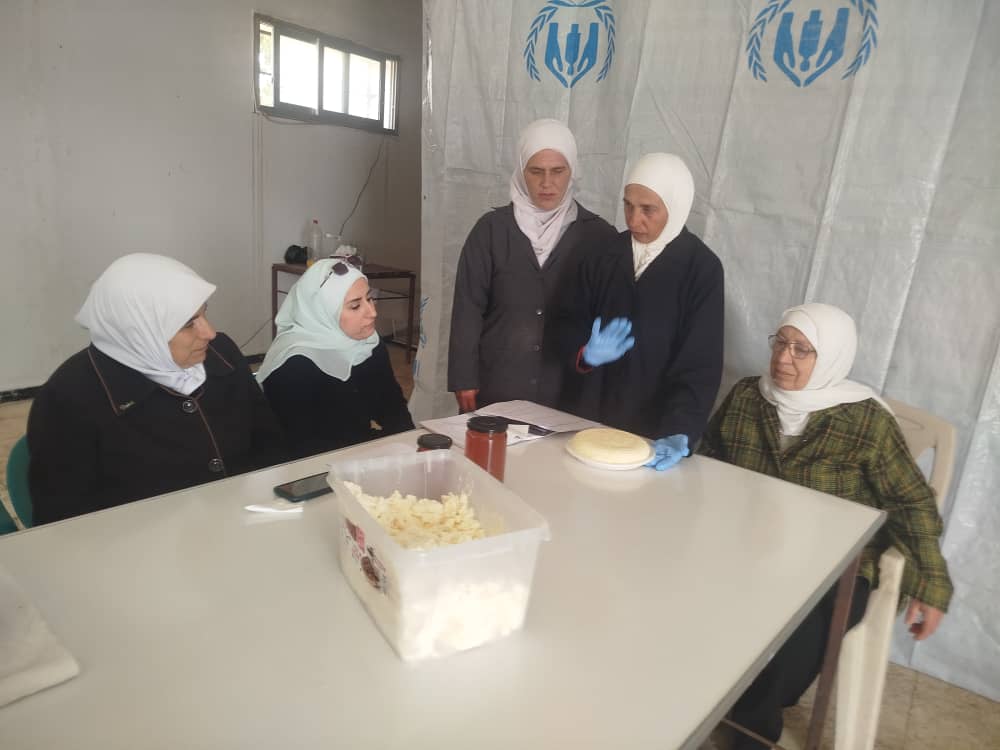
The collapse has had a cascading effect on Bir Ajam’s economy, and the traditional Circassian cheese-making workshops have lost the tourism that sustained them.
Flying Israeli checkpoints have lengthened the routes dairy producers must take. Issam Saleh, who oversees a dairy workshop, said he sees up to 100 liters of milk spoiled in a single summer day when refrigeration breaks down on the long detours.
“This is the situation across most of Quneitra,” he told Mondoweiss. “We are losing the product before it ever reaches the market.”
The settlers behind the bulldozers
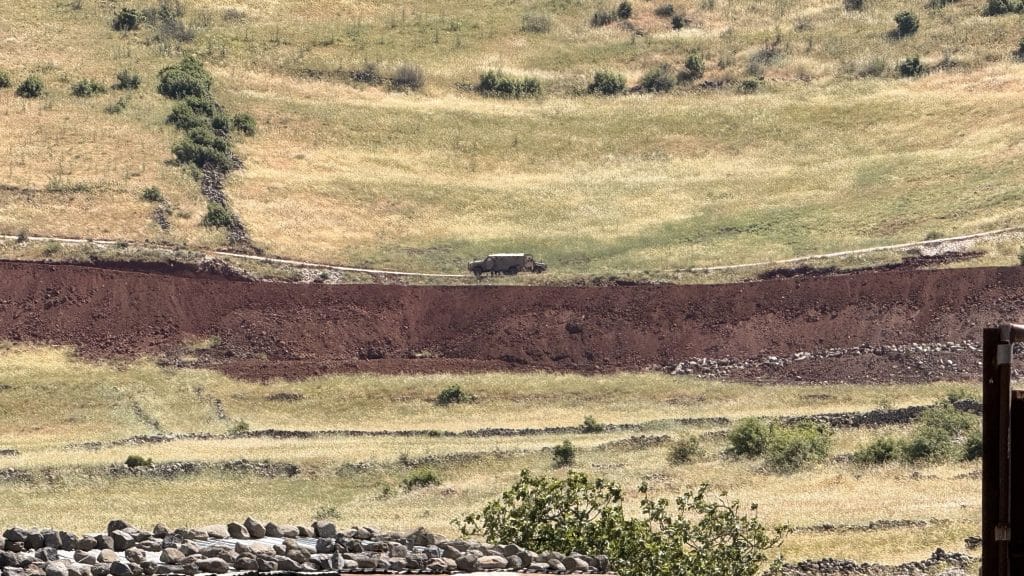
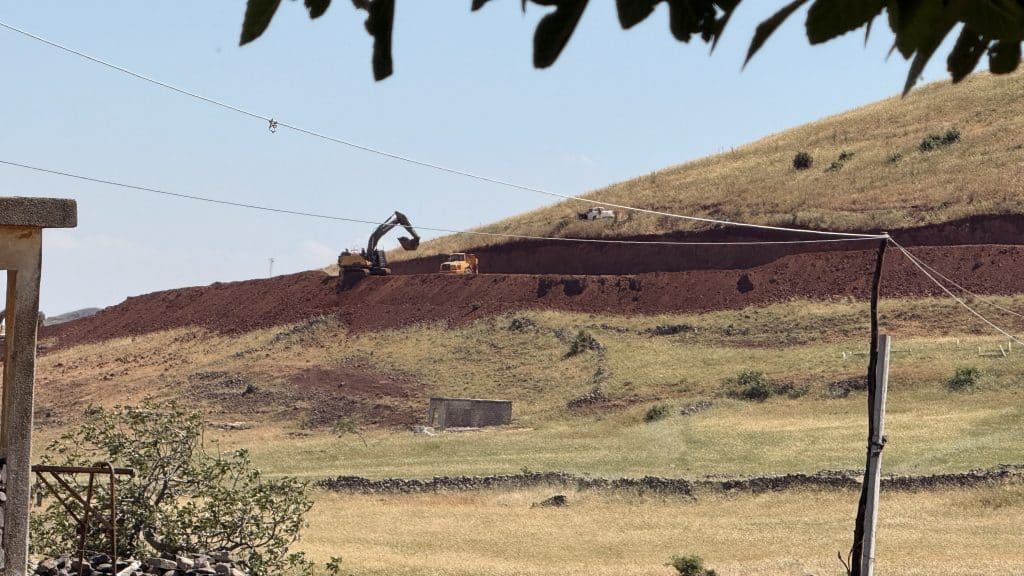
Israeli efforts to rewrite the geography of Quneitra to serve its own purposes go further. Project Sofa 53, also called the Great Storm, is a network of wide military roads, earthen berms, trenches, observation posts, and forward outposts that Israel began in 2022 and accelerated after December 2024. Israel describes it as its first line of defense and attack.
According to Bir Ajam’s municipality, one kilometer of construction remains before the project is complete within Quneitra.
Bulldozer excavations have run from Hadar village in the north to Saida in the south, converging through Ruwaihina, Qahtaniya, Bir Ajam, Koudana, and al-Hamidiya. Israeli forces have established mobile checkpoints between the village of Jabah and the town of Khan Arnabah, searched passersby, and crossed tanks into al-Hamidiya in central Quneitra as the network expands. Work continues in Daraa.
Arsan denounced Sofa 53 as a violation of international law and the opening phase of an implementation of what Israeli strategists call the “David Corridor.”
“This is the architecture of a new territorial reality,” he said.
Abdul Ghani framed it as the gradual annexation of Syrian land before any formal declaration, the same pattern that Israel has carried out in the occupied West Bank.
“They are creating a unilateral buffer zone that reaches between 500 meters and one kilometer into Syrian territory,” he added. “They are demolishing homes without military necessity. These are the markers of permanent presence, not circumstantial intervention.”
The one-sided demining operations Israel has carried out across the strip of land in Quneitra lack any international legal basis. The 1997 Ottawa Convention obliges states to clear their own territory of mines, but does not authorize a second party to conduct clearance operations within another state’s sovereign territory without that state’s consent. Israel is, conveniently, not a party to the convention.
Israeli settlers have already arrived. Five attempted settler incursions into Quneitra have taken place under the watch of both the Israeli army and Syrian General Security forces. The settlers belong to the Bashan Pioneers, an extremist movement founded in 2025 for the express purpose of settling Syrian land. The most recent attempt on May 17 involved settlers tying themselves to the wall demarcating the buffer zone. The largest, in late April, brought 40 settlers to the region.
The settler group posted a photo on X showing members standing on a rooftop and said they intended to remain there until Israeli authorities allowed their families to move in and establish a civilian presence — a move that, like in the West Bank, is illegal under international law.
The caption read: “Without civilian settlement, even the military hold won’t last long term. We’re here until they approve our families to enter and live here.”
Al-Hassan argues that the movement enjoys security cover from the Israeli army and shares an interest in altering the geography and demographic composition of the region by creating conditions to displace the local population, a reminder of what happened in Palestine in 1948.
“The repeated incursion into Syrian territory is not random,” he said. “It is bait. It is meant to draw out Israeli expansion in the region and to pressure the Syrian state in any future security agreement.”
This story was produced in collaboration with Egab.
Hudda Mattar
Hudda Mattar is a Syrian journalist, children’s program producer, and documentary filmmaker, with a focus on cultural and political affairs.