

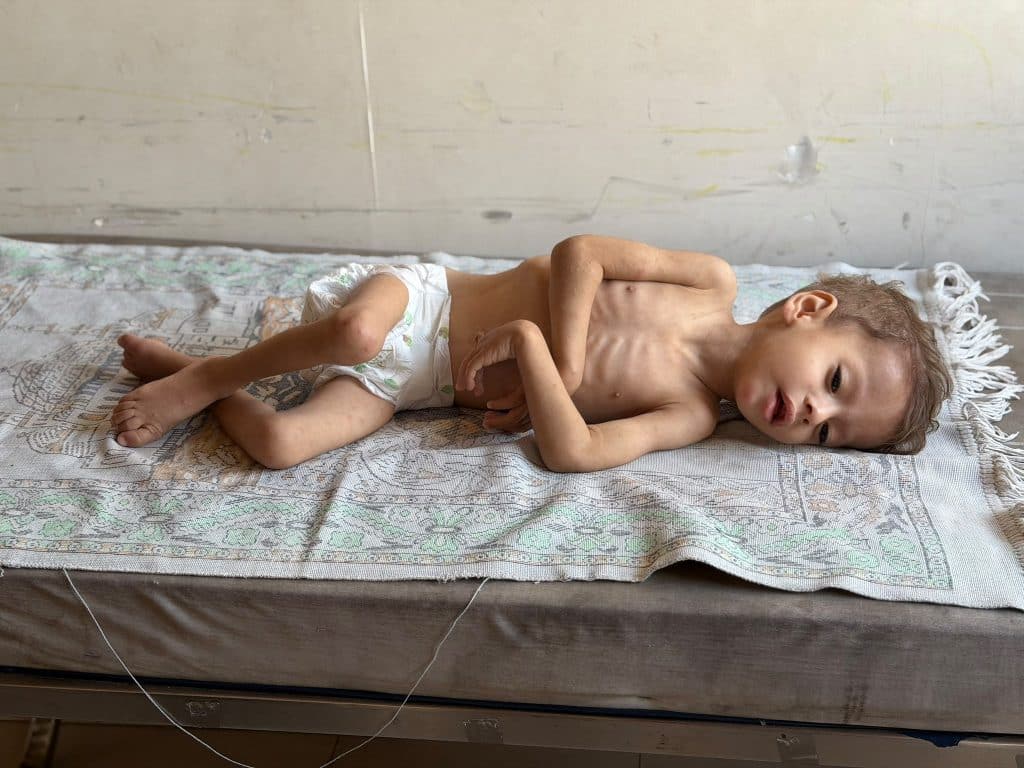
On August 23, two-and-a-half-year-old Hashem Abu Mustafa was discharged from Nasser Medical Complex in Khan Younis after being diagnosed with severe acute malnutrition. But his discharge was not a recovery. The underlying causes of his condition remain unclear, as he needs several tests, including an MRI and a blood culture, for which the necessary equipment and resources are not available in the Gaza Strip.
Hashem’s mother, Suha Abu Mustafa, 34, says that he is now suffering from quadriparesis as a complication of malnutrition, leaving him unable to move any of his limbs. He also has severe difficulty swallowing. Although he needs specially prepared, mashed food, a single meal can take between two and three hours because of his difficulty swallowing, compounded by the accumulation of health problems. It’s a delay his frail body can barely sustain.
Delivered 11 months into a US-brokered ceasefire in which Israel vowed to ease access to food and humanitarian essentials to the people of Gaza, Hashem was born in a tent in Rafah while his mother was herself dealing with hunger.
“Even my pregnancy was very hard on me,” Abu Mustafa said. “I rarely ate protein or a healthy meal. We exclusively depended on canned food. When Hashem was delivered, from the first moment, I realized that my hunger was reflected in him. He came so weak and skinny, weighing less than two kilograms.”
Acute food insecurity remains widespread across the Gaza Strip despite recent improvements brought about by the October 2025 ceasefire, according to a report published on August 13 by the Integrated Food Security Phase Classification (IPC), the world’s highest famine-monitoring body.
Between April 16 and June 30, 2026, more than 1.2 million people — 59% of Gaza’s population — faced Crisis or worse conditions (IPC Phase 3 or above), including 212,000 in Emergency (IPC Phase 4).
According to the organization, conditions are projected to deteriorate between July and December 2026, with more than 1.4 million people, or 67 percent of the population, expected to face Crisis or worse conditions. “In the absence of humanitarian food-security assistance, 1.9 million people, 90 percent of Gaza’s population, would face high levels of acute food insecurity through December 2026,” the report said.
The IPC uses five phases to measure the severity of acute food insecurity, from Phase 1, when households face no or minimal acute food insecurity, to Phase 5, which denotes catastrophe at the household level and famine at the population level.
In 2024, all of Gaza had been classified under Phase 4, but 133,000 people in the Strip had reached the Phase 5 famine classification. Then, by May 2025, more than half a million people were in Phase 5, which the IPC confirmed in a landmark August 2025 announcement officially declaring famine in the Gaza Governorate.
The latest IPC analysis indicates a relative improvement following the ceasefire and increased humanitarian assistance — no governorate in the Gaza Strip is currently classified as being in famine, although more than 1.2 million people remain in Phase 3 or worse, with that number projected to rise to more than 1.4 million during the second half of 2026.
The IPC report projected that approximately 74,200 children between the ages of six and 59 months would require treatment for acute malnutrition through April 2027, including more than 11,400 expected to suffer from severe acute malnutrition.
An estimated 24,600 pregnant and breastfeeding women were also expected to suffer from acute malnutrition during the same period.
The view from Gaza’s hospitals
In Gaza’s hospitals, cases of malnutrition have continued to arrive without interruption. On July 11, 90 cases of malnutrition arrived at hospitals across the Strip. Of those, 15 were classified as having severe acute malnutrition, 22 as moderate, and five involving children with stunted growth.
“Malnutrition remains a major concern for Gaza’s health sector,” Dr. Ahmad al-Farra, head of the pediatric department at Nasser Medical Complex in Khan Younis, told Mondoweiss. “Malnutrition in the Gaza Strip has reached dangerous levels — what we can describe as alarming figures, according to the United Nations classification.”
Deaths from malnutrition have reached nearly 500 cases, including approximately 160 children, al-Farra said. In 2023, the death toll was 4,000, dropping to 49 in 2024, then 408 deaths in 2025. In 2026, the number of deaths so far is approximately seven, a figure that reflects not recovery, but the relative improvement in aid flows since the ceasefire.
Al-Farra says the numbers he sees reflect a population-wide breakdown. “If we look at the current situation in the Gaza Strip, we are talking about approximately 198,000 people who have reached Phase 3 of malnutrition, 1.14 million people who have reached Phase 4, and 640,000 people who have reached Phase 5, which is the most dangerous stage of malnutrition,” al-Farra said.
Gaza’s worsening water crisis is compounding the problem. The amount of water available for a person is barely three liters a day, al-Farra says, including water for personal hygiene, drinking, and food preparation. The global standard is 100 liters per person per day, while the World Health Organization’s minimum threshold is 15. Water shortages and contamination, along with sewage mixing with drinking water sources, have contributed to increased malnutrition cases by raising the incidence of diarrhea and vomiting.
Shortages in baby formula, which al-Farra says have been deliberately restricted by Israel since the beginning of the war, have led to serious complications among infants. With formula unavailable, some families turned to cow’s milk as an alternative, leading to diarrhea, abdominal bloating, and severe sensitivity reactions.
Al-Farra also points to the deterioration in the quality of protein-rich foods entering Gaza. Many of these products have lost their nutritional value because they were frozen, thawed, and then frozen multiple times. “This has become a major concern for residents because of the risk of food poisoning,” al-Farra added.
Al-Farra also points to a noticeable increase in premature births and babies born underweight. These children, he says, are particularly vulnerable to malnutrition from the very start of their lives.
The consequences can become particularly severe when malnutrition persists beyond four weeks. Side effects include growth arrest as a result of hormonal disruption, deficiencies in sex hormones and delayed puberty, weakened thyroid hormone function, and short stature. Cases of short stature are expected to mount in Gaza.
“More dangerous is neural developmental injury,” al-Farra said. “These children will face extreme difficulty interacting with their surroundings, solving mathematical problems, remembering things, doing their schoolwork, and memorizing lessons.”
Globally, in most cases of malnutrition lasting more than four weeks, MRI scans show “changes in the children’s brains, affecting the cerebral cortex and the white matter.”
Abu Mustafa, Hashem’s mother, had spent months trying to secure proper food for both herself and her son. All the attempts, she says, were futile.
For Hashem, the window has already closed on much of what he should have had.
“Hashem is my first child, and since he was born, he has suffered hunger,” Abu Mustafa said. ”Now I’m watching him die and can’t do anything to help him. Sometimes I think a lot when the idea of a second child crosses my mind, and I ask myself: do I want to bring another child to suffer and die?”


“Gaza’s worsening water crisis is compounding the problem. The amount of water available for a person is barely three liters a day…”
Israeli airstrike destroys water desalination plant in northern Gaza
Israeli airstrike destroys water desalination plant in northern Gaza – Middle East Monitor
All of this is supposedly flows from the idea that Hamas has to be destroyed. But last August…
A group of some 600 retired Israeli security officials, including former heads of intelligence agencies, have written to US President Donald Trump to pressure Israel to immediately end the war in Gaza.
“It is our professional judgement that Hamas no longer poses a strategic threat to Israel,” the officials said.
Hundreds of Israeli ex-officials appeal to Trump to help end Gaza war