

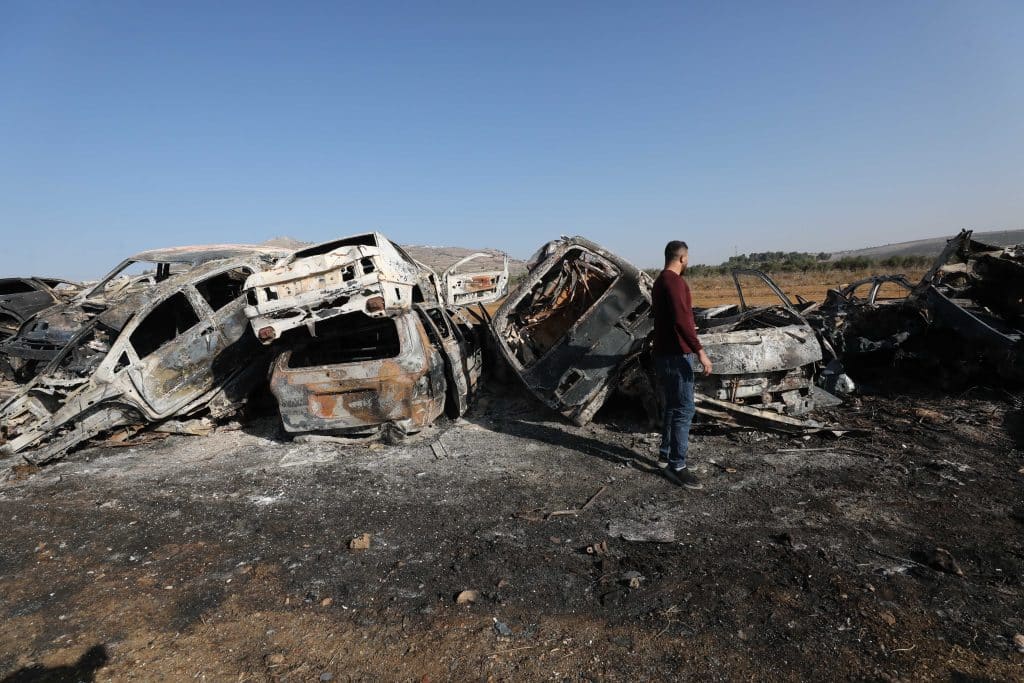
On August 9, dozens of Israeli settlers surrounded three Palestinian homes in Qusra, south of Nablus. They blocked residents from leaving safely, cut water and electricity, damaged water pipes, and prevented food and other essential supplies from reaching the families inside. Days later, U.S. Ambassador to Israel Mike Huckabee — a longstanding supporter of the Israeli colonial enterprise — called those responsible “Israeli terrorists,” echoing the growing use of the term in the mainstream media and by human rights groups, the UN, and diplomatic circles.
For Palestinians who have endured over a century of systemic settler colonial violence, this rhetorical shift may be tempting to welcome as a step toward accountability. But embracing the “terrorism” framework would ultimately harm our cause and our people.
Settler colonial violence is, of course, real and terrifying, but “terrorism” is the wrong framework for understanding and confronting it, because it was designed to serve imperial designs and make settler violence look like an aberration. In this way, the label of “Israeli terrorism” often misleadingly characterizes settler violence as confined to the Israeli far right, even though it’s the product of a broad Israeli consensus and a systemic feature of Israel’s colonial regime.
The origins of the ‘terrorism’ label
The terrorism framework did not emerge from positive or emancipatory values, but has been exclusively weaponized against oppressed and marginalized peoples in the service of imperial agendas. While in the 1960s, the terrorism framing was used by western imperial interests against anti-colonial struggles (Algeria, South Africa, Vietnam, to name a few), the post 9/11 global “terrorism” narrative shifted to focus on a new “global enemy” — Islamic fundamentalism — and used to justify military occupations and atrocities across the world under the banner of the “War on Terror.” More dangerously, it was used to build a legal arsenal encroaching on people’s rights and freedoms, undermining the rule of law and peoples’ sovereignty under the cover of legality.
Palestinians know intimately what this framework enables. For decades, the “terrorism” label has been used to criminalize the Palestinian liberation movement, from designating much of the Palestinian political spectrum as “terrorist,” to carrying out colonial violence under the guise of “counterterrorism” — assassinating, imprisoning, and torturing Palestinians in Jenin, Tulkarem and across Palestine. The same framework has been used to stifle Palestinian civil society, including through Israel’s designation of six leading Palestinian organizations as “terrorist” organizations. And today, the language of counterterrorism has been used to justify the genocide in Gaza against 2.2 million Palestinians.
The Zionist regime even uses the counterterrorism framework to punish Palestinians victims of the settlers’ violence. Case in point, the day after a group of armed settlers attacked Palestinian residents of the village of Til (framed as “confrontation” by the mainstream media), the Israeli army announced a “counterterror” operation in the entire Northern West Bank.
There is a reason why terrorism has no agreed-upon definition under international law. It is a political tool whose meaning has been shaped by those with the power to wield it. A framework built and weaponized by imperial powers against colonized peoples cannot become the tool through which we dismantle colonial violence.
Another danger of embracing the “terrorism” label for settlers is that it exceptionalizes their violence, turning masked settlers who kill Palestinians, burn their homes, and attack their villages into a violent fringe — “bad apples” supposedly detached from an otherwise legitimate Israeli state and Zionist establishment.
But this violence is neither marginal nor new. Armed Zionist militias carried out expulsions, massacres, and attacks on Palestinian communities long before the establishment of Israel, culminating in the Nakba of 1947–48 and continuing through the occupation that followed the June 1967 War. Today’s settler violence belongs to this same continuum of dispossession.
Nor do settlers act outside the state. Their violence operates alongside — and is enabled and protected by — the military, police, courts, and other state institutions that dispossess Palestinians. They facilitate the demolition of homes, the seizure of land, restrictions on water access and freedom of movement, the imprisonment of Palestinians, and the forcible displacement of communities. Settlers are not an aberration from this system, but are among its agents.
The 1994 Ibrahimi Mosque massacre illustrates this clearly. American colonial settler Baruch Goldstein murdered 29 Palestinian worshippers and was condemned by the Israeli government at the time as an extremist. Yet in the massacre’s aftermath, it was Palestinians in Hebron who were subjected to collective punishment for a massacre they did not commit. The “extremist” could be disavowed while the colonial system around him was strengthened.
Today, calling violent settlers “Israeli terrorists,” or insisting that figures like Israeli National Security Minister Itamar Ben-Gvir “do not represent us” performs a similar function. While such rhetorical evolution is celebrated in Western establishment circles as a welcome widening of the Overton window, it does not arise from “miraculous epiphanies” driven by “moral urgency,” to paraphrase Mohammed El Kurd’s Perfect Victims.
On the contrary, it allows Western governments and Israel’s supporters to distance themselves from the most visible brutality without confronting the system they continue to support. The selective sanctioning of a handful of “extremist settlers” — sanctions that can be imposed and removed according to political convenience — follows the same logic, offering the appearance of accountability while leaving support for the broader system intact. The “terrorist” label becomes a convenient smokescreen: remove the bad apples, and the system itself can remain unquestioned.
Not a right-wing issue
Framing settlers as “terrorists” reinforces another convenient fiction: that the violence of occupation belongs to Israel’s extremist far right, rather than reflecting a much broader political consensus.
While there are differences in rhetoric, pace, and strategic vision within Israeli politics — the so-called “left” favoring a more gradual and internationally palatable approach, while the far right openly advocates accelerated annexation and erasure — these differences obscure a large consensus within Israeli Jewish society calling for Palestinian dispossession and continued Israeli control. The divide is often less over the underlying project than over how aggressively and how visibly to pursue it.
This illusion is particularly visible during the current Israeli election campaign, as Western governments once again cling to the hope that ousting Netanyahu could restore Israeli institutions and reopen the path to “dialogue.” Yet Israeli politicians themselves repeatedly expose the limits of this distinction. When the UK condemned the E1 settlement plan, Foreign Minister Gideon Sa’ar defended the Jewish people’s right to live throughout the “Land of Israel,” invoking the Balfour Declaration as having recognized that right. In June, Netanyahu again rejected Palestinian statehood between the Jordan River and the sea, while Smotrich openly advances annexation in support of the Greater Israel vision. Even within the supposedly centrist opposition, positions on Palestinian land and settler violence reveal far more continuity than the language of “extremists” suggests.
Calling the most visible settlers and far-right politicians “terrorists” helps preserve this illusion. It allows Western governments to imagine that the problem lies with Netanyahu, Ben-Gvir, or a radical settler fringe — and that removing them could restore a more acceptable Israel — rather than confronting the structures that have sustained Palestinian dispossession for decades.
Erasing the Palestinian right to resist
Finally, the terrorism framework reinforces the fiction of “two sides.” Once a few government figures and settlers are framed as “terrorists,” their violence can easily be mirrored against Palestinian armed resistance: Israeli terrorists on one side, Palestinian terrorists on the other. Colonization is thus recast as a tit-for-tat conflict between two equivalent violent actors, erasing the profound imbalance of power between colonizer and colonized and denying Palestinians’ right to resist.
This false symmetry has concrete political consequences. When the EU sanctioned violent West Bank settlers, it simultaneously added Hamas figures to the same sanctions framework, as though condemning settler violence required an equivalent Palestinian target. The result is precisely the “both sides” logic the terrorism framework reproduces: an equivalence between the violence of an occupying power and the resistance of an occupied people.
The inconvenient reality is that decades of international impunity are the central reason why the colonial settlers’ movement has reached such levels of unleashed violence today. Calling settlers “terrorists” offers another escape from that accountability: it isolates individual perpetrators while leaving intact the system that arms, protects, and enables them.
I believe the “terrorism” label should not be used for any group, globally. West Bank settler violence is state-backed settler colonial violence. It is part and parcel of a century-long Zionist settler colonial project. Confronting this violence means confronting the institutions, policies, and structures that produce it — not simply the individuals who carry it out. Call it what it is.
In other words, language matters.
Is Israel a state the majority of whose citizens are Jewish, or is Israel a ‘Jewish state’? They are not the same thing, and using one or the other of those formulations leads to entirely different types of thinking. I suggest that every time the phrase ‘Jewish state’ is used it might be appropriate to interject: you mean the state whose citizens are 75% Jewish?
Another article here that gives a lot of food for thought.
I think that labelling settler violence as “terrorism” is useful: it fits the regular definition of terrorism as violence for political ends. Generally, terrorism involves non-state actors and there lies the problem that Inès Abdel Razek has highlighted: the settlers are acting on behalf of their state, covering for the politicians who urge them on with a nod and a wink and giving those pols “plausible deniability”. The nearest equivalent I can think of is the Loyalist terrorists in Northern Ireland during the “Troubles”.
I refer to colonial Israeli settlers as psychopaths and criminals.
The whole piece is an interesting take/opinion/argument, however, as an outside person who has been involved for decades looking in. The term “illegal Israeli settler” sounds so folksy. So innocent somehow.
Ines Razek : “I believe the “terrorism” label should not be used for any group, globally. West Bank settler violence is state-backed settler colonial violence. It is part and parcel of a century-long Zionist settler colonial project.”
Even “state-backed settler colonial violence” and “century-long Zionist settler colonial project ” sounds so ineffective. Softball instead of verbal hardball which is all Bibi, Smotrich, Israel Katz, Ben Gvir use when it comes to Palestinians etc. They so often make such violent, inaccurate claims about Palestinian resistance.
I want to hear their “terrorism” called out. Almost everything they say about Palestinians or anyone who stands up against their nation/state sanctioned terrorism are lies. Often seems like some Freudian transference of their own violent behavior on to others that they call “less than human” etc etc
How about “century long Zionist colonial terrorism project?”
Latest from Francesca Albanese
https://www.youtube.com/watch?v=_t2Mqz4J_2I
Toledo Ohio, Palestinian American Loui Ridi really likes that Israel firster Mike Huckabee finally called the illegal Israeli home and land thieves “terrorist.” Ridi himself called one of the Hilltop violent maniacs a “terrorist.”
https://www.youtube.com/watch?v=zSzZp66r-hg