

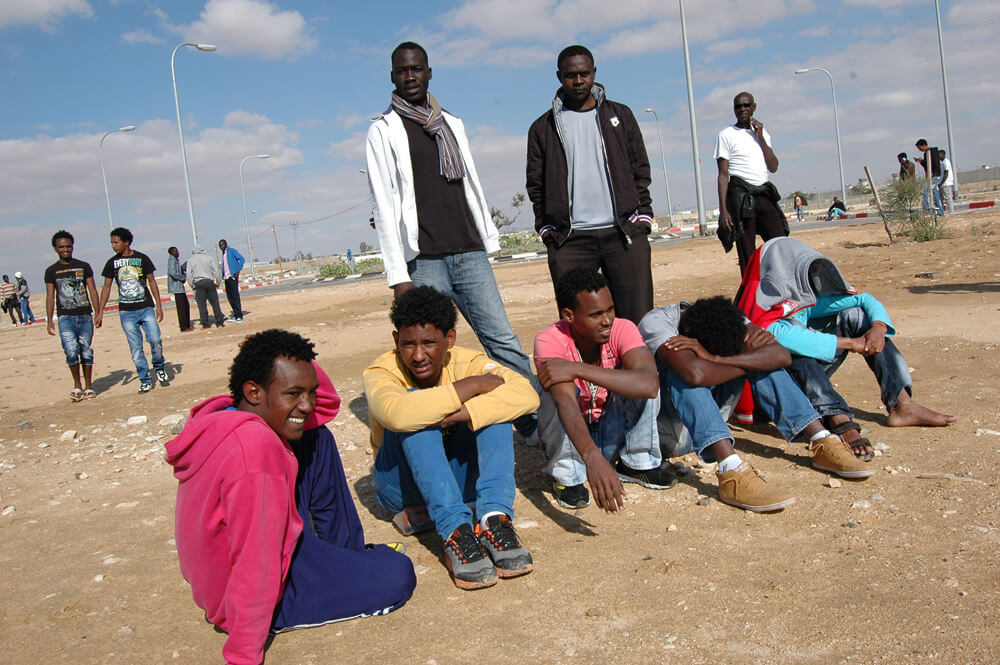
Mutasim Ali has 30 days to clear out his office as executive director of a Tel Aviv-based refugee rights group and pack a small bag of his most prized and pertinent belongings. On Tuesday the African asylum-seeker/protest leader lost a petition appealing his imminent detention in a desert facility built to “concentrate” refugees claiming status in Israel. He must report to Holot, located south of the Gaza Strip and ten minutes from the Egyptian border, by April 25th 2014.
Ali is one of 55,000 who braved the brutal trek across the Sinai in hopes of protective status in Israel to receive a summons to appear at Holot, despite not having committed any crime. He arrived in Israel in 2009 after obtaining a Bachelor’s degree in geology in his native Sudan. Since last December Israel has ordered over 3,000 asylum-seekers, all who have resided in the country for more than four years, to report to Holot.
After losing his case in a Tel Aviv court on Wednesday Ali then petitioned Israel’s high court to overturn his “invitation to attend the residence facility” (as it’s described on the government directed he was handed by the Ministry of Immigration). He hopes his case will garner a precedent to keep him and other Africans out of prison.
“When we filed the petition, we submitted my case as an example,” said Ali who is making the claim that because Israel never reviewed his application for United Nations sanctioned refugee status, the state must rule on his pending asylum first, before sending him off to prison. “No one called me for a hearing, no one called me to review my application.”
Ali’s lawyer Asaf Weitzen argued that because the thousands of asylum seekers who were ordered to Holot never saw a judge or had a trial, the state must overturn all of their detention summons. The petition stated (via Haaretz):
“The detention orders, from first to last, were issued without hearings, without clear and transparent criteria and without giving any justification, turning the authority of agency officials into a double-edged sword that cuts down the world of everyone against whom ‘detention orders’ were issued, together with the foundations of our judicial system.”
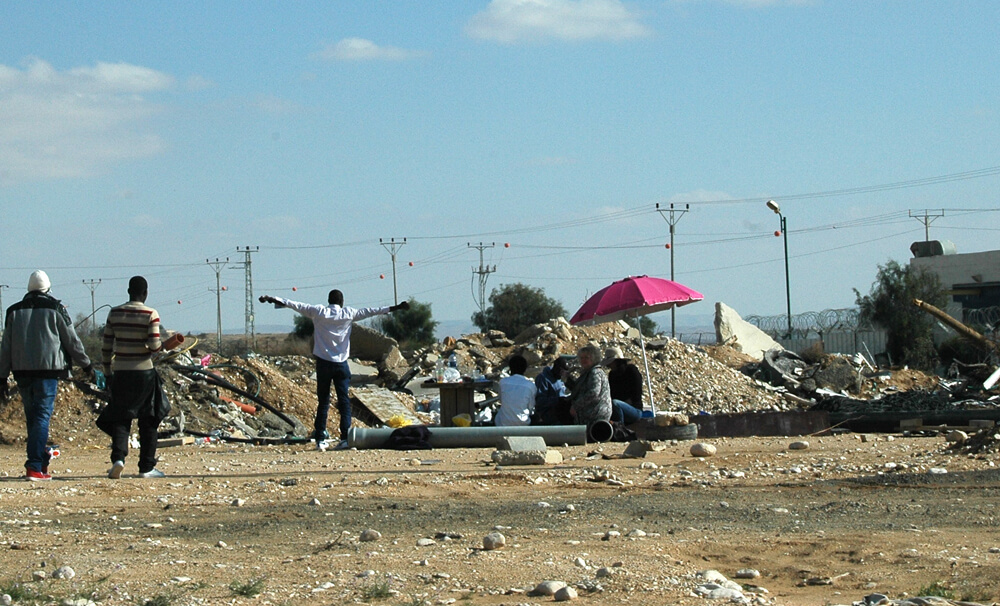
For the state of Israel, Holot is not classified as a prison or jail, so regular rules involving trials, judges and juries do not apply. The facility is a wasteland encircled in a trench of sun-dried sewage, off a dirt road where the only nearby structures are another prison, an army base and a crumbling abandoned gas station. Although it is staffed by the Israeli Prison Service, Holot is qualified uniquely as an “open facility,” with its own procedures and policies. Africans are allowed to leave the jail– comprised of small temporary structures made from shipping containers, resembling trailer-offices on construction sites– for a few hours. Still the inmates must check in with guards three times a day and are locked in at night.
Because prisoners are able to exit the front gates, unlike other detention facilities in Israel, journalists are not allowed to schedule a walk-through. So lawyers and aid groups must meet at squalid picnic tables off of the prison driveway. During my last visit to Holot, a baleful guard locked an African prisoner outside in the searing sun as a punitive measure for “speaking to a journalist.”
“We don’t know when the response [from the judge] will be or the hearing,” said Ali. But with his summons enforced next month, Ali noted, “I may be in Holot when the hearing comes.” In the meantime he is forced to resign his post with the African Refugee Development Center (ARDC) because the only employment Holot allows is working as the facility’s janitors for $5.70 per day.
“I will have to step down as according to the law I am not allowed to work while I am in Holot . However the board wants me to keep up directing the ARDC,” Ali said.
“I don’t want to be free when other people are behind bars when we have the same situation,” said the Darfurian activist and NGO professional of plans to continue organizing from within Holot. In the past he was incarcerated in Sudan for political activity and in Israel for five months at the notorious Saharonim prison, which is adjacent to Holot. There Ali was called “the leader” by his Israeli guards for instigating hunger strikes.
“We can do activism inside. All together, 2,000 people together inside in one place, that’s a lot of strength,” said Ali, continuing that he and other protest leaders are “working with volunteers to open an education center outside of Holot,” for professional training.
We are Jews. We were chosen by God. He made us suffer because he loves us so much. Now it’s time for dessert. We have a special prayer hotline. We are superior to other humans because we care and are so decent. And because we suffered. Our people were confined in camps in the desert by Pharoah and we have a holiday to remember the cruelty.
We are so decent. Except with goys. They can F*** off. They interfere with our prayers. We’ll torture anyone who gets in the way of our prayers. We can’t get close to god if we can’t pray.
We lay mines too. We also carpet bomb if necessary.
We sometimes pray for a sense of irony.
Yep. 3M Syrian refugees and zero in adjacent Israel.
Some Africans get to Israel and they must be rounded up and concentrated.
Israel must remain pure.
And is it just me or does the Israeli legal system seem to be completely subservient to how things are arbitrarily “classified” by someone, somewhere?
It’s like the only rule is that there are no rules. Or maybe even better, Israel’s legal system is based on strict legal construction (i.e. if a/any/all terms aren’t specifically written into a law, the law can be worked around by simply using another term). I’d hate to do business there. Talk about an extreme local court advantage in disputes. I can’t imagine what Mr. Ali must be going through.
Why is it that all those dozens of other African-ruled states, aren’t helping these so-called “refugees?” Could it be that Africans simply don’t care about other Africans?
It’s too bad these people don’t pose an even greater threat to Israel’s sustainability… then they would really have Allison’s support.
I used to comment at a site over-run by Zionist hasbara, (guess I’m a sucker for punishment!) and I would rail against Israel for using the Palestinians of Gaza for target practice, for keeping them surrounded in an open-air prison and imposing a blockade on people already struggling to survive. And I remember how these hasbarists would attack me from all sides for focusing on Israel and its oppression of Palestinians when people were being oppressed and killed in Darfur.
Well lookie here, now we have Israelis oppressing refugees from Darfur and Sudan! And then Israelis b*tch about their neighbors, but they’ve taken in hundreds of thousands of Palestinian and now Syrian refugees, while Israelis are blocking their entry, imprisoning their own refugees, denying them justice and inflicting racism on them. And let’s not forget the millions of refugees that Israel has created with bombing campaigns on Palestinian villages, ethnic cleansing and a racist one-sided Right of return.