There is ample evidence that Louis Brandeis converted to Zionism at 56, after a life removed from Jewish concerns, so as to get on to the Supreme Court, which President Wilson had made clear was impossible unless he was a “representative Jew.” Brandeis’s hagiographers, including Jeffrey Rosen, CEO of the Constitution Center, in his new biography from Yale Books, erase this history lest it would throw a shadow on a Zionist hero.
In light of the revelations made by the Al Jazeera investigative documentary The Lobby, Palestinian students in the UK have published a letter calling for an apology and the resignation of the National Union of Students VP Richard Brooks. In the footage Brooks implicates himself in helping to organise a group that is trying to oust National Union of Students President Malia Bouattia for her strong stance on Palestine.
“We will soon be the majority!” says a huge billboard in the heart of Tel-Aviv. Written in Arabic and showing Palestinians with Palestinian flags it is meant to frighten Jewish Israelis into supporting a two-state solution. The Israeli press is reporting that many Israelis “erroneously thought this to be a hostile takeover of the media by Palestinian terror organizations,” but the campaign is actually the work of a ‘liberal’ organization from the center of Israeli politics.
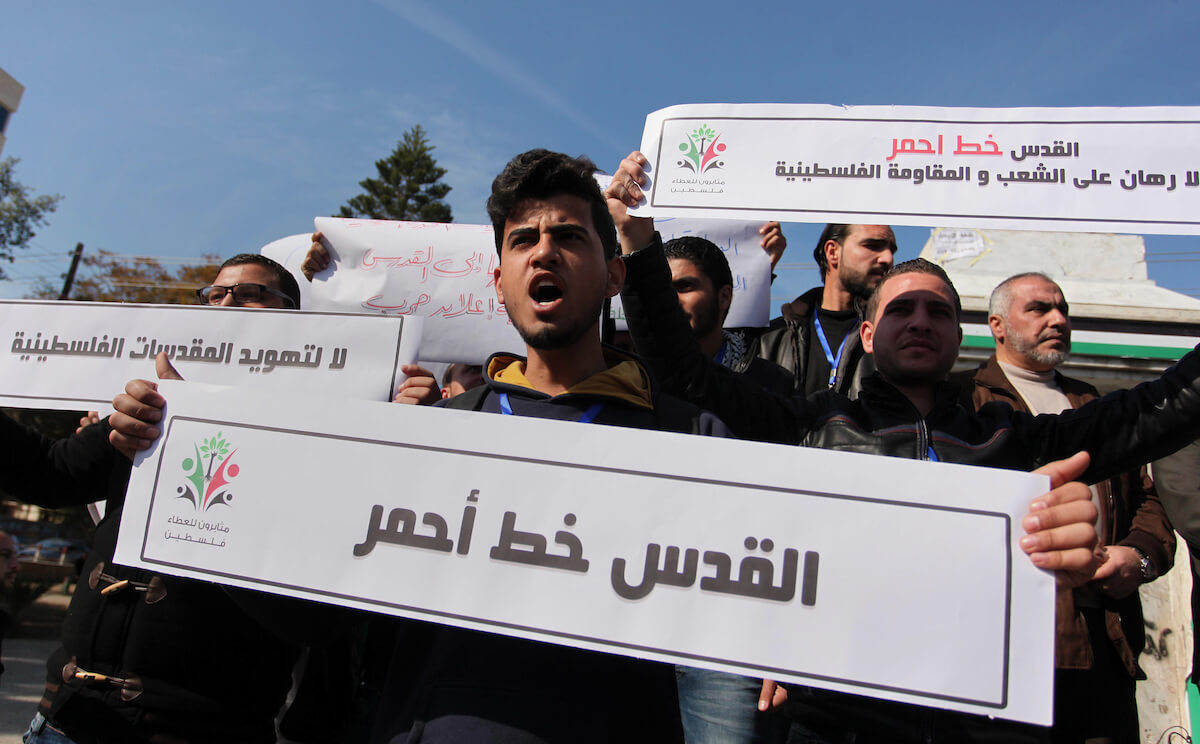
Is a two-state “solution” still possible? Or is it time to push for one state with equal rights for all? Palestinian youths in Gaza respond to the Paris Peace Conference.
Shafiqa Juma’a, 80, sleeps with her grand-daughters in house in occupied Kafr Qaddum, Palestine. When masked Israeli soldiers raid in the middle of the night to prevent demonstrations by the village, Juma’a must wake her grandchildren, so that the guns don’t. A staggering report by Amira Hass.
At the 92d Street Y, David Makovsky says SJP has its roots in Hamas and JVP doesn’t work with SJP, and other falsehoods about the Palestinian solidarity movement; and the pity is that his opponents are never invited to rebut him. The Jewish community used to be smart. Now Zionism dumbs down everything it touches.
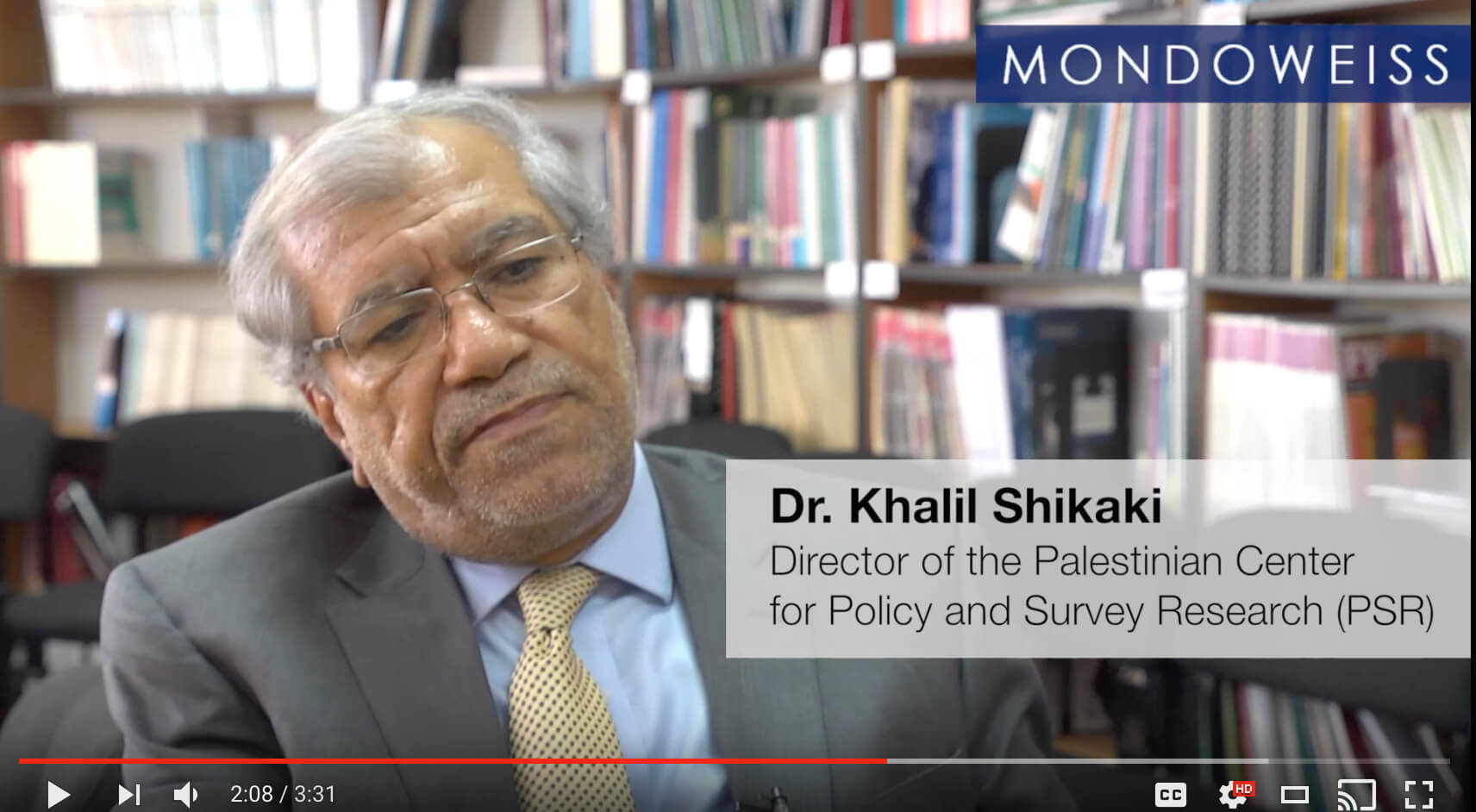
A central question of the Middle East Peace Process remains: can the two-state solution be saved? On Sunday, a conference in Paris will try to relaunch the moribund peace process and the French Initiative has been warmly received by the Palestinian leadership as a final chance to save the two-state-solution: “Two states today is possible. Tomorrow, it might be too late” warned Muhammad Shtayyeh, Fatah Central Committee Member, who nevertheless remains optimistic. “The reality on the ground, the demography on the ground, the geography on the ground, shows that a two-state solution is still possible today”. However, Palestinian public opinion no longer reflects this official position. A recent poll shows that 65% of Palestinians no longer believe the two-state solution is viable due to ongoing settlement expansion. “The more people think the two-state solution is no longer viable, the more likely they it is that they will shift and support a one-state solution” explains Dr. Khalil Shikaki, Director of the Palestinian Center for Policy and Survey Research.
At least 72 countries are set to meet on Sunday in Paris for the most recent effort in reaching a two-state solution in Palestine and Israel, neither of which are expected to be represented at the meeting. On Thursday, Israeli Prime Minister Benjamin Netanyahu openly criticized the conference, while Palestinian Prime Minister Rami Hamdallah reiterated his support for negotiations of a two-state solution saying he believed “only a negotiated two-state-solution will lead to an end of occupation and an agreement on all final status issues.” But Hamdallah’s sentiment does not seem to be echoed on the Palestinian street, where confidence in the two-state solution has taken a drastic hit.
Actor Kal Penn stunned Fox viewers and supporters of human rights by giving his $25,000 winnings on MasterChef Celebrity Showdown to Palestinian refugees through the UN Relief and Works Agency.
In Lebanon, one of the countries that has been most burdened by the Syrian refugee crisis, public schools are strained to the limits. Schooldays operate on a two-shift schedule—the first half of the day is for Lebanese children (and some Syrians if space permits), and the second half is for Syrian children. Still, half of all Syrian refugee children in Lebanon don’t go to school at all.