

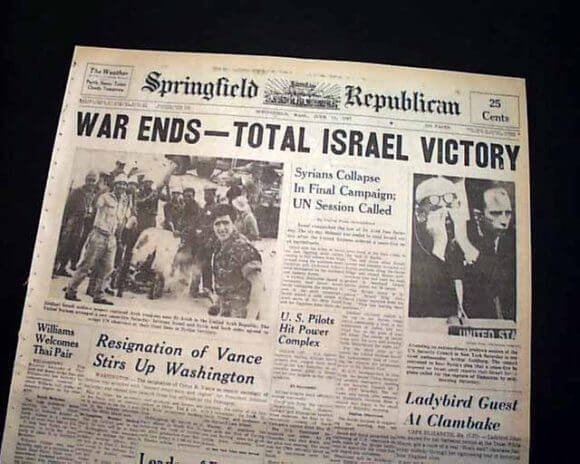
I am old enough to remember clearly how the Six-Day War was reported at the time. Just about everything we were told then was wrong, as the major historians of the period all acknowledge today. Let’s start with how the crisis was covered as it happened, 50 years ago:
* Gamal Abdel Nasser, the leader of Egypt, was portrayed as a dangerous demagogue, widely popular across the Arab world, who wanted to destroy Israel. The Western press regularly demonized him, and he was easily the most recognized Arab leader until Saddam Hussein.
* In May 1967, Nasser made his move. He ordered the United Nations to remove peacekeeping troops from the Sinai peninsula, where they had been serving as a tripwire to prevent conflict between Egypt and Israel.
* Next, Nasser escalated by closing the Straits of Tiran to international shipping, blockading Israel’s southern port of Eilat, which started to strangle the country.
* Meanwhile, Nasser was plotting with other Arab states, chiefly Syria and Jordan, to launch a joint invasion and push Israel into the sea.
* Israel’s very existence was in danger. Therefore, Israel launched a “preemptive” attack on June 5, fearing that it had no choice if it were to survive.
* Fortunately, despite the odds against Israel, it won in only 6 days.
* To protect itself against another onslaught, Israel occupied the Sinai, the Golan Heights, and the West Bank. The occupation was the purely accidental consequence of a fight for Israeli survival.
This Mainstream Narrative remains unchallenged in the popular imagination, 50 years later. Just the other day, a New York Times reporter stated as fact that in 1967, “Israel defied annihilation by its Arab neighbors.”
Norman Finkelstein, the distinguished scholar, has done as much as anyone to uncover the truth about the Six-Day War. In a wide-ranging interview in his Brooklyn office, he refuted the Mainstream Narrative point by point. You can find his detailed revisionist account in a chapter of his now classic Image and Reality of the Israel-Palestine Conflict, supplemented by another work: Knowing Too Much: Why the American Jewish Romance with Israel is Coming to an End. Finkelstein is known as combative, a man who has not been afraid to fight for the truth, despite damage to his career along the way. But what’s also vital to recognize is that he is a serious scholar, Talmudic in his intensity, and that no one has ever successfully challenged his research.

[We will run the entire interview with Finkelstein this weekend.]
Finkelstein emphasizes that no genuine academic today, whatever their political orientation, endorses the Mainstream Narrative. He starts by identifying what he has called the “Two Biggest Lies.”
* The truth is that Nasser and the other Arab leaders had absolutely no intention of invading Israel in June 1967.
* And Israel’s existence was never in the slightest doubt, as both Israeli and American leaders knew that Israel could easily win any conflict, even against a coalition of Arab states.
Finkelstein insists we cannot understand the Six-Day War without going back 11 years, to the 1956 Suez Crisis. That year, the Egyptian leader, Nasser, nationalized the Suez Canal — and Israel, Britain and France launched an unprovoked joint invasion of Egypt to seize the waterway back. But the United States, under President Dwight Eisenhower, opposed the attack, and pressured the tripartite invasion force to withdraw and leave the Canal to Egypt. Suez was a catastrophe for all three invading nations, and British Prime Minister Anthony Eden was forced to resign. Meanwhile, Nasser’s reputation in the Arab world, and across Africa, Asia and Latin America, rose to new heights.
Norman Finkelstein argues that the historical record shows that in 1967 Israel yearned to complete its failed mission of 1956. First, he says, Israel’s “primary goal was to neuter Nasser, to deliver a death blow to these uppity Arabs, and finish off what was called radical Arab nationalism.” He goes on that Israel’s government had a “secondary goal” — “to conquer the lands they had coveted but didn’t manage to seize in ’48: East Jerusalem, the West Bank, Gaza, the Golan.”
Israeli leaders had only one big doubt: what would America do? If Israel did attack, would the United States force another humiliating climbdown, as in 1956? Or would Washington look the other way?
Finkelstein challenges the Mainstream Narrative’s account of the specific events in the months leading up to the war. His analysis is not at all unusual, and is shared to a great extent by other scholars. He argues that the facts show that Israel was not peacefully minding its own business, but instead regularly and violently provoking its Arab neighbors. In November 1966, in the largest military action since the Suez invasion, Israel attacked the West Bank town of Samu, then under Jordanian rule, killing 18 Jordanian soldiers and destroying 125 homes. Israel continued instigating along its border with Syria in April 1967, triggering an aerial battle in which 6 Syrian planes were shot down, including one over Damascus. Voices in the Arab world started to accuse Gamal Abdel Nasser, the leader of the Arabs, of standing by and doing nothing.
So Nasser did ask the United Nations to remove the peacekeeping troops from Egyptian Sinai, mainly so he could be seen to be taking some action. But Finkelstein points out that Israel could have asked for UN peacekeepers to be placed on its side of the border, which would have maintained the tripwire. Israel did no such thing.
Nasser’s closing of the Straits of Tiran has been similarly distorted in the Mainstream Narrative. Finkelstein explains that Nasser may actually have had the legal right to close the Straits, that he probably did not intend to maintain the closure, and that he offered to take the dispute to the International Court of Justice, but Israel refused. And Israel would not have choked overnight, but got 95 percent of its imports through its other ports and had a several months’ reserve supply of oil.
Meanwhile, Finkelstein says, Israeli diplomats descended on Washington, D.C. to find out if the United States would give them a green or at least an amber light. Finkelstein has looked through the historical record, and here is a summary of what he found:
* The U.S. agreed with Israel that Nasser had no plans to attack.
* The U.S. agreed that Israel would easily defeat Egypt on the battlefield, either alone or with any combination of other Arab nations.
* And the U.S. tacitly gave Israel permission to start the war, or at least indicated there would be no repeat of Eisenhower’s repudiation after the 1956 Suez invasion.
Once Israel attacked first, Finkelstein says the conflict should more aptly be called the Six-Day Walkover. “In fact,” he says, “the war did not last six days; it lasted closer to six minutes. Once Israeli planes in a surprise blitzkrieg knocked out the Egyptian air force still parked on the ground, the war was over. . . If the war lasted longer, it was only because Israel wanted to conquer the Egyptian Sinai, the Jordanian West Bank, and the Syrian Golan Heights.”
Finkelstein does recognize that the Israeli public did believe the Mainstream Narrative, took to heart the lies and distortion their government was feeding the world, and genuinely feared the Arab states wanted to push them into the sea. He explains that the Israeli government “figured the Israeli people would give their all if they feared their backs were up against the wall. The leaders were culpable twice over; they provoked the crisis and then launched an unprovoked attack.”
Once the war ended, in the United States it was treated as a lark, a thrilling adventure. After Israel occupied the Egyptian Sinai, jokes circulated: “See the Pyramids. Visit Israel.”
But it was no joke for the at least 18,000 people who died in the fighting: 10,000-15,000 Egyptians; 6000 Jordanians; 1000-2500 Syrians; and nearly 1000 Israelis.
Israel did win its immediate war objectives; Nasser’s image was severely damaged, and he died three years later, with his brand of Arab nationalism greatly discredited. Israeli soldiers did occupy the West Bank, Sinai and the Golan.
Whether the occupation, now shuddering into its 51st year, has been good for Israel is still to be decided by history.


One of the reasons I began following developments in the Middle East has to do with the happenstance that I was away from Atlanta visiting my grandfather (with little to do but read) in June, 1967. In that part of Georgia, the television reception with a rotating antenna was much better for the Augusta and Macon stations than it was for the Atlanta stations, but since the programming of the Augusta and Macon stations was not up to Atlanta standards, the television was seldom used.
This time though, as luck (or not) would have it, one of the two Augusta stations preempted its daytime programming with the deliberations by the UN General Assembly of proposals that might lessen the likelihood of war between Egypt and Israel. I very much enjoyed watching several days of this, and I was very disappointed when I got up on June 5 and the station had reverted to its customary daytime programming because the UN General Assembly deliberations had been suspended due to Israel having, during the night, bombed the Egyptian air force on the tarmac in Egypt. Needless to say, I did not at all see Israel’s action(s) as defensive.
All told, this made quite a lasting impression (unfavorable as to Israel) on me!
The ironic thing is that the decision to occupy the 22% is now an existential threat to the future of Israel.
In 2010 Jeremy R. Hammind wrote a short essay on the same subject, demonstrating that the war was NOT pre-emptive. What I find most convincing in his essays are the words of 2 of israel’s PMs, Yitzhak Rabin & Menachem Begin.
YR to French newspaper Le Monde: “I do not think Nasser wanted war. The two divisions which he sent to the Sinai, on May 14, would not have been sufficient to start an offensive against israel. He knew it and we knew it.”
MB in a speech: “In June 1967 we again had a choice. The Egyptian army concentrations in
the Sinai approaches do not prove that Nasser was really about to attack us. We must be honest with ourselves. We decided to attack him.”
Israel’s only enemy is itself.
Israel is a state whose very life blood is lies,distortions,falsehoods,false accusations. The list is endless:
https://www.foreignpolicyjournal.com/2010/06/17/top-ten-myths-about-the-israeli-palestinian-conflict/
Underpinning it all and increasingly dominating its political agenda is a belief among Zionists that Jews are the “Chosen People” and that they are de facto superior to other human beings and are entitled to oppress, brutalise, torture and murder as they see fit as God has given them his blessing. They will when cornered or challenged blatantly use the Holocaust which came about as a result of this strain of thinking as some sort of justification for their actions.
They actually see themselves as God`s pioneers.
Civilised human beings see only scumbag murdering liars.