Richard Falk writes that the proper priority for genuine advocates of peace between Israelis and Palestinians should be centered around apartheid rather than be devoted to reviving an Oslo style ‘peace process’ or proclaiming the goal of an independent and sovereign Palestinian state. He says this is not attainable without first dismantling the apartheid structures that subjugate the Palestinian people as a whole so as to maintain the Zionist insistence on Israel as the state of the Jewish people.

After two decades fighting to remain in the United States, Amer Othman Adi spent the first days of 2018 saying goodbye to his friends and neighbors in his adopted hometown of Youngstown, Ohio. That is until his lawyer and supporters — including a Congressman — secured a final-hour stay of deportation yesterday, just a few days before Adi’s forced deportation to Jordan scheduled for Sunday. “I have been fighting this deportation for almost 23 years; I thought we had it solved,” Adi told a small group of teary-eyed friends and neighbors gathered at the hookah bar on Tuesday. “But when Donald Trump was elected I knew I was in trouble.”
The 101-year-old American Friends Service Committee, or AFSC, is barred from Israel by the government because it supports boycotts on behalf of Palestinians, many of them refugees. But last century the AFSC won a Nobel Prize for helping refugees of the Holocaust, including many Jews. The group is honored at the Israeli Holocaust memorial.
Israel issued a blacklist of 20 organizations that support the Boycott, Divestment and Sanctions (BDS) movement. Among those barred entry are Code Pink, AFSC, American Muslims for Palestine and Jewish Voice for Peace. “We wear this designation as a badge of honor,” said Yousef Munayyer of the US Campaign for Palestinian Rights.
David Halbfinger does his job for the New York Times by reporting Palestinian leaders’ discussion of a one-state outcome, and Richard Haass of the Council on Foreign Relations and Nick Kristof of the New York Times jump in to suppress the report by saying one state is not in Israel’s interests, thereby denying the 70 years of erasure and discrimination Zionism has meant for Palestinians.
Appraisals of Ahed Tamimi’s looks have been featured in reports around the world on the 16-year-old girl who slapped a soldier in her occupied Palestinian village: her long blonde hair, her western-style clothing. But this is perverse and demeaning. Ahed Tamimi’s bravery has nothing to do with what she wears or what color her hair is. The discussion needs to be about what she did, not her looks.
Stephen Sheehi explains why he is skipping the MLA Annual Convention this year: “Last year, the vote against support for the academic boycott exposed the MLA’s cowardice but, more so, its vote for the unconstitutional provision that prohibits any further motions regarding Palestinian academic freedom exposes the complicity in the occupation of Palestine.”
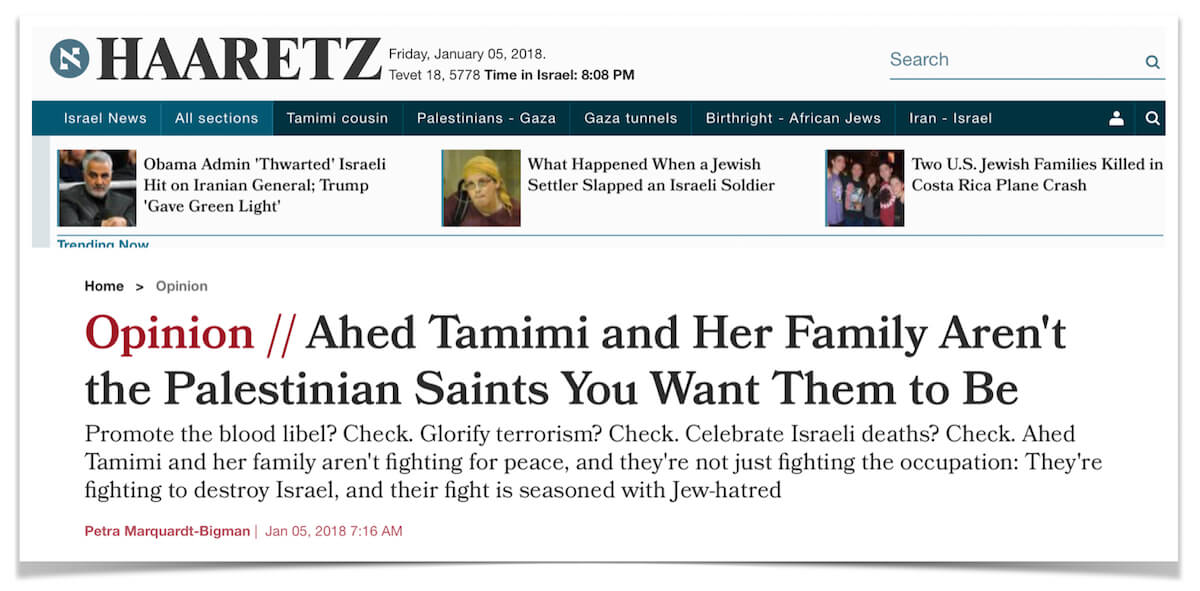
Why is Haaretz, a supposedly liberal outlet, publishing a one-sided, decontextualized smear piece on the Tamimi family by a known propagandist?
Some Israeli movements support Palestinians, but do not recognize a two-state solution based on UN resolutions, including the Right of Return. This means they support an idea of an unjust two-state solution, where a large part of Palestine is being used for the establishment of the Occupying State, and the State of Palestine is being turned into a large prison for the Palestinians, Badee Dwaik of Human Rights Defenders writes.
Those of us denouncing the decade-long siege on the Gaza Strip can help alleviate its impact, even as we continue to organize to bring an end to it. One way we can do this is by supporting the Edward Said Public Library, an oasis of escape, creativity, and cheerfulness in an otherwise gloomy environment.