
The topic of normalization has overwhelmed Palestinian news and civil discourse for months now, as Arab nations have lined up to sign normalization agreements, disguised as “peace deals,” with the state of Israel.
Palestinian civil society defines normalization within the Palestinian and Arab context “as the participation in any project, initiative or activity, in Palestine or internationally, that aims (implicitly or explicitly) to bring together Palestinians (and/or Arabs) and Israelis (people or institutions) without placing as its goal resistance to and exposure of the Israeli occupation and all forms of discrimination and oppression against the Palestinian people.”
From the United Arab Emirates, to Bahrain, and most recently Sudan, Israel and the United States have celebrated the establishment of full diplomatic and commercial relations between Israel and countries that had historically refuted such relations, in favor of supporting Palestinian liberation instead.
Everything from visa-free travel, telecommunications and security deals, and commercial trade between Israel and its newest friends have been put into motion since the deals were signed, with all signs pointing to even more economic and diplomatic channels to be opened between the countries in the near future.
The consensus among Palestinian civil society organizations and the general public, is that when Arab states, organizations, companies, and institutions treat Israel as a “normal” state with which business as usual can be conducted, it whitewashes Israel’s occupation, and paves the way for Israel to commit more crimes in the occupied Palestinian territory.
‘True face’ of Arab regimes
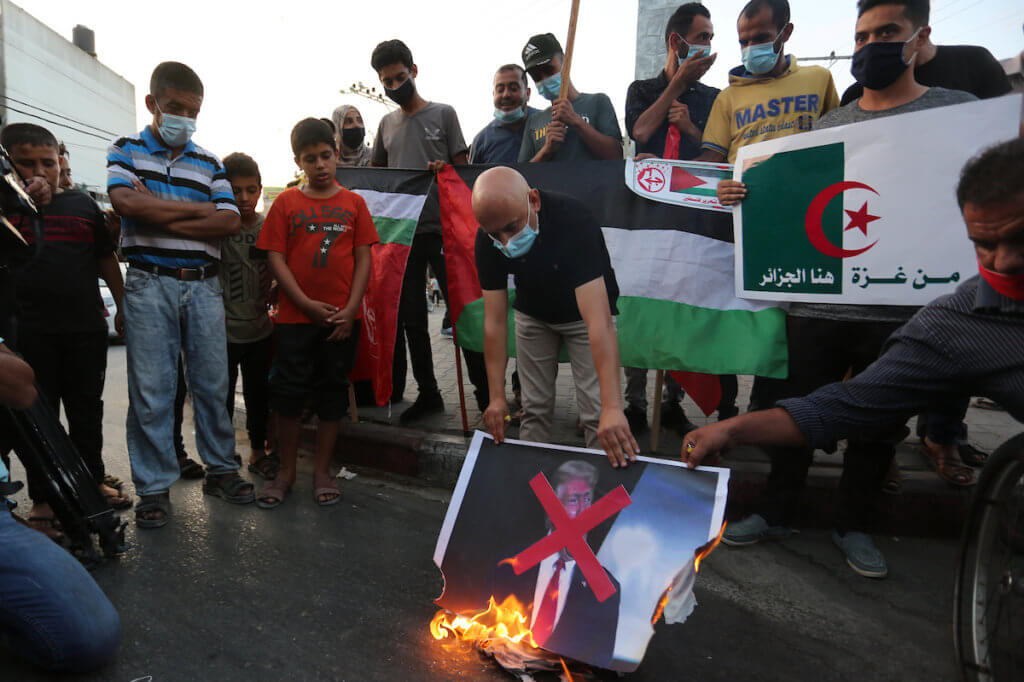
Palestinians have reacted to the recent spate of normalization agreements with frustration and outrage, with demonstrations against normalization breaking out across the West Bank, Jerusalem, and Gaza.
While normalization has been described by Palestinians as a “stab in the back,” and the “ultimate betrayal,” much of the Palestinian public expressed the fact that while upset, they were by no means surprised by the deals.
“When they announced the normalization, it was almost a relief, in a way, because we knew they were doing it for a long time under the table, and this was just confirming all of it,” Ayman Gharib, a Palestinian human rights activist in the West Bank told Mondoweiss.
“These normalization agreements just show us the true face of the Arab regimes, and put an end to the facade that they have kept up for so long,” he continued.
For Gharib, the normalization agreements have not changed much in terms of his day-to-day life in the occupied West Bank, which he spends organizing and coordinating activities to resist Israel’s occupation.
“Whether the Arab states choose to normalize or not, above or under the table, we as Palestinians are still here on this land, defending our homeland and remaining steadfast in our struggle,” he said.
In his criticism of normalization, Gharib expressed a common sentiment shared by many Palestinians, which is that even though Arab governments may choose normalization with Israel over supporting Palestinian liberation, there is an unbreakable sense of solidarity between Arab civilians across the region when it comes to Palestine.
“Even if their governments betrayed us, we expect the Arab people around the world to stand with us, and many of them have,” he said, pointing to anti-normalization protests that sparked in Sudan and Bahrain following their countries’ agreements with Israel.
“Normalization with other Arab countries happens between governments, but not between the people,” Mahmoud Nawajaa, the General Coordinator of the Palestinian National BDS Committee, told Mondoweiss.
“But eventually these dictatorships and regimes around the Arab world will fall, and we hope that with free elections in the future, the Arab people will make their voices heard,” he said.
“We think these kinds of governments and systems make these deals because they don’t have democracy,” he continued. “If these Arab states had democratically elected leaders, these types of agreements wouldn’t be happening, because their people would never let them accept this.”
In the wake of recent normalization deals and the visceral response expressed by Palestinian protesters across the West Bank and Gaza, many critics pointed to the prior existence of normalized diplomatic relations between Israel and countries like Egypt and Jordan, who both share borders with the former.
But while countries Egypt and Jordan have maintained diplomatic relations with Israel for years, Palestinians say this time around things are noticeably different, which has resulted in such a different reaction.
“This time feels different. When you see the normalized relations that Egypt and Jordan have — they’re not warm, they’re just agreements,” Diana Buttu, a Palestinian lawyer and political analyst told Mondoweiss, referring to the fanfare and celebration surrounding Israel’s agreements with the UAE and Bahrain.
“With the UAE, it’s definitely been over the top,” she said, adding that the pageantry surrounding the deals has only served to further slight the Palestinian people in the wake of the agreements.
“Many Palestinians feel like, okay, we understand why you made these deals,” for things like economic and political gain, she said. “But what in the world are you doing, celebrating it this way?” she asked, pointing to highly publicized flights between the two countries as an example.
Decades of failed Palestinian leadership
Perhaps equally as frustrating to the deals themselves, Buttu highlighted, has been the strategy, or lack thereof, on part of the Palestinian “leadership” in response to normalization.
“Well, there hasn’t been much of a strategy at all,” she said. “The government’s whole response to these normalization deals has just been to sort of wave their hands around and say ‘hey we’re still here!, and nothing more.”
According to Buttu, the lackluster response of the Palestinian Authority (PA) towards the UAE’s deal with Israel, was attributed to the fact that PA officials didn’t want to issue a harsh enough response that could have ended up endangering the status of the more than 300,000 Palestinians who reside in the Gulf state.
“But when Bahrain came around, there was another ‘nothing response’, just the same old same old, and then again it was a similar situation with Sudan,” she said. “The biggest problem with this strategy is it just shows how pathetic their approach has been for all of these years,” she said of the PA.
The current state of the PA — a financially drained body with no say in global and regional policies that affect their people — Buttu said, is a culmination of all the years of failed strategy since Oslo, and the complete circumvention of the PA as a decision maker for the past four years by the Trump administration.
“The PA has done nothing to change course since the Oslo Accords,” she said. “And as a result we’ve been stuck in the same scenario for 27 years. The PA still talks the same talk, while the world has clearly moved on.”
Recalling a saying commonly used by Palestinians in Gaza who refer to President Mahmoud Abbas as a “dead body that’s just walking and talking,” Buttu said “that’s exactly how he has behaved.”
“The total lack of organized response and action to normalization can absolutely be blamed on failed Palestinian leadership,” she said. “They never set up an alternative strategy, and we’ve been paying the price for years.”
A bleak future
In recent weeks President Trump and his Israeli counterpart Prime Minister Benjamin Netanyahu have boasted that similar normalization agreements with other Arab countries will come light in the near future.
It’s a worrying prospect, but for many Palestinians it’s a trend that they know is almost inevitable.
“The governments making normalization deals with Israel are all police states and apartheid regimes,” Nawajaa said. “At the end of the day, these deals are good for business.”
Nawajaa said that the case of Sudan, which was pressured in normalizing relations with Israel in exchange for getting taken off the US terrorism blacklist and the removal of economic sanctions on the country, is a good indicator of why these types of deals are going to continue to happen.
“The US is paying for and pressuring countries into these agreements,” Nawajaa said. “The American government is far from a moral system — they use their power and influence to pressure the Arab governments into this corner and agree to normalization with Israel,” he said, adding that regional superpowers like the UAE also play a similar role in the region.
The current reality has painted a very bleak picture for many Palestinians living under occupation, who find themselves outraged by normalization, but with little to no direction from their leaders on how to fight against the latest affronts to their struggle.
“The question of what’s next is terrifying because the Palestinian leadership have totally destroyed the current system,” Buttu told Mondoweiss. “We all see where this path, the path of Abbas’ failed strategy, is leading us to.”
Even with an administration under President-elect Joe Biden, Buttu said, “nothing is going to be undone,” she said, pointing to Biden’s vocalized support for Israeli and regional normalization.
“The sad thing is, for many Palestinians, especially the youth, there is no agency,” she said.
“There is very little hope for the future,” she said, adding that many Palestinians are being forced to witness the rapidly changing reality to their cause that is happening around them without any real power to change anything, with decades of failed leadership to blame.


“There is very little hope for the future” says Buttu. So what now?
The Israeli intelligence-security community states very clearly what they’re really afraid of, the only way they could be clearer about their worst nightmare is if they put it up on billboards: they’re afraid of a peaceful campaign by the Palestinians to demand the vote – they know if that happens it’s game over.
First and foremost these shameless Arab countries should have made ending this brutal occupation a condition before agreeing to sign those agreements with hearts and flowers. They have now proudly stated that their dealings with Israel, a one time enemy, is official and public, no longer having covert dealings with it. Perhaps the UAE has forgotten how Mossad killers entered their nation, making them look fools, and killed a Palestinian official in a Dubai hotel. All’s forgiven.
Look what Iran has made them do, break Arabic bread and dance the Hora with Israel. Unthinkable at one time.
If these Arab nations are willing to ignore the plight of the Palestinians, and not stand up for their freedom and rights, then who will?
“… the complete circumvention of the PA as a decision maker for the past four years by the Trump administration…..They never set up an alternative strategy, and we’ve been paying the price for years”, Diana Buttu.
What a depressing read. First Trump practically begged Abbas for a bargaining position and was rebuked, told essentially to go fly a kite. A self-inflicted wound. Abbas could have responded with a counter, negotiated, in public, directly with Trump, by-passing Netanyahu. Trump declared he wanted to resolve the IP conflict and then move on to full ME peace. He clearly wanted a deal and told Abbas/Palestinians in so many words keep up this nonsense and I’ll cut your money, as he had warned Netanyahu.
Second we hear from three leading Palestinian thinkers. Nothing from them on getting closer to a deal. Where are idea people for politically getting to either a 1SS or 2SS.. How to figure this? I’m afraid the picture at the top tells the story. Stone will eventually work. America has to submit then we will be given our freedom.
2 of 2
On 16 June 2009, after meeting with former U.S. President Jimmy Carter, Ismail Haniya, prime minister of Hamas’s Gaza Strip government, announced that “If there is a real plan to resolve the Palestinian question on the basis of the creation of a Palestinian state within the borders of June 4, 1967 [i.e. 22% of historic Palestine] and with full sovereignty, we are in favour of it.”
“‘We accept a Palestinian state on the borders of 1967, with Jerusalem as its capital, the release of Palestinian prisoners, & the resolution of the issue of refugees,’ Haniyeh said, referring to the year of Middle East war in which Israel captured East Jerusalem & the Palestinian territories. ” (Haaretz, December 1, 2010) No response from “Israel.” (By calling for a “resolution of the issue of refugees,” Haniyeh was in accordance with UNGA Res. 194, which calls for financial compensation as a possible option for the Palestinian refugees rather than their “inalienable Right of Return.”)
In its revised Charter, April, 2017, Hamas again agreed to a Palestinian state based on the 4 June 1967 borders. Unfortunately, but not surprisingly, “Israel” promptly rejected the Hamas overture instead of using it to open a dialogue.
https://www.haaretz.com/isr…
“Senior Hamas Official: ‘I Think We Can All Live Here in This Land – Muslims, Christians & Jews.’” By Nir Gontarz. March 28, 2018, Haaretz. No response from “Israel.”
Unfortunately, Israel’s response to every peace overture from the Palestinians, Hamas & the Arab states has been rapidly increasing illegal settlement construction along with escalating dispossession & violent oppression of the indigenous inhabitants in occupied Palestine and other Arab lands.
As for Netanyahu & the Likud party, here’s a brief summation of their positions that are contrary to international law & explain why the conflict continues:
The Likud Party Platform:
a. “The Jordan river will be the permanent eastern border of the State of Israel.”
b. “Jerusalem is the eternal, united capital of the State of Israel & only of Israel. The government will flatly reject Palestinian proposals to divide Jerusalem”
c. “The Government of Israel flatly rejects the establishment of a Palestinian Arab state west of the Jordan river.”
d. “…. Settlement of the land is a clear expression of the unassailable right of the Jewish people to the Land of Israel…”
This article is a prime example of how far the lunacy extends, but at least its conclusion is the right one.
First “normalisation” is defined as having any contact with Israel or Israelis for any reason except ending the occupation. So if effect what you’re saying is that I’m only willing to have one conversation with you and Im going to decide what we talk about. Good luck with that.
Second, “The governments making normalization deals with Israel are all police states and apartheid regimes,” Nawajaa said. According to this quote, having contact with Israel automatically turns you into a police and apartheid state.
Finally, claiming that if only the people of the steet would be in charge these peace deal wouldnt happen may be true today after decades of disinformation. Now that these societies will mix and meet eachother it will be very hard to sell this falsehood any longer. Arabs from the UAE will come to Jerusalem, will send pictures back home, will meet Israelis that they like and some that they dont, but there will be context.
The palestinians had decades to try to use Israel’s isolation the their advantage. Some of them have. Arafat and Abbas will both have the distinction of being billionaires at the time of their passing, but look at what they leave behind. Shameless!
The conclusion however is correct. Decades of corrupt “leadership”, if you can call it that.