
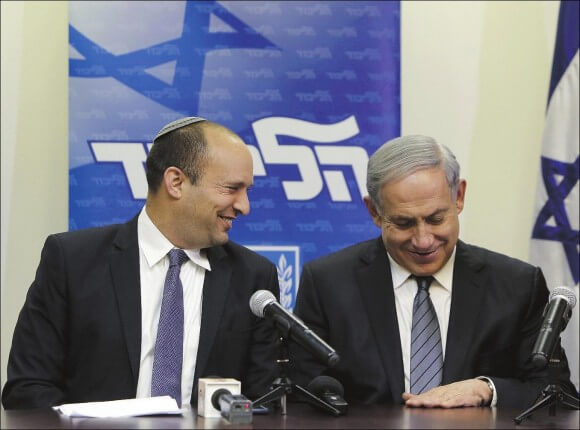
There is growing speculation that Israeli politicians will finally knock out Benjamin Netanyahu after the March election by getting a far rightwinger, Naftali Bennett, to join forces with other Jewish parties that oppose Netanyahu.
Such a deal would entail the same governing principle that has prevailed in Netanyahu’s center-left opposition in the last three elections: We won’t make a government with the Palestinian parties, but we are willing to work with rightwingers.
Amir Tibon of Haaretz explained the speculation in a discussion with the Israel Policy Forum two days go. He said he was “not optimistic” that Netanyahu opponents have the votes to knock out Netanyahu– in the fourth election in two years– and chances for a deadlock and fifth election are good.
“Either Netanyahu and religious parties have a governing majority, or the anti-Netanyahu bloc has a non-governing majority,” he said.
What does that mean, non-governing majority? In the last three elections the anti-Netanyahu bloc was center-left and won a majority of the parliament– Blue/White, Yesh Atid, Labor, Meretz, Yisrael Beteinu and Joint List in various forms got about 62 seats. But the center-left failed to form a government because Jewish leaders refused to make a government with the Palestinian Joint List, which won as many as 15 seats.
A fact history won’t look approvingly on, Tibon said. (Yeah, that’s how the Democratic Party worked up till 1964.)
Today Bennett’s Yamina (Right Turn) party is considered a likely part of a rightwing coalition. And it is polling well, at 11 to 13 seats, in the next election. If there is another deadlock, Tibon said, there is going to be pressure on Bennett to cross to the anti-Netanyahu forces so that Israel gets a new prime minister.
After all, the anti-Netanyahu bloc is no longer center-left, but right-center-left, as it includes Gideon Sa’ar, a settler advocate and former member of Netanyahu’s Likud Party, who is to Netanyahu’s right. Times of Israel:
Bennett and Sa’ar are fighting each other for the support of anti-Netanyahu voters on the right of the spectrum, in an election in which the long-serving prime minister is being challenged both from the center-left and the right.
Left-right Ideology means a lot less in this election than Netanyahu/anti-Netanyahu.
Except for anti-Palestinian ideology, that is!
The Palestinian Joint List has 15 seats in the 120-member parliament now, and is polling at 10-12 in the next election. It is on the left of Israeli politics. But the center-left doesn’t want those Palestinian seats.
“If there is a deadlock and the country is headed for a fifth election, Bennett could switch sides and if you add Bennett to the anti-Netanyahu bloc, then you don’t need the Joint List anymore,” Tibon said. “You take the Joint List out of the equation, and you put Bennett instead who crosses between the blocs. Then you have a governing majority. A very weird governing majority… It’s at least a Zionist governing majority and also a secular to moderately religious governing majority without the ultra orthodox parties.”
Zionist majority means: A Jewish majority. No Palestinians need apply.
So Israeli politics continue to lurch rightward.
Bennett is adamantly opposed to a Palestinian state, has bragged about personally killing Arabs, and has called for annexation of large portions of the West Bank, with checkpoints to allow Palestinians to go from one enclave to another around Jewish areas. “On the matter of the Land of Israel, we have to move from holding action to a decision,” he said in 2017. “We have to mark the dream, and the dream is that Judea and Samaria will be part of the sovereign State of Israel. We have to act today, and we must give our lives,” Haaretz reported.
For Bennett to betray Netanyahu, first Netanyahu and the rightwing parties, including Bennett’s, have to fall short of 61 parliamentary seats. “And he [Bennett] needs to grow a spine to act against Netanyahu,” Tibon said. That betrayal and coalition may be the only alternative to a fifth election or another Netanyahu government.
This post initially stated that Yamina is part of Netanyahu’s governing coalition now. A commenter pointed out that it is not. Thank you. And to Annie Robbins.


This report ignores the developments in the Joint List. Namely, that it’s split: the Islamic faction ,the United Arab List, led by MK Dr. Mansour Abbas , is running independently. In recent weeks Netanyahu -who is a grandmaster at causing splits in rival parties- has been courting the Arab vote, made overtures to MK Abbas , and for the first time ever added a Muslim Arab , Nael Zouabi, to the Likud list. For Netanyahu this is a win-win situation: if the UAL doesn’t make it to the 4-mandate threshhold, fine for him, all those Arab votes go down the drain. If they do make it, he’s still weakened the opposition, and MK Abbas may be in his pocket, bought with some bs promises. However, Netanyahu may have done something unintended: legitimized Arab politicians as political partners.
“But the center-left failed to form a government because Jewish leaders refused to make a government with the Palestinian Joint List, which won as many as 15 seats.”
So what would you say the repercussions were for the refusal to “make a government” with the MAJORITY that included the “Palestinians Joint list” Any serious repercussions? Or is it just aok not to work with elected majority?
” But the center-left doesn’t want those Palestinian seats.” What does this mean? Why don’t they want those seats?
“Today Bennett’s Yamina (Right Turn) party is part of Netanyahu’s coalition.”
No. It isn’t. Get your facts straight.