
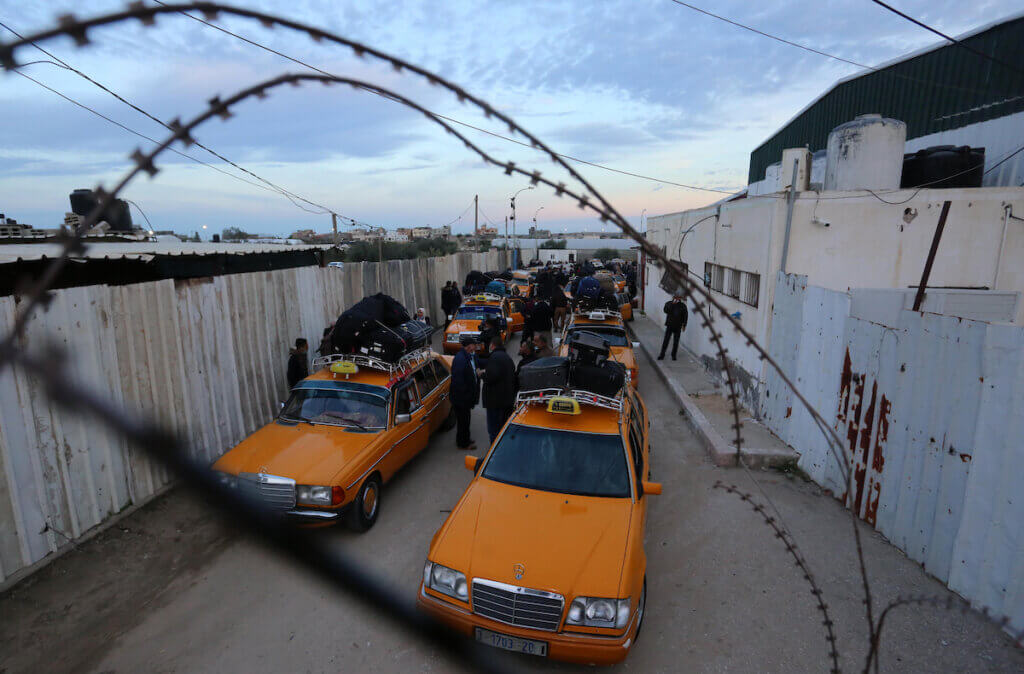
At the Egyptian side of the Rafah crossing is the beginning of a miserable journey for every Palestinian who dreams to travel.
It was 8 a.m. February 15th 2021, I packed my luggage, carried my backpack, and hugged my family. I did not know when I would see them again. Fifteen minutes after my departure, I arrived at the tourism agency office. I received a call from them two days prior informing me that my name had made the travelers’ list. A week before this phone call, I had paid a huge amount of money to get my name on this list. I wanted to make it out of Gaza to Turkey through Egypt. I was hoping that paying this money would help me when I arrived in Egypt to travel safely. My experience proved to be the opposite.
After arriving at the tourism agency office, I sat in the hall on the Palestinian side of the crossing for half an hour, until a Palestinian man from Hamas wearing civilian clothes and a cap came out, walked towards me and stared at me. Naturally, I stared back at him unknowing who he is. I speculated whether he was a police officer, when he asked for my passport but I was given no confirmation. After I gave him my passport, I watched him leave the hall and enter another room closer to the border crossing area. I wanted to follow him as he was holding my passport, but the men at the exit asked me to wait in the hall without offering any explanations.
After a brief wait, I was called over by the same man who took my passport and asked to enter an isolated room where another man in civilian clothing sat on a chair. It turned out that they were both policemen and wanted to interrogate me about the purpose of my travel. I was annoyed by all their questions about where I was going and if I had any political affiliations. I was starting to get anxious that I would miss the bus to the Egyptian border. I could hear outside the interrogation room the other police officer calling out names to fill up the bus. After fifteen minutes of their investigation, I was allowed to catch the bus to the Egyptian side of the crossing. This is where my story actually begins — an unforgettably degrading and unjust experience.
I had heard of the difficulties at the Egyptian border from others who traveled out of Gaza, and so I had booked from Gaza what was advertised as a ‘VIP traveler experience’ upon arrival in Egypt. After taking the bus to the Egyptian border, I was dropped off at a hall with other VIP travelers. Next to us was another hall where I could hear the voices of Egyptian officers shouting out names to what seemed like an audience of hundreds of people.
Every twenty minutes, the Egyptian police officers would call two or three names from the VIP room and ask them to get on the bus to the airport. To my surprise, nine hours had passed and they had yet to call my name.

By 7 p.m., I was the only one left in the VIP room along with a 70-year -old man. Finally, we were approached by a policeman who told the elderly man that he will be returning to Gaza, and that I will be heading to the airport along with twenty-eight other young men, all aged 19-30, and traveling to Turkey, like me. I was still not allowed to take back my passport, and was given no reason or explanation as to when I would expect it back. We were then all shoved into small buses and driven for twelve hours through countless military checkpoints. All the while, an Egyptian police car followed our buses. At midnight, we arrived at Cairo International Airport.
Upon arrival, we were denied our passports, and an intimidating Egyptian police officer screamed instructions at us to line up in two rows. We were being treated like criminals while everybody else who was not a Palestinian from Gaza roamed the airport freely, passports in hand.
We then continued to be aggressively escorted in the airport, without our passports and being spoken to with complete disrespect, until we came to a closed-off room where we were told to stay until the time of our flight’s departure. Two officers stood at the door and we were told that we were not allowed to leave for any reason. We were not even allowed to buy water by ourselves, or to buy it at regular price like everybody else. Only the cleaning lady could do this for us and not for free. We were asked to pay 60 Egyptian pounds for a small bottle of water.
Suddenly, the officer’s voice turned sternly threatening, and questioned whether we had booked our flight tickets. He threatened that if we had not booked them that we do so with him or we would be sent back to Gaza. In my mind, I could not bear the thought of having to take this inhuman journey again, and so I raised my hand in fear. I had not booked a flight yet, as I thought it would be wiser to book it at the airport as other travelers could. I could not predict how long it would take me as a Palestinian from Gaza to make it from the Egyptian side of the border crossing to Cairo International airport and so I could not decide on a flight departure time that I could guarantee not to miss.
The officer looked at me with disgust but I felt he sensed an opportunity. He asked for my name while keeping my passport with him, and escorted me along with two other Gazans down the hallway towards EgyptAir offices. Once at the offices, we were instructed to follow the police officer to the back and that we were not allowed to speak or have access to our passports. It felt like we were attempting a criminal act.
It became apparent that EgyptAir with the help of the Egyptian police, coerced Palestinians from Gaza to book flights through them instead of other airlines offering travel to Turkey by threatening to send them back to Gaza if they did not. I was dumbfounded by their willingness to take advantage of our disadvantaged situation. I quickly decided on a ticket, despite preferring a better flight by Turkish Airlines, while the police officer hovered over me. The employee at EgyptAir also participated in scamming me by giving me an inflated ticket price. I ended up spending over 5,000 Egyptian pounds for a two-way ticket to Turkey from Egypt. After purchasing the ticket, the police officer kept the ticket with him and escorted me back to join my group.
When we got back to my group, he called my name and asked me to follow him to the bathroom. It turned out that he wanted a bribe to give me my ticket, but I only had 26 Egyptian pounds left. He got very angry when he found out and started screaming at me and the other guys in the hall that we would be sent back to Gaza. All of their faces turned pale-yellow upon hearing his threats after a night without sleep and over eight hours on the road. The police officer then called out for my name a second time, and asked me to follow him back to the EgyptAir offices. I was terrified at this point, having been sleep deprived, hungry, and dehydrated. Once at the offices, the employee who sold me the ticket told me that I needed to pay the officer a 1,000 pounds in order to validate the ticket as a two-way ticket. It was a clear situation of collusion to get the police officer the bribe that he wanted. I made a transfer of a 1,000 Egyptian pounds and gave it to the officer.
After paying the officer over a 1,000 pounds, the police officer harassed me by not giving me any room to walk while escorting me back to the room where the rest of the group was waiting for their flights. He said that this was because I did not pay him a bribe. The situation shocked the words out of me. I was left speechless.

It was 4 a.m. and we were 29 guys in the room, tired, hungry, confused, and still were not allowed to touch our passports. We remained this way until 11 p.m. the next day. Our flight was to take off in two hours, when they escorted us to our flight terminal. This time, at the flight terminal, we were told that we were not allowed to move at all. I was completely wiped out when we were finally given our passports back five minutes before boarding the plane. I stumbled onto the plane exhausted, dehydrated with bloodshot eyes.
I did not feel alive again until I arrived at Istanbul airport, and was considered and treated like a normal human being.

So what does this have to do with Israel, since all the hassles the author experienced were caused by Egyptians?
https://www.btselem.org/gaza_strip/control_on_air_space_and_territorial_waters#:~:text=The%20disengagement%20plan%20states%3A%20%22Israel,occupied%20the%20Gaza%20Strip%20in
“Due to Israel’s control of Gaza’s air and sea space, the Palestinian Authority cannot, on its own initiative, operate a seaport or airport. This situation infringes the right to freedom of movement to and from Gaza and impairs the ability of Gazans to carry out foreign trade.”
The political entity that prevents Gaza from having a seaport and airport is Israel.
The Egyptians are under the thumb of the Israelis. (The closed border from Gaza is not by the will of the Egyptian people.) And no doubt some of them take advantage of the situation to extract bribes.
What a horrible experience for you, Mr. Moussa. Israel and Egypt should be chastised by the world community for such treatment toward people. It’s perfectly alright with Israelis that Palestinians are treated so badly. I’ve traveled a lot and have noticed when Israeli are traveling, they expect to be treated better than anyone else, shove to the fronts of lines, demand all kinds of services, actually knock people out of their way. Arrogance is ugly and they practice it to the extreme. I’m sure some Israeli are not arrogant and rude, but I didn’t meet any there. However, I was treated with respect and kindness by Palestinians, Syrians, Iranians, Cubans, and Russians.