

In fairy tales, as everyone knows, spells often are broken by unlikely characters who scarcely know what they are doing. Ben Cohen and Jerry Greenfield, with their friendly, soft-hearted former company, Ben & Jerry’s Ice Cream, are unlikely game-changers in Israel-Palestine. They don’t seem to know a lot about the situation and they don’t really want to fight about it. Yet it’s looking like B&J’s action to end sales of its ice cream in Jewish-only settlements on the West Bank has set in motion a powerful counter to the amazing cloak of impunity that protects Israel’s persecution of the Palestinians.
To be more precise, the company’s decision — which founders Ben and Jerry fully support as individuals, though they sold Ben & Jerry’s to Unilever in 2000 — triggered a typically extreme reaction from Israel Israel’s leaders, who branded B&J’s decision an antisemitic, terrorist threat to the existence of the Jewish state and vowed revenge. Yet the more Israel seeks to punish B&J, the deeper the damage to its standing is likely to be.
What makes the Ben & Jerry Affair so dangerous in its potential to demystify and delegitimize Israel is that it is funny. Ice cream is about yummy fun. It’s about “Good Humor.” So, when one of the most unfunny governments in the world – self-righteous, self-pitying, frowning, solemn-voiced, “be very afraid of us” Israel – comes after the ice-cream guys, Ben and Jerry, it enters a realm more like “Tom & Jerry” cartoons. Or maybe an episode of “Laurel & Hardy,” where the hapless heroes have wandered into the tidy domain of a pompous authority figure. Their bumbling ways get on the man’s nerves and soon drive him crazy. By the end, as Laurel and Hardy tiptoe away, his hair is mussed, his clothes are in tatters, and his fancy home, shop, car, or whatever, lies in ruins.
Some Israeli officials, if not the Israeli public, which has been calling for blood, may already get this. They may sense the danger that the Jewish State could end up looking crazy, mean, ridiculous, even pathetic. But the leadership of Israel is already in too deep. Backing out would be tricky for a country not used to retreating, whose foreign minister once described its basic philosophy in dealing with insubordinate Palestinians as, “When they do something, we go crazy,” by which Tzipi Livni meant violently crazy. She knew Israel could go crazy with impunity.
When it comes to the Boycott, Divestment, and Sanctions (BDS) movement, moreover, Israel has been going crazy for years. In this case, within hours of B&J’s announcement about leaving West Bank settlements, the top leaders of the country had decreed vengeance and ordered their obedient allies in America, including the governors of 35 states with anti-BDS laws, to go after the ice cream makers. Yair Lapid, the foreign minister, called the move a “shameful surrender to antisemitism.”
It’s hard to see how this doesn’t play out as a sweet victory for the Palestinians and their American supporters, both in the court of public opinion, and in any law courts where B&J (perhaps along with its corporate owner, Unilever, which Israel has also threatened) will assert strong First Amendment rights.
Ben and Jerry are ideal defendants to stand against an enraged Israel and the American politicians who serve it. They have locked in their role as the warm, fuzzy targets of Israel’s vendetta. (When Ben and Jerry sold the company to Unilever, the deal included a governance structure to give an independent board of directors the responsibility to protect the company’s brand integrity and to pursue its social mission.)
In a New York Times article titled “We’re Ben and Jerry. Men of Ice Cream, Men of Principle” the duo gave Israel no room to paint them as antisemitic, anti-Israel or anything but the well-meaning fellows the public has long known them to be. They declared that they remain “Jewish supporters of the State of Israel.” Although they made clear that they and B&J knew that divesting from the West Bank settlements as a matter of principle would cause a “swift and powerful response” from Israel, they insisted that “the company’s stated decision to more fully align its operations with its values is not a rejection of Israel.” According to the two men, despite their love of Israel – maybe, in fact, because of that love — they had to reject Israeli policies that “perpetuate an illegal occupation that is a barrier to peace and violates the basic human rights of the Palestinian people.”
Actually, this op-ed version of the B&J story is something of a sugary confection. The decision to divest was far from a simple matter of personal conscience compelling a political gesture entitled to First Amendment protection. Their article failed to note or explain why B & J and the founders spent more than 10 years resisting pressure to have the company express criticism of Israeli settlement policies, which haven’t changed since the 1970s. Also, the gesture itself was timid, since Ben & Jerry’s Ice Cream won’t be pulled out of the settlements until the end of 2022, when the B&J contract with a local Israeli manufacturer runs out. Finally, the decision doesn’t apply to Israeli territory within its pre-1967 borders.
The timidity of the divestment decision, has, in fact, left the company still facing protests from “Vermonters for Justice in Palestine” (VTJP), the group that has been relentlessly demanding that B&J immediately quit the West Bank settlements and the rest of Israel. Were Ben and Jerry as truly concerned about Palestinian rights as they say, they would have acted long ago. Instead, according to longtime VTJP member John Heermans, the protests had been getting nowhere until a far larger group intervened – the Movement for Black Lives (M4BL).
In a textbook demonstration of the power of solidarity between social justice movements, VTJP, in 2020, had energetically mobilized to support protests organized by M4BL after the police murder of George Floyd, Heermans says. “We established a solid relationship with Black Lives Matter.” Meantime, Ben & Jerry’s had endorsed Black Lives Matter and the effort to address structural racism.
When the unprecedented “Unity Intifada” erupted in May of this year throughout Palestine-Israel and with the massive participation of all parts of the global Palestinian community and its friends, M4BL and other social justice groups (including Jewish Voice for Peace and Migrant Justice) joined VTJP’s protests outside B&J’s Burlington headquarters.
“During the last massacre in Gaza, more than 300 protesters stood in front of Ben & Jerry’s famous store. It’s the top tourist attraction in Vermont. We were chanting ‘Shame Shame Shame’ for about five straight minutes,” Heermans told me. “This was huge by VTJP standards. It shook up the Ben & Jerry’s people.”
Meanwhile, “behind the scenes,” according to Sandra Tamari, executive director of the Adalah Justice Project, M4BL was applying “intense pressure” on B&J. Tamari detailed the “tipping point” in a July 22 email report: “The company, with its stated commitment to racial justice and ending police violence against Black people, wanted to partner with M4BL to push forward their legislative agenda. But M4BL responded, ‘What about Palestine?’”
So, it turns out that B&J and Ben and Jerry had business motivations to make a gesture of solidarity with Palestinians. Still, while the fuller story of the B&J decision may dim the idealistic luster of the Ben & Jerry’s brand and of its founders, Israel would be wise not to use that against B&J. Doing so would likely further tarnish its own image, illustrating the intimidation that Israel and its cronies deal in, while also showing that more and more people are defying them, whether from conscience, self-interest, or both.
When the cartoon ends of big, bad Israel chasing Ben and Jerry all over the place, Israel is likely to look ridiculous, vicious and beatable, an image that may prove hard to shake.
Postscript: The cartoon is not likely to end soon. Ben and Jerry not only face a barrage of retaliation from the unified forces of Zionism in Israel and the United States, M4BL has already served notice that B&J’s “step in the right direction” in deciding to partially withdraw from Israel-Palestine will not be sufficient. As Tamari’s email quoted him, Montague Simmons, M4BL’s Director of Strategic Partnerships, has insisted that “small attempts at fixes don’t override the bigger context of apartheid, settler colonialism and military occupation. We continue to demand an end to human rights abuses, settler colonialism and U.S. investments in the occupation of Palestine and the apartheid state.”

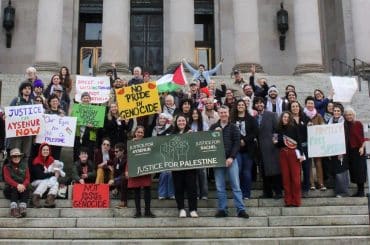
The shape of things to come:
1 of 2
http://normanfinkelstein.com/2021/07/29/how-an-enemy-combatant-became-a-comrade-in-arms/
“How an Enemy Combatant Became a Comrade-in-Arms” July 29, 2021, in Letters to Finkelstein.
“The disillusionment of a former admirer of Israel” (G.M., from Florida)
EXCERPTS:
“I speak as someone who grew up with so much admiration for Israel, and I have to admit, I had a lot of contempt for Palestinians. I grew up hearing how Israel is ‘the only democracy in the Middle East’, that it ‘lives in a bad neighborhood with organizations like Hamas who want to destroy Israel and throw Jews into the sea’, that Israel is only ‘defending itself’, that it keeps extending its hand for peace and offering a state but it only gets war and violence, and that the Palestinians are the Arab equivalent of Nazis, justified by the fact that their leader during World War Two, the Mufti of Jerusalem, collaborated with the Nazis. When I used to be on social media, I followed StandWithUs, the Jewish Virtual Library, CAMERA, Algemeiner, the Jerusalem Post, UN Watch, Honest Reporting, and other Israel advocacy sites. This ‘villa in the jungle’, with its technological advancements, democracy, gorgeous women seemed so cool.
“I internalized all of this, and didn’t begin to question it until I decided one day to email Dr. Finkelstein to hear his take, because it baffled me why a Jewish son of Holocaust survivors was so critical of Israel. I had my opinions, but I was fair and wanted to hear from someone like him. He gave very convincing arguments and scholarship, and I slowly came around to understanding that Israel wasn’t the rosy place I made it out to be, but learning more about what actually happened showed me that a lot of what I internalized was just propaganda.’
“I was initially all in favor of ‘Eretz Israel’ going to the Jews, but I don’t see how this can be implemented in the 21st century without thousands of people being utterly screwed over. I saw a video of a settlement leader in May saying ‘Yes, Arabs lived here (in East Jerusalem) and it’s at their expense, but then again, so was our state’, and an Israeli girl at the recent riots in Jerusalem saying something like ‘I don’t want to say ‘death to Arabs’ like the Lehava, but we should say nicely ‘we’re taking the land, so please get out’. I can’t defend that. When I saw some of the videos of the riots, and from Sheikh Jarrah, it made me cringe.” (cont’d)
2 of 2
“Seeing an overweight American man saying ‘If I don’t steal your house, someone else will’ to an innocent Palestinian woman, it made me angry and somewhat ashamed. I can’t stand making a woman, elderly man, or children homeless on ideological grounds. I didn’t appreciate how bad this is in reality.”
“Israel can’t sustain itself this way. I don’t see how it can continue to live in a bubble and taking more land. It seems like it’s just shooting itself in the foot. I think, if it carries on this way, the Palestinians will eventually win by virtual of sheer numbers, and the fact that even the human rights organizations are closing in on it, American Jews are losing patience with it, Palestinians will continue to reproduce and exist on the land.”
The 2021 gold in the most-over-the-top hasbara event goes to:
https://www.jewishboston.com/read/israel-wont-buy-ben-jerrys-new-flavor-bitter-taste/
In a new lick of hatred toward Israel, the company announced that it would no longer sell ice cream in Judea and Samaria and East Jerusalem, places they call “Occupied Palestinian Territory.”…We do not need Ben & Jerry’s products, but we Jews do need each other to create a united front to stand strong and stop our enemies. That will be the only way to avoid being erased from the map, which is the ultimate goal of those who want to boycott us….an we consider Jewish self-haters as part of our people, the people of Israel? Why should we? They would be the first to march against Israel across America….Today the aggression against us is over dessert, tomorrow other foods, clothes, wine, and the arts may become weaponized. Our enemies find any excuse to spread antisemitic hatred under the false umbrella of justice.
I have found myself succumbing to the extreme giggles over Israel’s and too many others reaction to this and then the sobering thoughts that B&J/Unilever only made a tiny step toward BDS and abiding by international law.
btw, some might not want to watch or promote this upcoming show on the Food Network:
“Molly Yeh Hosts New Ice Cream Competition Ben & Jerry’s: Clash of the Cones”
https://www.foodnetwork.com/fn-dish/shows/ben-and-jerry-s-clash-of-the-cones,
Alternatively, it could be another platform to launch the truth and information by those who stand for justice in Palestine…
The mere fact the the NYT not only carried the op-ed, but felt the need to carry the op-ed by the Ben & Jerry co-founders was a devastating blow to Israel and its insane propaganda offensive to defend the indefensible.
The fact that the NYT has yet to carry a defense, counter argument, or rebuttal by anyone from the Israeli government or their unofficial spokesmen like Stephens, Weiss, Friedman, and Co. is a double-scoop serving of whoop-ass.
Israel honestly thought it could get away with their usual playbook of crying “anti-semitism”, “terrorism”, and politically bullying a “soft” target into submission and met with a cold hard ice wall in the form of a beloved company with a rich and creamy history of standing up for human rights and being on the right side of history.