
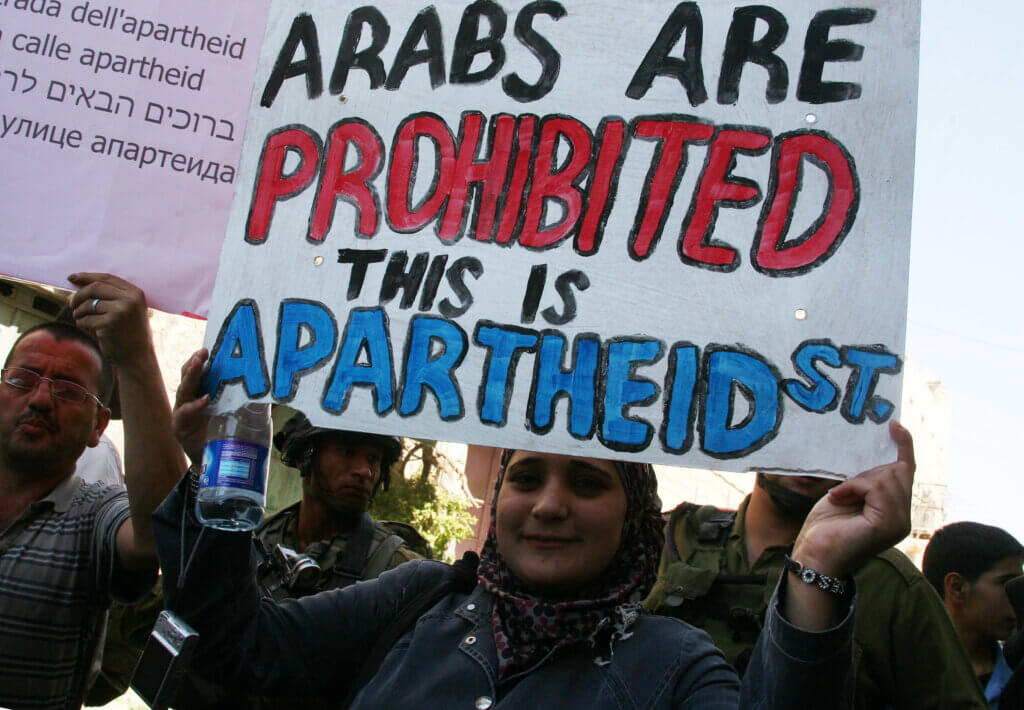
The Middle East Scholar Barometer is a joint initiative from the University of Maryland Critical Issues Poll and the Project on Middle East Political Science at George Washington University. It’s a survey that tracks the opinions of Middle East scholars based in the United States.
Back in February (before the forced evictions in Sheikh Jarrah and Israel’s most recent attack on Gaza) the group’s first round of findings were released. In that poll 59% of scholars described Israel as “one-state reality akin to apartheid.” 52% said that a two-state solution was no longer possible.
The group recently released their second round of results and found that both of these numbers have increased. 65% of scholars now say the situation is akin to apartheid and 57% say a two-state solution is no longer possible.
The Abrahams Accords are frequently celebrated by lawmakers on both sides of the aisle, but the poll shows that academics have a very low opinion of the agreements. 72% of those poll said they would negatively impact the prospect of Israeli-Palestinian peace and 70% said they’d have a negative impact on expanding human rights in the region.
The projects co-director Shibley Telhami (University of Maryland) and Marc Lynch (George Washington University) broke down the results in the Washington Post. They suggest that recent events in Palestine could have impacted the numbers, but they also point to the bombshell reports put out by B’Tselem and Human Rights Watch this year:
What explains such a significant increase in less than seven months? While it’s impossible to know for sure, two notable events intervened between the two surveys. First, the crisis in Israel following planned evictions of Palestinian families from their Jerusalem homes showed graphically the unequal treatment of Jews and Palestinians under Israeli control. The subsequent Gaza fighting between Israel and Hamas further focused global attention.
Second, two human rights organizations — the Israeli-based B’Tselem and the U.S.-based Human Rights Watch — released widely read reports. The B’Tselem findings describe the reality in Israel and the Palestinian territories as apartheid, while the Human Rights Watch report argues that Israel’s behavior fits the legal definition of apartheid.
You can read the entire questionnaire and the results online.


I’m mystified. Israel controls 4-5 million people who don’t have a vote in the system, corrals them into progressively smaller and smaller areas, demolishes their homes because they lack the right “building permits”, jails them without even charging them or giving them a trial, moves them around as if they were stones on the landscape (see: Bedouins), and even the Palestinians who are formally citizens of Israel are second class citizens no matter what the laws officially say. Is there another definition of apartheid? Why is there the slightest debate about this, why does anyone have the tiniest doubt?
It appears that the people who study this topic for a living are becoming bold enough to withstand the threat of Zionist smear attacks. A very good sign. The suppression of honest scholarship has always been bad for society. But even Galileo, as suppressed as he was, was eventually vindicated.
It’s RAW RACISM, six decades on, in addition to brutality, genocide, ethnic cleansing and land/property theft perpetrated in what little remains of Palestine. Those who don’t believe Israel’s Zionist regime practices apartheid/racism are abject deniers suffering from cognitive dissonance!
“65% of scholars now say the situation is akin to apartheid and 57% say a two-state solution is no longer possible.”
The remaining 35% and 43%, respectively, do not deserve to be called Middle East scholars. They are nothing but pusillanimous tools of the Zionist establishment.
Just for a smile:
I was a scrutineer at the election on Monday. (Americans call us poll-watchers.) I wore my shirt that says “JNF 100% ISRAELI APARTHEID.” A man told me he was offended, and that it was inappropriate to wear that shirt in a public place (!). I asked him if he’d be offended by a shirt that praised Israel. Of course not – that’s not political. Only criticizing Israel is political. And I told him that I was glad he was offended – it showed that he still had a conscience.
His comment made it worth wearing the shirt.