
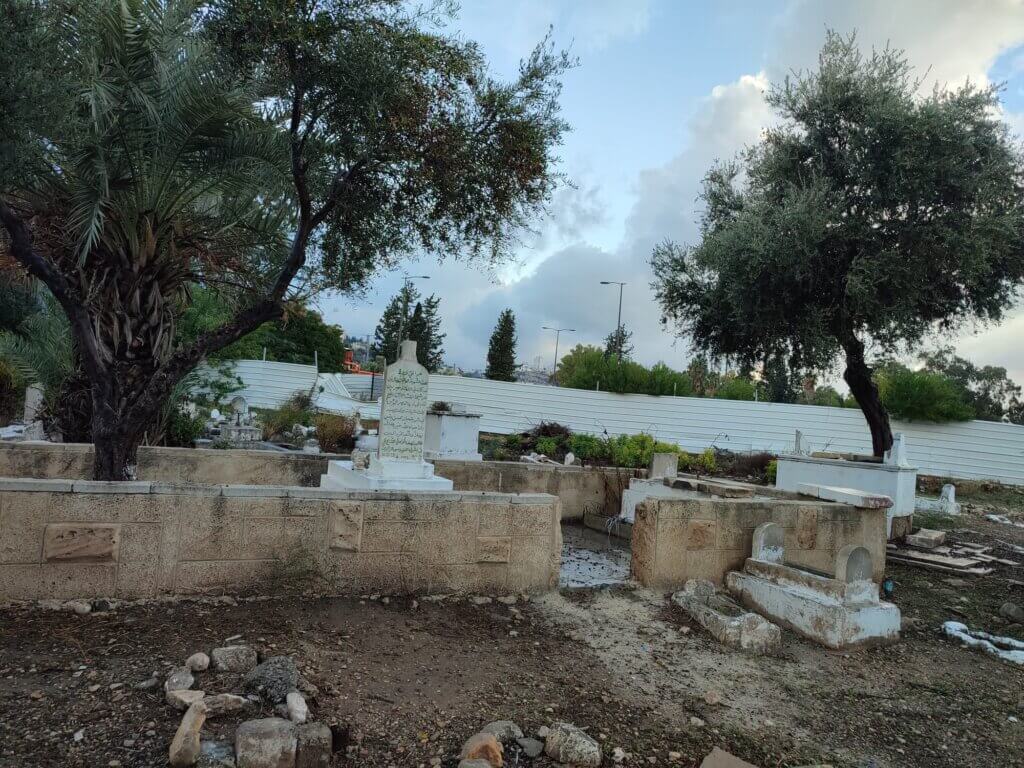
The Muslim cemetery in Balad a-Sheikh reminds us of the days before the 1948 Nakba, when Haifa was a major Palestinian city. Since 1948, the state of Israel and private companies have been trying to destroy the cemetery and convert it to commercial property. The Palestinian community succeeded, so far, to prevent its destruction. Now, facing new plans to build on the cemetery, the struggle is entering a new phase.
The Historic Significance of “Al-Qassam Cemetery”
In the beginning of the twentieth century Haifa was a rising city on the Mediterranean shore, with its port, new rail lines that stretched to Damascus and Amman, and developing industry and commerce. This development accelerated under the British occupation (since 1918) with a deep water port, an airport and the petrol refineries. People from all over the region were emigrating to Haifa to look for work and opportunities. Haifa developed as a center of Arab cultural and political activities. Many Palestinian trade unions, clubs, associations and parties were established or expanded in the city.
As the city was full of people, its old cemeteries became overcrowded. So, in the thirties, a new Muslim cemetery was established in Balad a-Sheikh, a few kilometers South-East of the city. It was a big cemetery, spanning over 44 dunam (dunam is a thousand square meters), and it served people from Haifa and the surrounding villages and shanty towns.
A central figure in Haifa’s public life at the time was Sheikh Izz ad-Din al-Qassam, the Imam of the Istiqlal mosque and head of the Young Men’s Muslim Association. In the beginning of the thirties, he tried to organized the Palestinian population to wage a war of liberation against the British occupation and against Zionist colonization. In November 1935 his group of rebels was surrounded by the British army near Jenin, and he fought them back until he fell martyr. His funeral in Haifa is described by some historians as the biggest political protest in Palestine under the British occupation. Al-Qassam and two of his comrades in arms were buried in the new cemetery in Balad a-Sheikh, giving it its popular name as “Al-Qassam Cemetery”.
The cemetery bears evidence to the turbulent historical period. You can find there the graves of the revolutionaries from the great Palestinian revolution of 1936-39, as well as the graves of Palestinians civilians killed by indiscriminate British reprisals. You can also find there the graves of the victims of massacres that were performed by the Zionist settlers’ militias, Hagana, Etzel and Lehi, in the run-up to the 1948 Nakba. Sami Taha, the secretary general of the Association of Arab Palestinian Workers, was also buried there.
Zionist attempts to take control of the cemetery
In 1948 the vast majority of the Arab Palestinian population in Haifa was expelled: more than seventy thousand were expelled, and less than two thousand succeeded to escape the ethnic cleansing. The whole population of Balad a-Sheikh, which suffered two massacres before the final military assault, was forced into exile, like the residents of all the other Arab villages and shanty towns around Haifa. The houses of Balad a-Sheikh were given to new Jewish immigrants and the town was renamed “Tel Hanan” (Hanan’s Hill) after the name of a Hagana officer who was killed there while performing a massacre against civilian population in the town.
Israel’s expropriation of the native Arab Palestinian population was not limited to their houses and personal property, but extended also to holy places like mosques and cemeteries.

In 1954, Israel’s then finance minister, Levi Eshkol, issued an order confiscating 15 dunam of the new Balad a-Sheikh cemetery. The order decreed that, as these lands “were not held by their rightful owners as of April 1, 1952”, and as they “were allocated to vital needs of settlement and development”, they will be passed to the ownership of “the development authority”. The only truthful phrase here is “April 1”, as this is the day for telling lies. The rightful inhabitants of the cemetery didn’t leave it for a single day. And the “needs” for the place were so urgent that today, almost 70 years on, the usurpers, which prevent the cemetery’s guardians from maintaining it properly, haven’t even presented a plan for any other usage.
Soon after confiscating the land, the state’s representative sold 13 dunam out of the confiscated land to a big commercial firm, named “Kerur Akhzakot”. Later on, this firm will play a central role in the attempts to demolish the cemetery.

Dubious deals
The main tool of the Israeli government to expropriate Arab homes and lands is the “Absentees’ Property Law” from 1950. By this law the property of hundreds of thousands of Palestinian refugees and internally displaced people was confiscated. Concerning the holy places, most of them are defined as belonging to some “waqf” (endowment). After some legal wriggling and a new law from 1965, the Israeli “legal” robbery system verified that “god is also an absentee” (or at least the Palestinian Muslim Waqf), and hence took control of most holy places.
The Balad a-Sheikh cemetery was different, as it officially belongs to a local Haifa Waqf named “Waqf al-Istiqlal” – or “Independence Waqf” – after The Istiqlal Mosque whose imam was al-Qassam. As there continued to exist a diminished Muslim community in Haifa, in spite of the Nakba, they could not claim its local waqf was absentee, like they did in hundred of villages and towns that were completely destroyed or ethnically cleansed. So, they had to invent other ways to take control of the cemetery’s land. They did it by appointing a “waqf trustee”, named Suhail Shukri, who was doing his master’s dirty work by betraying the waqf and its community.
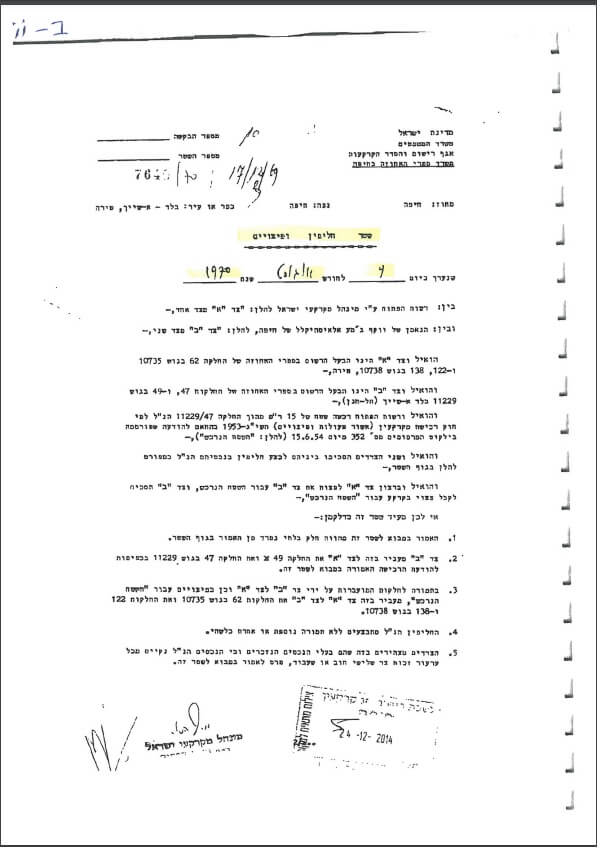
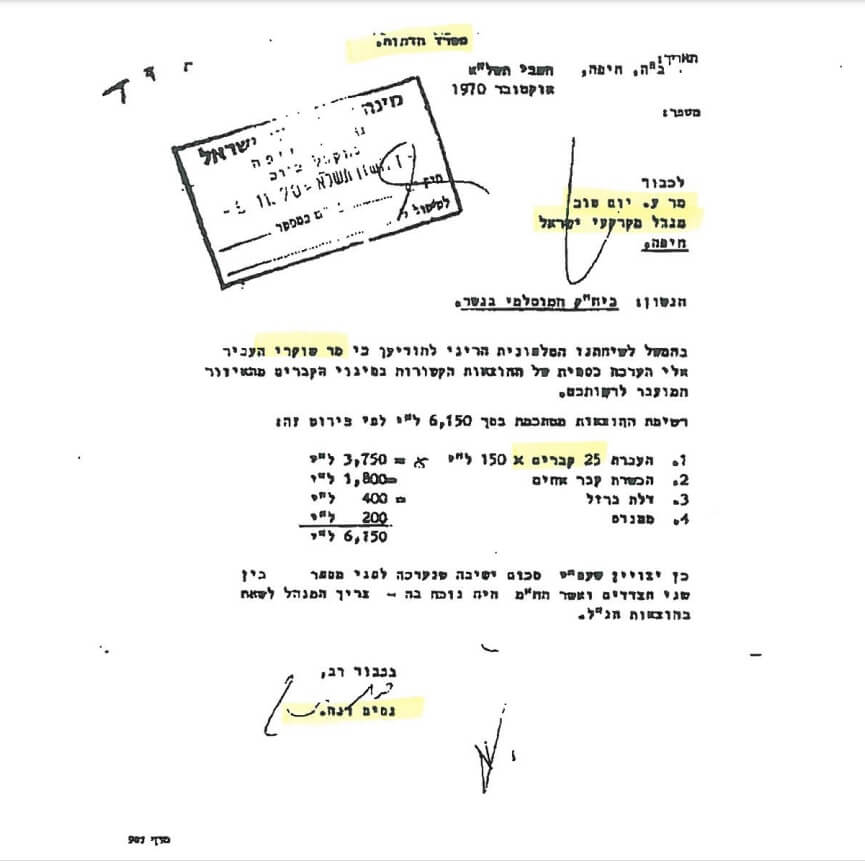
In 1970 the Israeli lands’ authority signed an agreement to “exchange” 31 dunam of the Balad a-Sheikh cemetery (including the 15 dunam that were confiscated before), giving the waqf in their stead a section for Muslim burial in the new Kafr Samir cemetery to the South-West of Haifa. The first question raised by this “exchange” is why should the Muslim community “pay” by giving up land in an existing cemetery for their right for a section in the new cemetery, while all other religious communities in Haifa received their (much bigger) sections free of charge?
The “exchange deal” itself was not signed by Shukri himself. The person that signed in Shukri’s name (in accordance with a power of attorney on behalf of Shukri from 1968) was one named “Oved Yom Tov”, who happened to negotiate the deal (with himself) in the name of the Israeli lands’ authority. The same Shukri also received the sum of 4,000 lira as payment for his effort to transfer 25 graves (an insignificant part of the graves in the cemetery) to the new cemetery – an action that he apparently didn’t bother to perform.
Shukri’s masters knew that, as a “trustee”, he is not empowered to sell, exchange or demolish the cemetery. In order to get more legal pretense to their dubious deal, they appealed for the Muslim Shari’a court in Akka (Acre), which is also subordinated to the state’s authority. The verdict from the court decreed that land from the cemetery can be exchanged, but only land that have no graves in it. The agreement between the authorities and Shukri to transfer graves from the cemetery proves that they knew well enough that the land contained graves, and, by implication, the endorsement of the Shari’a court to the agreement is void.

The struggle for recognition of the cemetery
After the “deal” about al-Qassam cemetery, and other similar dubious deals, were exposed, Shukri had to leave the country. After a long struggle by the Haifa Muslim community, new, faithful, trustees were appointed to take care of the “Istiqlal Waqf”, and they have taken on themselves to save what may be saved of the Waqf’s mosques, cemeteries and property. Meanwhile, Haifa is resuming gradually its natural role as a central city for the Arab Palestinian community. The struggle to save the al-Qassam cemetery is one of the major issues that unite the community in defending its rights and reconnecting with its pre-Nakba past.
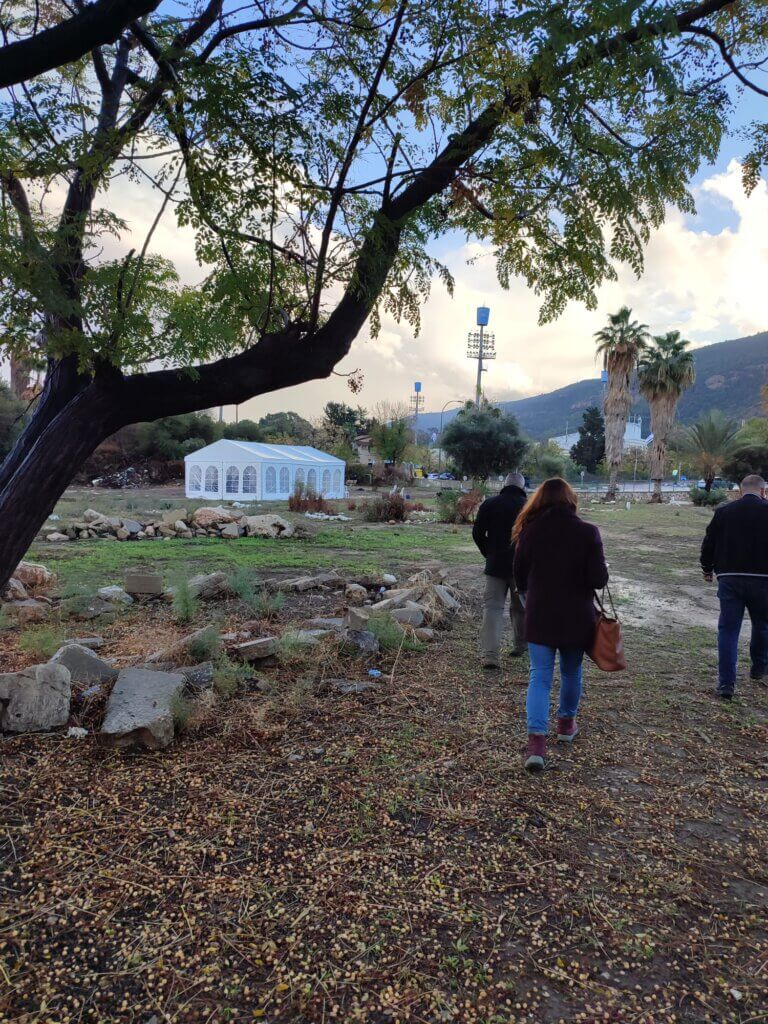
In 1989, the Abna al-Balad movement organized a volunteer work-day to clean the cemetery, which was hidden in a tangle of tall thorns, and for the re-marking of the graves. In the beginning of the 2000s, there was a big struggle against the intention to path a multi-lane street through the cemetery’s land. For several months there was a protest tent in the cemetery and local youth from the Islamic Movement stayed guarding the ground day and night. Finally, this struggle culminated in a symbolic victory, when a massive bridge was built to allow the street pass above the cemetery without affecting the graves.
In 2014, the “Kerur Akhzakot” company (which claims ownership of the 13 dunam confiscated in the fifties) filed a civil lawsuit in the Krayot magistrate’s court against the trustees of the “Istiqlal Waqf”. The company asked the court to declare that the plot on which it claims ownership has no graves. Alternatively, it sought to oblige the Waqf trustees to vacate any graves. The demand for the evacuation of the graves provoked public protest. Contact was made with many families whose loved ones are buried in the cemetery. At all court hearings there was a mass presence in the courtroom and there were demonstrations and protest vigils around the building, with participants carrying pictures of their buried family members. At the end of the hearings, Judge Shlomo Ardman ruled that there are graves in the plot that is the subject of the lawsuit. He refused to issue an order to evacuate the graves on the grounds that it is “too early at this stage”, until a specific construction plan is submitted that requires evacuation.

As the families of the buried organized, they decided to apply together to the Supreme Court to re-recognize the cemetery in its entirety. But in a preliminary hearing the Supreme Court judges proposed to the plaintiffs to withdraw their petition, while threatening them in a judgment that would have serious consequences to their detriment. Some of the plaintiffs concluded their impressions from the hearing by saying that “the judges refused to dig in old papers, and think it is better to dig even older graves.”
Meanwhile, news is gathering of new plans for commercial construction on the cemetery grounds and of a new developer entering the picture. In early December 2021, the Waqf trustees, in collaboration with the families of the buried and under the auspices of the High Follow Up Committee of the Arab Public, erected a protest tent in the cemetery’s area. The frustration with the “legal route” has brought back to the center the public struggle to repel the plans for expropriation and destruction. The demands are simple – recognize the cemetery and allow the dead to rest in peace.
Yoav Haifawi
Yoav Haifawi is an anti-Zionist activist and maintains the blogs Free Haifa and Free Haifa Extra.


“In 1948 the vast majority of the Arab Palestinian population in Haifa was expelled: more than seventy thousand were expelled, and less than two thousand succeeded to escape the ethnic cleansing.” – the details can be found in Ilan Pappe’s “The Ethnic Cleansing of Palestine”, which is available online: https://yplus.ps/wp-content/uploads/2021/01/Pappe-Ilan-The-Ethnic-Cleansing-of-Palestine.pdf
Page 85 –
From the morning after the UN Partition Resolution was adopted, the 75,000 Palestinians in the city
were subjected to a campaign of terror jointly instigated by the Irgun and the Hagana….the Jewish troops rolled barrels full of explosives, and huge steel balls, down into the Arab residential areas, and poured oil mixed with fuel down the roads, which they then ignited. The moment panic-stricken Palestinian residents came running out of their homes to try to extinguish these rivers of fire, they were sprayed by machine-gun fire. In areas where the two communities still interacted, the Hagana brought cars to Palestinian garages to be repaired, loaded with explosives and detonating devices, and so wreaked death and chaos. A special unit of the Hagana, Hashahar (‘Dawn’), made up of mistarvim – literally Hebrew for ‘becoming Arab’, that is Jews who disguised themselves as Palestinians – was behind this kind of assault.
Also, briefly for the record:
Israel did not hesitate to terrorize Palestinians it ruled. In October 1948, the residents of the Christian village of Ikret in western Galilee were removed for ‘security reasons’ for what was supposed to be only fifteen days. Still not permitted to return nearly two years later, they petitioned the courts and the verdict ordered the Israeli army to permit them to do so. ‘The army responded by destroying every house in the village, choosing Christmas Day 1951 for their action. Not even the church was spared: and, to add insult to injury, the church bell was removed to a nearby Jewish settlement and used, not to call people to prayer, but to announce the times for meals.’ (Hadawi, p. 154-55, Bitter Harvest)
On September 16, 1953, the inhabitants of the Christian village of Kafr Bir’im were expelled and it was subsequently destroyed. On Good Friday 1954, the Christian cemetery in Haifa was desecrated as 73 crosses were smashed and trampled on. ‘Since 1948, over 350 Christian churches and Moslem mosques have been destroyed.’ (Hadawi, p.155, Bitter Harvest)
No respect for the living. No respect for the dead. No respect for humanity. How despicable!!!
SHAME ON YOU, israel!!! You really believe that only YOUR pain is worth commiserating with??? One day you’ll pay a price for all this…