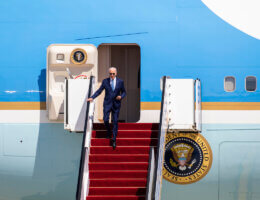
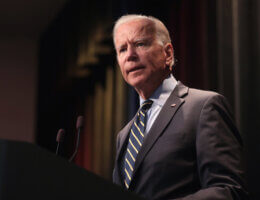
Why is Biden is telling Israeli leaders that the relationship with the U.S. is “bone-deep”? To please the Israel lobby back home, which has flexed its muscles in Michigan and Maryland, pouring millions into two Democratic primaries. Biden doesn’t want to alienate those donors. Even if Democratic voters don’t care. Ads in those primaries don’t even mention Israel!
Joe Biden is making his first presidential trip to the Middle East this week, with stops in Saudi Arabia and Israel (with only a quick visit to the occupied West Bank). The usual clouds hover and, in the case of Israel, the biggest is definitely Shireen Abu Akleh.
Lawyer and researcher Salah Hammouri appeals to French president Emmanuel Macron from inside Israel’s prisons: “Mr. President, what is the reason behind your double standard in the treatment of people living under oppression?”
Israeli mailing restrictions in Gaza have resulted in an effective book ban for two million Palestinians.
Even as several U.S. senators press Joe Biden to address Israel’s killing of Palestinian-American journalist Shireen Abu Akleh in May on his trip to Israel, experts at an Israel lobby organization say the matter is a “domestic issue” in the United States and not an issue for Israel. While Neri Zilber, an Israeli journalist, laments that Palestinians will hold up photos of Abu Akleh in demonstrations– “not a terribly helpful visual.”
After a year of battling for justice for her husband, Jihan Banat and her four children have found neither justice nor solace, and the Palestinian public has been left without answers.
Expect Biden to parrot conservative pro-Israel writers in the New York Times who hail the lately-fallen Israeli government as a model for the United States in its inclusion of an Arab party. Shmuel Rosner calls it “thrilling.” Too bad that NPR also salutes the “hell of an experiment.” All these positive reviews leave out Israeli apartheid.
New evidence reveals that US plans to build an embassy in Jerusalem would place the diplomatic compound on privately-owned Palestinian land that was confiscated from its owners by Israel, following the Nakba and the establishment of the state in 1948.
Polling by Huwaida Arraf, a Democratic House candidate in Michigan, shows that her position of cutting off aid to Israel is not unpopular. “Palestine is a political positive…Attitudes toward military aid to Israel undermine claims by AIPAC that strong support for Israel is ‘good politics… [S]ix in ten (60%) voters under 45 want aid to Israel reduced or ended,” a memo to donors asserts.