
For years, the once and possibly future Prime Minister of Israel, Benjamin Netanyahu, pursued a strategy of focusing on the right wing in Israel, around the world, and in the global Jewish community. His deep ties to the Republican party in the U.S. and his cozy relationship with figures as far right as Viktor Orban in Hungary led him to abandon Israel’s traditional strategy of maintaining broad support across the political spectrum.
So when Yair Lapid took power, Mainstream Democrats, who were desperately trying to maintain their lock-step and uncritical support for Israel even while the apartheid nature of Israel’s regime was becoming ever more apparent, were energized. They now no longer had to contend with an Israeli leader trying to undermine them domestically and it is no coincidence that, since Lapid ascended to power, the pro-Israel right wing of the Democratic Party has become increasingly assertive and groups like AIPAC have redoubled efforts to purge the party of pro-Israel liberals such as Andy Levin and discredit more vocal critics such as Rashida Tlaib and Bernie Sanders.
This dynamic has also inspired pro-Israel “liberals” to redouble their efforts to combat anti-Zionism in the Jewish community. One such effort is taking place in New York City, at the Stephen Wise Free Synagogue. There, Rabbi Ammiel Hirsch has launched a program called “Amplify Israel.” Here’s how their web site describes the program: “As American liberalism has become increasingly hostile to Jewish values and as anti-Israel animosity intensifies, Stephen Wise Free Synagogue has created an education and advocacy initiative aimed at healing the fractured relationship between American liberal Jews and Israel.”
That description alone betrays a distorted view of why Israel’s image among American liberals has taken such a hit. It is certainly not the case that American liberalism has changed; it remains resistant to fundamental change, as is evidenced by its rush to elect Joe Biden, a man who promised that nothing would fundamentally change under his watch after the radical lurch rightward represented by Donald Trump.
No, what has changed is that Israel has become so brazen about its apartheid policies that more people realize how it maintains its iron-fisted control over millions of Palestinians, how it has dispossessed them for over 74 years, and how it has denied them the most basic rights for the past 55 years. More American liberals have seen the rampaging settlers, the violent soldiers, the closures, the killings of journalists and children, the strangulation of Gaza, and the many other crimes of Israeli apartheid. For all of Israel’s charges of antisemitism, there are many liberal Americans, and specifically American Jews, who know that Amnesty International, Human Rights Watch, and B’Tselem are not antisemitic, and when they find out that those groups are confirming what Palestinians have been saying for decades, are finding supporting such a regime impossible to reconcile with their values.
Hirsch understands this. He told The Times of Israel, “The [Reform Jewish] movement is drifting in terms of how it speaks, what it speaks about, what it says and avoids saying. It’s drifting from the centrality of the Jewish people and our Zionist principles. Were that to happen it would be catastrophic.”
There’s a great deal to unpack in those words.
First, Hirsch is, understandably, overstating the case. Support for Israel, despite its apartheid policies, remains high among Reform Jews. 58% of Reform Jews say they are emotionally attached to Israel, which is exactly the same percentage as among Jews overall, according to a 2021 Pew Research poll. Another Reform and passionately pro-Israel rabbi, Rick Jacobs, said of the poll, “I believe the big takeaway is that liberal Jews don’t care less but rather care differently about Israel…”
By contrast to Hirsch, Jacobs is understating the reality; it’s certainly true that 58% represents a significant decline from the past. A 2016 poll of Reform Jews showed about 70% expressed an attachment to Israel, so there has been a notable decline in a relatively short time, even granting that these polls can be fuzzy.
But the issue of the “centrality of the Jewish people and our Zionist principles” is a stark example of historical revisionism. The dynamic of mythology distorting history and projecting a nationalist interpretation of a group’s history back to the earliest days of that people is typical of nationalism, not at all unique to Zionism. But that historical revisionism has been a powerful force, in Jewish perceptions of our own history, and in the politics of Zionism as a force among Jews and against Palestinians.
Zionism is a modern, nationalist movement, one that quickly took on a settler-colonial character. It is not an ancient tenet of Judaism, something that is clear from any reading of Jewish history before World War II and from the fact that Zionists were a distinct minority among Jews before the Holocaust. This is a fact that is well known, most recently recounted again by Zachary Lockman, professor of Middle East Studies and History at New York University.
Indeed, even the constitution, in the late 19th and early 20th centuries, of Jews as a modern nation didn’t depend on Zionism. Other Jewish nationalists, who did not tie their sense of Jewish nationhood to Palestine, were largely wiped out by the Nazis, such as the General Union of Jewish Workers, referred to often as The Bund, a class conscious, egalitarian, socialist Jewish movement that was quite popular among Eastern European Jews. Zionism has largely smothered the memory of the Bund and other, smaller, Jewish collective movements that were not interested in dispossessing another people and taking their land.
Rabbi Tracy Kaplowitz is heading up the effort to actualize the Amplify Israel program, and she makes little effort to hide the McCarthyist agenda at the root of it. “The purpose is to ensure that our teens, long before they head off to college, have the language that they need to understand Israel,” Kaplowitz told The Times of Israel. “They can assess what they hear about Israel or even the ability to advocate and to say, ‘The way you’re presenting Israel to me seems inaccurate, it’s maybe bordering the line of antisemitism.’”
It’s not hard to imagine what Kaplowitz means by “understanding Israel.” Given the ongoing and increasingly hostile debates on college campuses, this is about equipping new students with the requisite talking points on Israel. But more important is the clear intention to steer them toward specious and false accusations of antisemitism. As has been frequently noted, it’s really all Israel advocates have left.
The effort to turn the tide on liberal support for Israel is getting increasingly desperate, especially now that it appears more likely than not that Netanyahu will be returning as Israel’s prime minister in the upcoming election. We’ve seen the large-scale, public efforts directed against politicians like Rashida Tlaib and media personalities like Katie Halper. We’re likely to see more localized efforts like Amplify Israel as well.
But Hirsch himself ultimately explains the futility of the effort. “Zionism is a liberal movement. It’s about the self-determination of an oppressed people,” he claims. “Liberals support self-determination and freedom and liberty…We support coexistence. We do not support, when two peoples are in conflict, dismantling one of them. That is not liberal, that’s reactionary.”
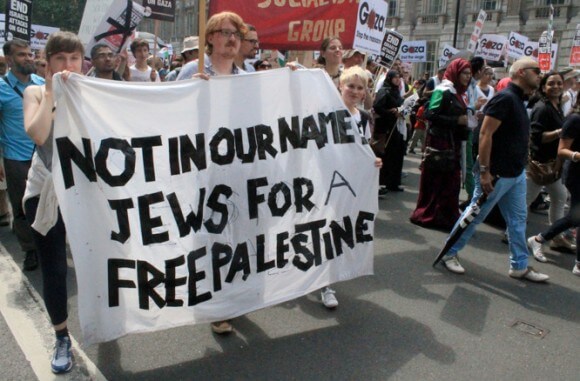
It’s this formulation—one that tries to paint support for apartheid as liberal by omitting the massive crimes committed historically and on an ongoing basis against the Palestinians, individually and collectively—that explains why liberal Jews are joining their more radical fellows in opposing Israeli apartheid.
Because Zionism is not a liberal movement. While a small minority of its earliest thinkers—none of whom supported Political Zionism—might not have wanted to see the imposition of a Jewish state that dispossessed, displaced, and discriminated against the existing Palestinian population, that has never been Zionism’s political expression. It was intentionally designed to replace that Palestinian population.
It’s easy to say you support “coexistence” when the form and function of that coexistence dictates that your group holds a superior position, whether through elevation by law, enforced and manipulated demographics, or, in this case, both.
The movement for Palestinian rights, which by definition must point out not only Israel’s crimes but the apartheid nature of the state that makes such crimes inevitable, demands equal rights for all. Hirsch defines that as “dismantling” not just Israel but Jews as a nation. That, my dear rabbi, is reactionary and deeply illiberal, not a call for equality.

Great article summed up by this:
“As American liberalism has become increasingly hostile to Jewish values and as anti-Israel animosity intensifies, Stephen Wise Free Synagogue has created an education and advocacy initiative aimed at healing the fractured relationship between American liberal Jews and Israel.”
No, what has changed is that Israel has become so brazen about its apartheid policies that more people realize how it maintains its iron-fisted control over millions of Palestinians, how it has dispossessed them for over 74 years, and how it has denied them the most basic rights for the past 55 years. More American liberals have seen the rampaging settlers, the violent soldiers, the closures, the killings of journalists and children, the strangulation of Gaza, and the many other crimes of Israeli apartheid.