I consider these words with caution, I write them with intention, I borrow the stories, I expound where necessary. I write earnestly and I launch from the recognition that all my knowledge is out-weighted by my ignorance. What I do as a journalist is share knowledge from the personal and intimate spaces I access while providing information about the larger relations they pose locally or globally.
It’s distressing to be a journalist in Palestine. It is not merely the ugly nature of the realities we cover, but the size and frequency in which the same violence is enacted. We find ourselves searching for the words to accurately depict reality.
It is already a challenge to search and find the vocabulary which can describe the grief of losing a child, brother, sister, friend. It becomes a burden to find the words, visuals, images to describe the grief of a population losing their loved ones in such an ugly way, over and again. Not only the death, but the mutilation of bodies, the withholding of slain corpses, the mass imprisonment of men and boys, the denial of water services for days, the settlers charging closer with new homes that were once trailers, now villas reaching the hilltops of Ramallah.
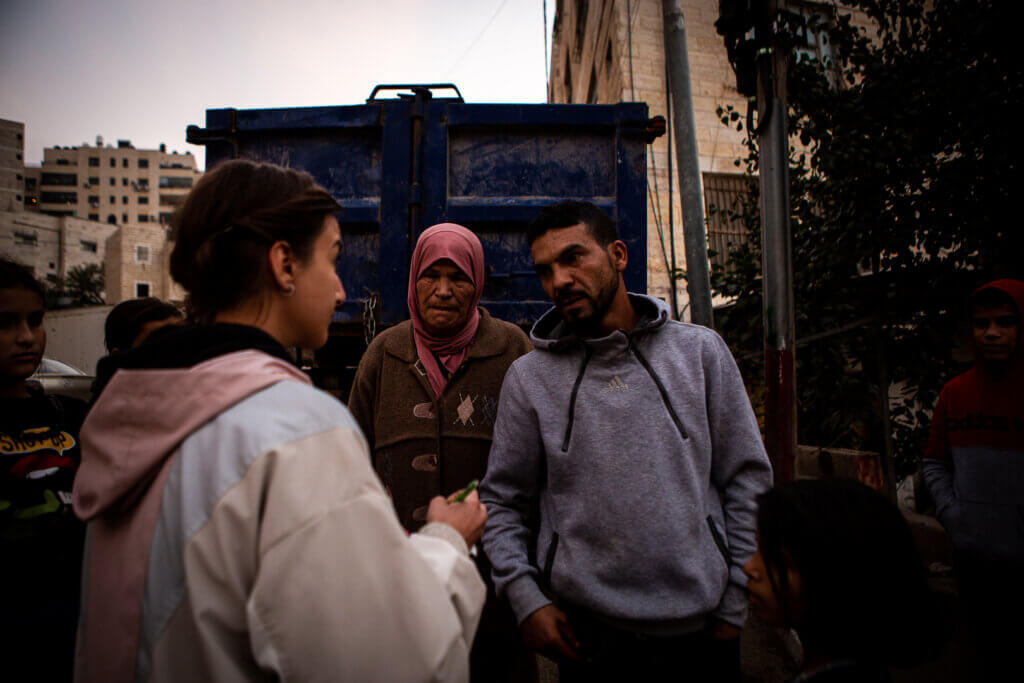
In formal Arabic, the city of Ramallah is pronounced Ramu- Allah which means “the hills of God,” each hilltop seems to be a new or expanding old settlement. The reports I carve are not the facts and truths I outline in essays. They are the product of conversations with the security guards on the night shift, the coffee shop workers, the taxi drivers, the friends and family members I see, and the fact I am Palestinian covering Palestine.
There is an ebb and flow between hearing the stories, being on the ground reporting on the developments of war, and being a part of this reality at the same time. No certainty of what can be found, no real safety, and a looming feeling of endlessness.
We wake up preparing to cover the story of whomever misfortunate Palestinian was the target of Israeli soldiers or settlers. The number of deaths seems endless. The list of overnight arrests seems endless. The detainee lines seem endless. I wondered how many interrogators Israel has hired, the sheer work that must be needed for that amount of Palestinians being detained. Last year, there were an average of 15-20 arrests per day. In the first two days of the new year, 36 Palestinians were arrested across the West Bank.
To allow these numbers the chance at exposing the extent of abuses happening in Palestine, requires an exploration of every number at its intimate level. The names, the homes, the children that are not yet capable of conjuring the language to explain the horrors they witness.
The stories we cover are the stories of the survivors that must recall the tragedies, in hopes that one day, the story will be written differently not because we managed to carve the accurate words to finally capture what it means to experience this reality, but because it is different.