

STRANGER IN MY OWN LAND
Palestine, Israel and One Family’s Story of Home
by Fida Jiryis
392 pp., Hurst (2022), $29.95
I am an agemate of Sabri, father of our author, Fida Jiryis. His name is connected in my mind to an ancient oak tree. This is not only an allegory. The oak is still there on the way from my hometown of Arrabeh (of Land Day fame) to Wadi Sallameh, the site of Thahir el-Omar el-Zidani’s earliest claim to fame as per local legend.

That oak tree is one of the things I remember from reading Sabri Jiryis’s classic Palestinian resistance volume, The Arabs in Israel, when it first came out in 1966. The book brought Sabri fame and political prominence even before he self-exiled to Beirut and the Palestine Liberation Organization (PLO), where he became a close advisor to Arafat and headed the Palestine Research Center.
The oak owes its claim to fame to the Israeli military governor of the region who had issued a house arrest order of a Mr. Dilky, the head of a refugee family, the said house being the oak in whose shade the family had sheltered. That military governor’s concern was based on his conception of the propensity of his Palestinian subjects to do harm to the state, with little concern for the betterment of their living conditions.
By and large, we the Palestinian citizens of Israel still suffer from the same attitude of Israel’s central authorities.
Zionism is colonialism
Now that I have established my own credentials vis-à-vis Sabri, let me turn to Fida’s book: in a concise introduction, the author gives a skeletal sketch of the settler colonial nature of the Zionist enterprise as a search by European powers to solve Europe’s own problem of anti-Semitism — by dumping it outside of Europe, hence the commitment of Europe and America to supporting the establishment of a Jewish national home in Palestine, with all that it entails in terms of tearing Palestine apart through intentional forced exile and the physical demolition of Palestinian communities in step with Israel’s infamous “Plan-D.”
This was done with the Zionist leaders fully knowing the falsehood of claims to the contrary. Witness testimonials like the following:
When we come to take over the land, the question immediately arises: what will the Arab peasant do? … The Arab, like any man, has a strong bond with his homeland … I can still hear the dirge of the Arab women on the day their families left their village of Ja’una, today Rosh Pina, to settle in Hawran, east of the Jordan. The men rode asses and the women walked behind them, bitterly weeping, and the valley was filled with their keening. From time to time they would stop to kiss the stones and the earth … We must not uproot people from land to which they and their forefathers dedicated their best efforts and toil.
Fida Jiryis, Stranger in My Own Land, p. 120
But Plan-D was largely implemented, and the Nakba goes on, cumulatively, to this day.
Next, we are in the presence of Fida’s paternal great-grandfather as he offers what food the family has stored to refugees from Tarshiha on their forced expulsion to Lebanon. Little comment is offered, but we are made partners to young Sabri in his deep outrage at the injustice of it all, especially with his expectation, and that of the others in his village of Fassouta, and other Galilee villages, of their exile.
But, miraculously, Fassouta remains, and the reader is slowly but surely exposed to its traditional ways and its residents’ lives.
Fida’s account focuses on her father’s multigenerational family, and later on the family of her mother. One gets an intimate account of the extended family’s lifestyle, first of the male-dominated family of Sabri’s, and then of her mother’s struggling family after the loss of her grandfather.
Without much fanfare, the maternal grandmother heroically raises six children and supports the oldest daughter, Fida’s mother, through university. Then we see Sabri practicing law in Israel. He dabbles in leftist party politics and in the establishment of the al-Ard (The Land) movement with its Nasserite, pan-Arab nationalism, an activity that marks its participants in Israel’s eyes for persecution and imprisonment.
Early life in exile
Sabri marries a fellow villager who is also a university graduate, and the two self-exile to join the PLO in Beirut, where he becomes a close adviser to Arafat and heads the Palestine Research Center. His wife, Hanneh, also works at the Center.
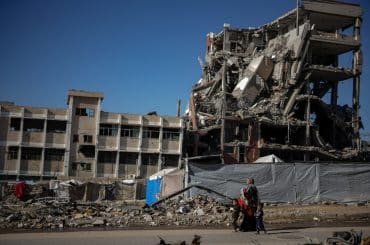
Fida’s narrative then turns dark, with all the violence that Lebanon and the Palestinian refugees living there suffer, culminating with Israel’s invasion of southern Lebanon and Beirut in 1982. Then there is the unspeakable violence of Sabra and Shatila. A car with a massive amount of explosives is detonated outside the Research Center and Hanneh is killed in the event.
Sabri and his two children, Fida and Mousa, move to Cyprus, where the Palestine Research Center is reestablished. Sabri’s life continues to revolve around the Center, whose archives, seized by Israel in Lebanon, are returned to the PLO as part of a prisoners’ exchange deal. He marries Hanneh’s sister, who takes to the two children as her own, and a stable family life is regained, with the children attending school, and upon graduation, continuing on to higher education in England.
Fida’ reflects on her time in Cyprus, which “was generous in its food, produce, and the warmth of its people. They were simple and open-hearted, with culture and traditions very similar to ours. My father joked that they were Arabs who spoke Greek.” (pp. 397)
Yet, the scar from Fida’s childhood years in Beirut “ran too deep,” as she admits:
In my third year at school, someone pointed out two Palestinian children, a brother and sister. I had seen them before; they were in other classes. The first thing that anyone noticed was a haunted look on their faces, a seemingly deep sorrow that did not shift. Even when they smiled, their eyes only lit up for a second before the sadness returned. They had survived the Sabra and Shatila massacres three years before. The little boy had hidden in the bathroom and covered his younger sister’s eyes while their family was being slaughtered. Somehow, the attackers did not see them. The children stayed there for hours until the massacre was over and the first journalists were allowed in. A British photographer chanced upon them, crying and shaking, still holding each other in the bathroom. He decided to adopt them. He brought them to Cyprus and enrolled them at our school, and I saw him, sometimes, coming to coach the football club, saw the warmth of their relationship with him. I never approached these children or talked to them; the scars ran too deep, for all of us.
Fida Jiryis, Stranger in My Own Land, p. 400
At the same time, Sabri did his utmost for his two children to maintain their Palestinian Arab identity with private classes, books, music records, and frequent phone calls home to Fassouta.
“We were crying for Palestine, for a scattered people, for a terrible situation we could not change.”
Fida Jiryis, Stranger in My Own Land, p. 408
“The feeling was growing stronger in my heart that we belonged elsewhere, that our life abroad was temporary until we could go home,” Fida’ recalls. (p. 402)
Reading Arabic Literature — especially Palestinian literature — listening to Arabic songs and music, wearing Palestinian dresses, and dancing Dabke, Fida kept at it all till she graduated and went to study computer science in England. There she made Palestinian friends, some from Ramallah, and when they parted, “we held each other, and, before we knew it, we broke into heavy sobs. It was much more than the sorrow of parting. I felt we were crying for Palestine, for a scattered people, for a terrible situation we could not change.” (p. 408).
Return to a strange land
Yet, a miracle, even if psychologically doubtable, did happen: in the wake of the Oslo Accords, Fida, her father and brother were allowed back to Fassouta, their village in Galilee, as Israeli citizens.
The whole village, if not the entire community of Palestinian citizens of Israel, celebrated their return:
It went on for three days as people came from near and far. … On the fourth day, [Sabri] woke up, washed, and went out. For three hours, he walked around the village. It had grown in ways he barely recognized. New roads and houses had sprung up in places that he remembered as fields. On his way, he bumped into people who knew him. They rushed to greet him and invite him in, but he continued walking, taking stock of everything.
Fida Jiryis, Stranger in My Own Land, p. 420
Fida tries her best to fit into “her” Palestinian village. She finds work in Israeli hi-tech companies, makes superficial acquaintances with fellow Israeli workers, and opts out of one job after another.
Then, Fida marries a first cousin from Fassouta. She finds another job in an Israeli firm, this time in Karmiel, in the north. Quickly, she starts sounding like the rest of us Palestinian citizens of Israel:
Most of the state’s budget for infrastructure and economic development went to Jewish communities. We had no business initiatives, and no industry or factories. Many of our local councils were insolvent, and most had to raise their own funds to install basic infrastructure such as water and sewage systems. More than half of Palestinians in Israel lived below the poverty line. In my village, most families made about half the earnings of an average Jewish family, and some breadwinners supported five or six people on the equivalent of 800 dollars a month, barely enough for one. Our communities had a lower life expectancy and a higher number of people suffering from stress-related diseases such as diabetes and hypertension. To add insult to injury, the Hebrew term ‘avoda aravit’, Arab work, was commonly used to denote work of poor or slapdash quality—despite the sad irony that most of the State of Israel was built by Palestinian hands.
Fida Jiryis, Stranger in My Own Land, p. 464
This is the tone of local Arabic weeklies in Israel. But in fact, this speaks of our never-ending Nakba, our catastrophe, a term appropriate even for us who stayed put in our villages, and, even worse, for the few returned Palestinians like Fida who had experienced exiled life:
At work, while walking outside at lunch breaks, I stopped and looked over the horizon, thinking of them [the Palestinian refugees]. They were barely an hour away. It was only through a fluke of fate, I realized, that I was not in some refugee camp with them. When I went back to the office, I had to silence these thoughts. There, I was just an employee in a software company, with projects, deadlines, and internal politics. There was an impenetrable wall between me and my colleagues. They had their homes, their jobs, their lives; few stopped to think of where the land that they lived or worked on had come from. It was this jarring sensation, of being in a huge graveyard while everyone else ignored the tombstones, that began to eat away at me, and that would eventually break my sad attempt to integrate.
Fida Jiryis, Stranger in My Own Land, p. 481
And again:
For a while, I seemed to fit in. There was something warm and cozy about strolling down the road for coffee with an aunt, being invited into homes, chatting with a cousin at the grocery store. I still felt people’s looks of curiosity, heard them asking each other who I was, nodding and dissecting me with their eyes. Rania visited me when she came to see her parents in the village. I became close to another cousin, as well, and to a neighbor, who was from Mi’ilya and had married in Fassouta. But I felt like a lone ship at sea. Hebrew was everywhere, including, to my dismay, in our dialect.
Our identity was a warped mutation between Palestinian and Israeli; we were a minority struggling to survive, while trying to hold on to its own fabric. I noticed that we referred to Israel as ‘al-blad’, in Arabic—the country. We could not say ‘Palestine’, but, often, we avoided saying ‘Israel’, too. There were no links to the Arab world; they had been cut off by decades of prohibition. I struggled to understand this community and to fit in.
Fida Jiryis, Stranger in My Own Land, p. 488
Then, the events of the second intifada unfold: Arafat is blockaded at his headquarters in Ramallah; Israel surrounds Palestinian fighters, even at the Church of the Nativity, in Bethlehem; the number of victims on both sides, especially among Palestinians, rises sharply; Israel decides to surround the West Bank with a separation wall. Fida, the only Palestinian at her workplace, feels more estranged than ever, with the few colleagues whom she had befriended becoming distant or even critical of her identity and behavior. It all brings her alienation to a boiling point. Summing it up, she declares: “What had first seemed like a miracle had turned out to be a nightmare. In eight years in Israel, I had never felt happy, nor free.” (p. 528).
She and her husband emigrate to Canada. They obtain Canadian citizenship but still return to Israel. They then divorce, and Fida moves to Ramallah, where she flourishes as a writer, first of three Arabic-language collections of short stories, and now of a historical memoir, in English, of her and her family. But, in fact, the account is one of Palestine’s ongoing Nakba, our catastrophe.
Please pardon this rushed summing up, for I am in a hurry to share my conclusion and clinical best guess: I am a physician and I used to be a pretty damned good diagnostician, for I practiced for several decades “in the wild,” relying on my stethoscope and five senses. Let me guess, from this distance (I am currently in Honolulu): I am certain Fida has a case of Post-Traumatic Stress Disorder (PTSD). This is not surprising at all. A study of Palestinian children in Gaza in 2003 found that 98% suffered moderate to severe levels of PTSD. Yet, I sense that Fida is doing well because she has hit upon Bibliotherapy. Way to go, Fida Jiryis, my friend!
Please note: the page numbers of the quotes refer to the Kindle version and not to the hard copy. Apologies!