

A version of this article first appeared in 7iber in Arabic on May 16, and was translated into English by Dalia Taha. It is published by Mondoweiss with permission.
Walid Daqqah, a Palestinian political prisoner from the village of Baqa al-Gharbiya in occupied Palestine, has been deprived of his freedom for 37 years. Walid’s sentence was due to end this spring, on March 24, 2023, but in 2018 the Israeli government vindictively extended the sentence by two years. During this time he was diagnosed with bone marrow cancer.
In the following account, Walid’s brave wife Sana’ Salameh bears witness to their battles during nearly four decades of incarceration. During these years, their family fought relentlessly for all the things that we otherwise take for granted, in and out of Israeli courts; the right to be married, the right to conceive a child, the right of a father to hold his daughter — and finally, the right to life itself. To this day, Walid, Sana’, and their daughter Milad continue to struggle together for Walid’s right to life and freedom. This is their story.
Free Walid Daqqah campaign
Walid was arrested on March 25, 1986, and has, as of the time of writing, lived 37 years in prison. He is one of the oldest political prisoners in Palestine.
Walid completed a Bachelor’s degree and a Master’s degree in prison. Like other prisoners, his spirit during years of imprisonment has not flagged. Our prisoners have transformed Israeli jails into universities and schools; into places where the praxis of our resistance is conceived and the human spirit is nourished. There is no better example of this creative defiance than Walid, because he is a writer, a novelist, and a formidable fighter. In all of his battles against the prison authorities, he got the upper hand, prevailing in all of them.
“Parallel Time,” the name of a play that Walid wrote in prison, is also a concept in his writings that has proven inspirational to many writers and students. “Parallel Time” was performed in Al Midan theater in Haifa in 2016, after which the theater was shut down by the Israeli government, because this regime cannot allow our prisoners to speak. After Al Midan was shut down, the Israeli media launched a vicious smear campaign against Walid. Walid also wrote a wonderful children’s story called The Tale of the Oil’s Secret, for which he was punished by the prison administration. He was denied family visitations, they fined him, and he was put in solitary confinement, in the most inhumane conditions. Finally he was charged with smuggling mobile phones into the prison.
Walid finished serving his original sentence of 37 years on March 24, 2023, just a few weeks ago, and he was now supposed to be free among us. But to punish him for this supposedly heinous crime the Israeli authorities added two additional years to his sentence in 2018. In other similar cases, such offenses were punished with a few days of solitary confinement. In Walid’s case they added two years. During these two years he was diagnosed with cancer.
The last case that pushed the Occupation Authorities and Prison Services to target Walid and incite against him was the birth of our daughter, Milad. Milad was born by means of liberated sperm, smuggled out of the prison. Because we became a mother and a father in spite of the occupation authorities, Walid and I became targets of their vindictiveness.
Walid is from Baqqa al-Gharbiya, which is an Arab village inside Israel, and I live in Yaffa. We both hold Israeli citizenship. This citizenship gives us the right to a conjugal visit. We fought in the courts for 12 years to have this right recognized, but they refused us. So we decided that our son or daughter should come into the world despite them. We would not ask for their permission. Milad came into the world on February 3, 2020. Thereafter Walid was subject to their endless punishments and reprisals, which continue to this date. We believe that there are people in the Prison Services who work tirelessly to ensure that Walid never leaves prison standing on his legs. They attempt to assassinate him by slow and gradual means, because he defied them for all those years. I really hope that Walid defies them and his illness and emerges victorious in his last battle.
Meeting Walid
I come from a political family. My father was a political prisoner in the 70s and 80s, but for short periods of time. Perhaps it was this life that brought me to the issue of prisoners. In the 1990s I was volunteering in a “prisoner’s supporters” association, which works to help political prisoners and address their needs. I was writing about the prisoners and someone suggested that I ask the prisoners themselves to report on their news. So they gave me Walid’s name and the names of others.
I visited Walid in prison in 1996 because I felt that I heard his name before, that I knew this person. I asked him on that day. What can we do for you? What do you need? Walid gave me a list of things to do for the prisoners and told me about their situation. The list of things to do has only continued to grow ever since. It never grows shorter. There are thousands of prisoners and thousands of things to do, big and small. Walid and I worked together.
After some years, this relationship became a romantic relationship, and we got married. We held a small wedding in Ashkelon Prison on August 10, 1999. It may seem strange that they gave us the right to have it at all. We were a bit lucky that it happened before the Second Intifada, which completely changed this politically. We put pressure on them, and were supported by Arab politicians in Israel. In the end we got all that we needed for our wedding day. Like any married couple we wanted to have a child. We fought in the courts for many years to have this right recognized. But in the end we managed in spite of them and in spite of everything. Through this long life that I shared with him, Walid was always strong and hopeful.

One of the essays that Walid wrote is called “Dissolving Consciousness.” It is necessary reading for anyone who wants to understand the reality of the prisoners movement and the reality of political life in Palestine. Walid wrote it after the prisoners hunger strike of 2004, which had tragic consequences for the prisoners — it rolled back many of the incremental gains made by the movement, bringing them back to zero.
You also learn about Walid himself in this essay — what kind of person he is. His vitality, generosity, intelligence, and strength. Really, he is an exceptional person. And they kept fighting him. Even in his illness they fight him. We haven’t been able to see him since he underwent the last surgery, which lasted for more than 5 hours. It is a very sensitive and difficult surgery. Before the surgery they let me and Milad see Walid for 10 minutes, while his legs and hands were chained. When he was first transferred to the hospital I went there but they didn’t let me see him. They didn’t even allow me to wave at him from afar. He is now in a very critical and difficult situation, and we are not allowed to be with him in these difficult moments. For them even the smallest things, the smallest human moments, become opportunities to persecute us.
The birth of Milad
Milad was conceived after many years of trying. Immediately after she was born they began another round of punishment and harassment. First the Ministry of Interior refused to register her under the name of her father. Then they refused her the right to visit her father.
Milad is the first child for whom the Israeli Intelligence Services (Shabak) opened a file before she was born.
Walid first saw his daughter a year and a half after her birth. We had to fight in the Israeli courts, and against the Ministry of Interior, for Milad’s papers and rights. It should be known that Milad is the first child for whom the Israeli Intelligence Services (Shabak) opened a file before she was born, and it should be known that the Israeli Intelligence Services warned against the birth of Milad during one of the court’s sessions.
This is a paranoid and racist regime. Walid wrote a wonderful text at the time, in the voice of his daughter, before her arrival into this world, offering a disquisition on her right to live. He wrote: “I’m not scared of this government and its hubris. Not because I’m fearless, nor because I have faith that the preciousness of childhood will be recognized — as you will learn, this racist government has never had any concern for childhood — but simply because I stand above them, ethically speaking, as someone possessed of a right, the right of even the simplest of creatures, which is the right to live. They make death, and I’m the product of life. And here I ask you, what is insanity? Is it insanity that a child of my age speaks? Or that the Shabak has opened a file on her even before she is born?”
I learned during my life with Walid that there is no such thing as boredom. Because you are always busy fighting for the simplest of things, the simplest of rights. Walid saw Milad for the first time after a year and a half. We wrested the right for him to see her by fighting the courts. We went through a DNA test. We understood from the beginning that we had to battle this prerogative that they thought they had…the prerogative to ask: who is this girl? How come she is his daughter?
When Milad met Walid
I cannot describe with words the day that Milad first visited her father. All the prisoners were there in the visitation room because they wanted to see Milad when she met her father. Walid asked that Milad enter the visitation room walking, not carried by me. He said “I want to see the whole of her. Let her walk into the room. I will be standing between two prisoners. Ask her, where is Baba, and I want her to point at me.” Walid wanted to feel that Milad recognized him. I followed Walid’s instructions. Milad entered the room walking. But the one who was not standing on his legs, the one who was crying, was Walid. All the prisoners cried. Words can’t describe this moment.

These days when Milad visits her father nothing stands between them. We imposed this on them. All visits are usually mediated by a glass barrier. But a few months ago, an exception was made for Milad. It meant that her father could for the first time touch her, kiss her, smell her. Of course I’m not allowed to do this. This meant that Milad had to enter by herself, and when the prison guard came to bring her inside, I told him not to touch her, not to carry her. I said, “she’ll walk by herself.” In truth, I didn’t want the prison guard to carry her before her father. When they opened the iron door it made a very loud sound. Even adults are terrified by this sound, so imagine a child. Milad was scared but she entered. She stayed only one minute even though she was allowed 15 minutes. Once inside she saw that I was the one behind the glass barrier and started crying. Her father was happy with his one minute with her and brought her back to me.
Describing that day Walid said: “Today I experienced what it felt like for the prisoners who dug a tunnel out of the prison, stepped out into the light, and were then caught. It was a moment of freedom, a freedom with Milad.” As I have said, words can’t describe these days. It is a jumble of feelings, of pain and love and happiness, in spite of everything.
The Prison Services give each prisoner a number. They don’t treat these numbers as a banal matter, but work to truly transform the prisoners into numbers. To strip them of their humanity and to cover up the justice of their cause. Everything our prisoners have done has been a refusal of this transformation into a number. This is also the case for Walid. It’s important that everyone knows that our prisoners are not just numbers. That they turned this game of numbers into a pedagogy of resistance and a feeling of pride — pride that you belong to a beautiful genealogy of fighters.
A policy of slow killing
The prison authorities can’t crush Walid’s spirit. But after 37 years in prison even steel starts to rust. When the body becomes sick it is no longer a matter of will or strength. In 2012, Walid was diagnosed with an illness called polycythaemia , a blood illness. This type of illness requires routine checkups and medical follow-up. After the birth of Milad, Walid was classified as highly dangerous, so they stopped transferring him to the hospital for checkups. If neglected, this illness can turn into blood cancer, either leukemia or myelofibrosis — and this is what happened with Walid.
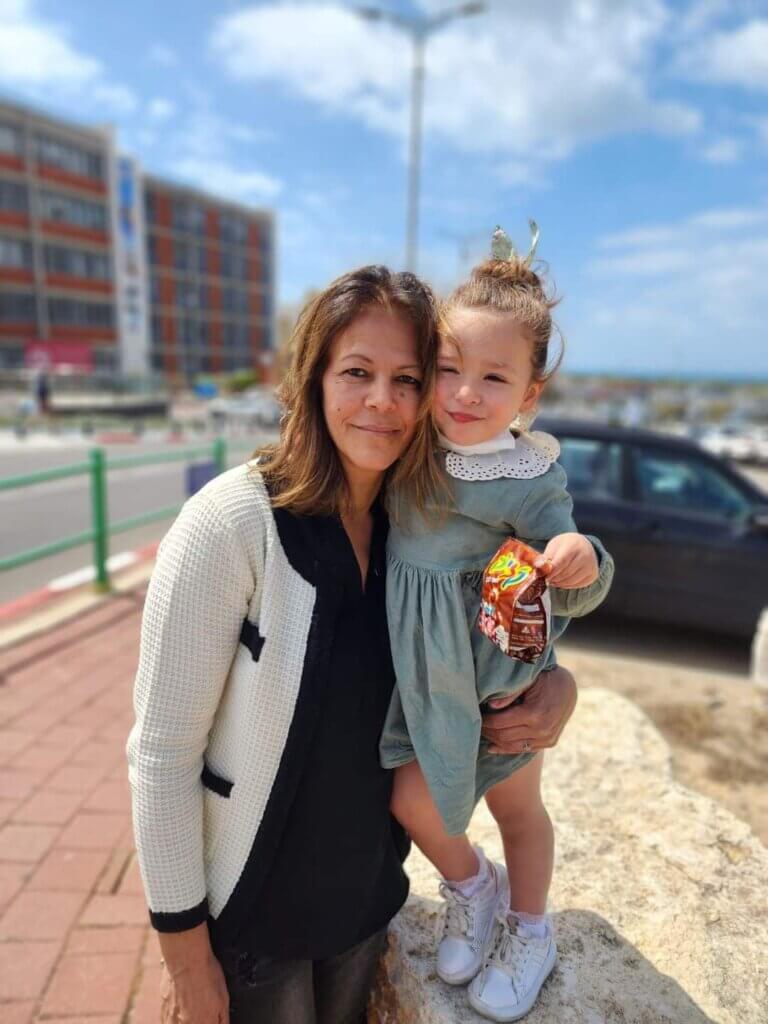
In the beginning they told us it’s leukemia. Then they changed the diagnosis and told us it’s myelofibrosis, a rare bone marrow cancer. He would now require treatment and a bone marrow transplant. After this diagnosis, Walid also developed a lung infection. Due to their negligence, a simple lung infection eventually led to an operation in which a third of his lung had to be removed. Only after we put pressure on the Prison Services, Walid was transferred to Barzilai Hospital, where he arrived in a critical state. All his vitals were very low. If he had arrived a few hours later we would have lost him. We were lucky because we had a scheduled prison visit, and saw the poor condition he was in when they brought him to the visitation room. We refused to continue the visit, and I asked the prison guard to return him to the prison clinic and then to send him to the hospital. If we hadn’t had that visit on that day we wouldn’t have known how bad his condition was, and wouldn’t have thought to pressure the Prison Services to transfer him to the hospital. It was a painful visit to see Walid like that. For a week, we kept asking that he be transferred to a hospital, and they finally transferred him on March 22, 2023 late at night. His condition was already horrible, and his kidneys and lungs were failing.
On April 12, 2023 Walid underwent an operation during which most of his right lung was removed, while the left lung is not entirely intact. Until April 19, 2023 he was under complete sedation. We thank God that Walid is right now able to breathe on his own, although with the help of oxygen. He can’t speak and he can’t stand. The doctors confirmed that it will take a long time for him to be able to do things like talking and walking.
We are pressuring the Prison Services to at least keep Walid in the hospital if they won’t release him, and not to send him back to prison. He is now so frail that he can’t fight even the simplest of illnesses, even a simple cold. We are asking that he remain in hospital, because he is a cancer patient, and because they have in the past delayed transferring him to the hospital until it was almost too late. This policy of medical neglect is well known. We call it a policy of slow killing. On account of this policy we have lost many prisoners, like [Nasser] Abu Hmeid, who died of cancer. They are still holding his body, denying his family the right to bury him. Everything that concerns Walid and his medical situation requires us to battle them. To obtain his medical records we have to fight. To have him admitted to hospital we have to fight. To visit him we have to fight. To ensure he receives the right treatment we have to fight. To be with him even for a few minutes we have to fight.

Now, as a family we have launched a campaign calling for the release of Walid. You can participate in it on Instagram and Facebook. We ask for the help of anyone who can help make Walid’s voice heard around the world, nationally and internationally, and to use the hashtag #Free_Walid_Daqqah. We ask for the help of any organizations concerned with human rights to bring attention to Walid’s case and the cases of other Palestinian political prisoners. We tell our political leaders that it is an outrage that a prisoner spends nearly forty years in prison, becomes sick, yet is only heard of when he is about to die. The issue of Palestinian political prisoners is an urgent human and political issue.
In the month that was supposed to be Walid’s first month of freedom, instead of celebrating his return, we find ourselves launching a campaign calling for his release, so that he can receive life-saving treatment. This campaign is now what our daily fight against the occupation is about.
After 37 days in Barzilai Hospital, Walid was transferred to the Ramleh prison clinic on April 30, 2023. Air pollution there exacerbated breathing difficulties arising from his surgery, and on May 22, 2023 he was transferred to Assaf Harofeh Medical Center, and then transferred back to the Ramleh prison clinic on May 25, 2023.

Walid, Sana’ and Milad are a wonderful family. It is reprehensible that they are hated by the Israeli regime simply for that fact “they are a beautiful family”.
How any Israeli can look themselves in the mirror knowing what their State perpetrates in the name of democratic justice is beyond belief. Each and everyone of you who supports this and all other atrocities carried out against Palestinians stands guilty of crimes against humanity, and “No”, there are no excuses.
May this family be blessed and upheld in their trauma.
In 2006, Yigal Amir, (Jewish, Israeli) was allowed to marry WHILE in prison and have conjugal visits.
Israel’s Prison Authority approved the request for the visits to conceive a child, while Israel’s attorney general approved the marriage.
That is the face of “democratic” Israel.
Haaretz opinion article on Walid Daqqa:
https://www.haaretz.com/opinion/editorial/2023-05-30/ty-article-opinion/israel-must-free-walid-daqqa/00000188-6e35-de23-ad8d-ffbd93b40000
I cannot and will not devote much time to complaining of the wickedness perpetrated against one man. We need a drive to get the UN Office on Genocide Prevention and the Responsibility to Protect to demand action to stop apartheid, war crimes, ethnic cleansing and the threat of Genocide in order to protect all Palestinians
“Our prisoners have transformed Israeli jails into universities and schools; into places where the praxis of our resistance is conceived and the human spirit is nourished.”
_________________________________________________
The Second Intifada may have advanced the paranoia and racism toward more apartheid.
Prisoners could make a difference if they discussed and debated ways for getting to Israelis and Palestinians living together in a secular state.