

Editor’s Note: The following article first appeared as a thread on X (formerly Twitter).
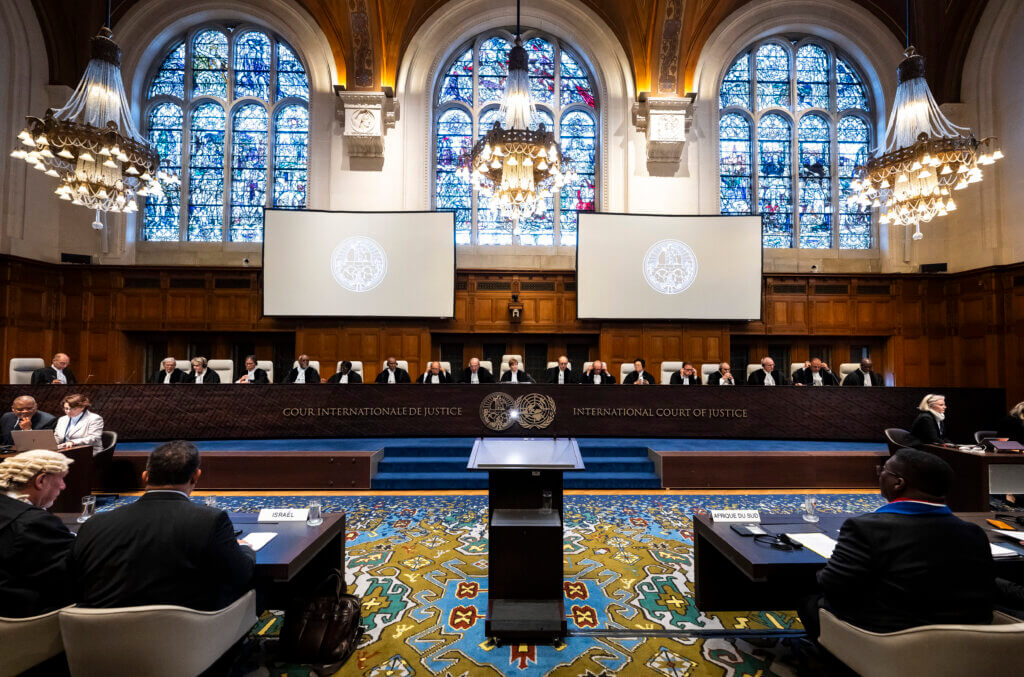
The International Court of Justice (ICJ) has issued a press release stating that it will this Friday “deliver its Order” in response to South Africa’s “Request for the indication of provisional measures” in the case concerning “Application of the Convention on the Prevention and Punishment of Genocide in the Gaza Strip (South Africa v. Israel)”.
Many people, rightly horrified by Israel’s genocidal campaign against the Palestinian people in the Gaza Strip, expect the ICJ to order a comprehensive ceasefire. In their view this is the least the ICJ can and should do. They will consider anything less a failure by South Africa, a betrayal of the Palestinian people, and an indictment of the ICJ and indeed of international law itself.
My own view is that this matter should be looked at very differently and judged by different criteria.
The ICJ can respond in several ways to South Africa’s application. It can determine that South Africa has not presented a plausible case that Israel needs to answer, decline to order any provisional measures, and effectively consider the case closed. The Court could also determine that South Africa has failed to demonstrate that there is a dispute between South Africa and Israel as defined by the Genocide Convention, and dismiss the case on technical grounds. Either scenario would be a clear defeat for South Africa and the Palestinians, and for that matter the concept of international justice. Most specialists consider either of these scenarios to be the least likely outcome, largely because the South African legal team presented such a meticulously detailed and cogently argued legal and factual case, while Israel’s rebuttal was comparatively weak.
If the Court does indeed order provisional measures, it is not bound by those requested by South Africa. It can adopt all of them, some of them, or entirely different ones than those proposed by South Africa. In the relevant precedents, Bosnia and thereafter Myanmar, the ICJ sufficed with general injunctions ordering the accused state to “take all measures within its power” to prevent acts that amount to or contribute to the crime of genocide. In doing so, it may even prohibit specific acts identified in the Convention, such as deliberately inflicting conditions of life calculated to bring about the physical destruction of the threatened group.
The ICJ did indeed order a ceasefire in the case of Ukraine, but as was pointed out to me in response to a previous thread, this was an entirely different case. Ukraine did not claim that it was the victim of genocide, but rather that unsubstantiated Russian accusations of genocide against Ukraine were being used by Russia to justify military operations on Ukrainian territory. It was on this basis that Ukraine requested, and the ICJ ordered, Russia to halt those operations.
Although South Africa has, in the present case, asked the Court to order an “immediate” suspension of Israeli military operations in the Gaza Strip in order to prevent further Israeli violations of the Genocide Convention, it has not asked the Court to specifically rule on the legality of Israel’s military operations against the Gaza Strip. The ICJ is, therefore, highly unlikely to offer its view on the matter by, for example, declaring Israel’s Operation Iron Sword illegal or intrinsically genocidal and, on this basis, ordering it to a halt.
On the basis of the above, I do not expect the ICJ – which does not operate in a vacuum – to voluntarily wade into a political hornet’s nest and order a ceasefire. Even if it did, such a ruling would be dead on arrival because Israel has already stated it would ignore it. The Court does not have the power to enforce its rulings. That role is performed by the United Nations Security Council. And so long as the United States remains a veto-wielding permanent member of the Council, it will block any attempt by the ICJ to prevent Israel from committing genocide. I have it on good authority the U.S. Constitution will soon include a 28th amendment codifying Israeli impunity.
It would, in my view, therefore, be a mistake to judge the Friday ICJ Order by whether or not it calls for a ceasefire. It won’t, for reasons largely unrelated to the substance of this case, and even if it did, this would have only symbolic value and have zero impact on the ground.
Much more important, in my view, is whether the Court issues any provisional measures at all. If it does anything other than dismiss South Africa’s application, this would be hugely significant because it means the world’s highest court has judged that South Africa has made a plausible case that Israel is in violation of the Genocide Convention and that its allegations deserve a full hearing. Think of it as a formal accusation requiring a proper and full trial. And any provisional measures mean there will be that full trial.
As has been noted elsewhere, the Court is, at this stage, not determining whether or not Israel is guilty of the crime of genocide. Rather, it is only examining whether South Africa has plausibly accused Israel of genocide and if so, what “provisional measures” are required to prevent irreparable harm pending the conclusion of the hearings. If it indeed proceeds to that stage, these hearings can be expected to last several years. (The Bosnia case was initiated in 1993 and concluded in 2007; the Myanmar case was launched in 2019 and remains ongoing.)
While anything is possible Friday, including an ICJ ruling that either dismisses the case or orders a ceasefire, many specialists expect neither. Rather, they seem to believe that the Court will agree to proceed with the case and adopt more generic provisional measures. This would, as noted, be hugely significant. It means that Israel stands legitimately accused of genocide, widely considered the most serious crime on the books, “the crime of crimes.”
The state that claims to be a “Light unto the nations,” that claims to have “the most moral army in the world” because it fights according to the code of “purity of arms,” and that claims to exist so that “Never Again,” will stand accused of intentionally seeking to destroy a group of people on the basis of their identity, and be forced to defend itself. A searchlight unto the nations, determined to do it yet again. Irrespective of the ultimate outcome, it is a stain from which Israel will never recover.
I am indebted to Ardi Imseis, professor of law at Queen’s University, for pointing out a further significant aspect of an ICJ Order on provisional measures: “The Convention is not just about the punishment of the crime of genocide, it is also about the prevention of the crime of genocide. Once you have a plausible case of genocide, which is implied if the Court does issue a provisional measures order, that triggers a positive obligation on the part of other signatories to the Genocide Convention: to prevent genocide. This leads to the need to adjust their own policies vis-à-vis the occupying power’s actions in Gaza, including arms transfers and diplomatic protection.”
In other words, judge the ICJ Order Friday by whether it endorses or dismisses South Africa’s application, not on the basis of whether or not it orders measures that Israel will ignore and the U.S. render meaningless.
It is also worth reflecting on how far South Africa has come since its white minority regime was one of Israel’s closest allies. Given Israel’s long and sordid record of alliances with anti-Semites, it should come as no surprise that many of the South African apartheid regime’s ruling National Party leaders, such as D.F Malan, H.F. Verwoerd, John Vorster, and P.W. Botha, actively supported the Nazis during WWII or otherwise openly espoused anti-Semitic policies. During the 1970s and 1980s, both Israel and South Africa were international pariahs, bringing these institutionally racist, supremacist states even closer together. US intelligence strongly suspected that they jointly conducted a nuclear test in the Indian Ocean in 1979. Birds of a feather…
South Africa is today a, if not the, leader of the free world. By contrast, the US and EU merely posture as beacons of freedom and preach empty slogans that, as we see in Gaza today, are primarily honored in the breach. And speaking of nuclear weapons and sanctimonious posturing, Israeli cabinet minister Amichai Eliyahu today once again advocated dropping a nuclear bomb on the Gaza Strip. “Even in The Hague they know my position,” he noted.
Why does he speak so brazenly? Because when he previously advocated nuclear war in late 2023, each and every Western capital ignored his genocidal advocacy and looked the other way. Because their official position is that Israel does not possess the nuclear weapons it has, and only Iran is a proliferation risk. That’s how their disintegrating rules-based international order operates.

The NYT ran a major story today about Israel producing government documents to rebut South Africa’s case:
https://www.nytimes.com/2024/01/25/world/middleeast/israel-genocide-defense-declassified.html
The readers’ comments are largely scornful of Israel’s action. The original headline read “Israel rebuts…” but now reads “Israel tries to rebut…”. Someone there must have read my unpublished comment about the inaccurate headline. Heh, heh!
So worth listening to and reading. Great detail about the ICJ decision tomorrow,
https://theintercept.com/2024/01/17/intercepted-gaza-israel-genocide-icj/