
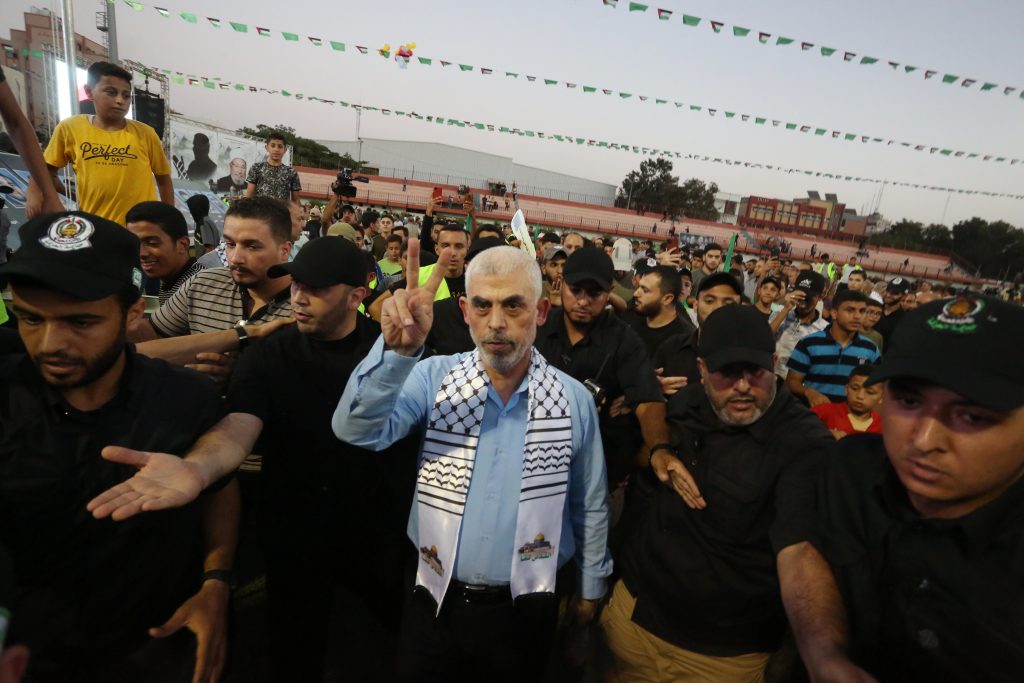
Even before October 7, the taboo against talking to Hamas allowed the world to ignore the ever growing crisis in Gaza and its people until it blew up in their faces. However, it is a well known truth that you don’t make peace with your friends but with your enemies.
When October 7 occurred, Israel rapidly weaponized the demonization of Hamas, already declared by Israel and the US to be a terrorist group, to justify all its actions in Gaza. This was bolstered by a multitude of false accounts of beheaded babies, burnt pregnant mothers, sexually mutilated bodies, and mass rapes, none of which was proven. Every public discussion of the war had to start with the question: “Do you condemn Hamas?” And if you failed to do so, or if you failed to declare their actions “barbaric” rapidly enough, you were personally attacked and called antisemitic.
Any attempt to objectively discover what happened on that fateful day was compared to Holocaust denial. Hamas certainly undertook considerable violence against civilians, but we must acknowledge that just this week, leading Israeli paper Haaretz finally admitted to Israel’s widespread use of the Hannibal Directive: the killing of its own citizens to prevent capture. The declared objective of eliminating Hamas, not just defeating or neutralizing its fighting force, was the goal, and this became the justification for not only destroying Gaza — its hospitals, universities, markets, housing blocks, and infrastructure — but also for repeated population transfers on a mass scale in pursuit of that impossible objective.
Also read: The question of Hamas and the Left
I am not and have never been a supporter or apologist for Hamas. I am a Christian, and Hamas is an avowedly Muslim organization. I am a pacifist, and Hamas believes in armed struggle as the path to liberation. Yet, I know that there is no path to peace that does not involve Hamas, as well as some deeply abominable Israeli Jewish and Zionist organizations and politicians.
Recognizing the need to speak with Hamas does not in any way constitute support for that organization, its objectives, ideology, or tactics. Hamas is a political party, one which also oversaw an entire government structure and all its functions for years, in addition to maintaining an armed resistance force, the Qassam Brigades. The party has an official ideology, but it can also be pragmatic when forced to be. If it is allowed to engage in political negotiations, it will have to accommodate itself to such realities and enter into serious negotiations that may contradict many of its bombastic positions.
As with many other political parties, particularly in Israel, its doctrines, ideology, or statements can be objectionable, especially to the other side. If you look at the founding documents, statements, ideologies, and actions of many Israeli parties, you will find things equal to or far worse than Hamas: shall we look at Likud? Jewish Power? National Religious Party? Yet, each of these parties makes up the current government coalition, and they have power and take actions detrimental to Palestinians and any prospects for peace. There is no doubt that they will participate, for better or worse, in any decisions about the future of Gaza and Palestine, as well as in any peace negotiations.
The PLO, the ANC, the IRA, the Algerian Resistance, and other liberation movements were initially labeled terrorist organizations, and they did indeed commit acts of terrorism and atrocities against civilians. But, they were eventually invited into the political process.
The Palestine Liberation Organization (PLO), as well as the African National Congress (ANC) in South Africa, the Irish Republican Army (IRA), the Algerian Resistance, and other liberation movements, were initially labeled terrorist organizations, and they did indeed commit acts of terrorism and atrocities against civilians. But, they were eventually invited into the political process and subsequently moderated their positions in response to new realities and avenues for political engagement.
In the late 80’s and early 90’s, peace activists in Israel, the US, and elsewhere conducted a serious campaign to urge politicians to talk to Yasser Arafat and the PLO. We witnessed the PLO change its charter, renounce violence, accept the principles of compromise, and even accept conditions far below their initial demands. These were all changes they remained faithful to, even as the Israelis failed to reciprocate.
Is there any reason why a similar process should not be started with Hamas?
Those who resist this line of thinking are those who are not interested in peace or in an end to war. They are now in control of the narrative and are quick to attack anyone who challenges their thinking. They still dream of “total victory,” refusing to speak of “the day after” or conjuring up improbable future scenarios “that do not include Hamas.”
After nine months of fighting and immense genocidal violence, Hamas continues to exist as a resistance force but more potently as a doctrine, ideology, and movement, with many more potential recruits. It exists in Gaza, the West Bank, and elsewhere, and it cannot be eliminated. As that reality sinks in, maybe the time has come to consider how and under what conditions Hamas can be brought into a political process and engage in negotiations for a better future for everyone concerned.
As in the early days of the PLO, activists who care about peace must take bold action, perhaps at great risk of personal loss and sacrifice, to bring Hamas into the equation. It may even be illegal (certainly in Israel) to talk to Hamas, but such civil disobedience is necessary if we are serious about peace between Israeli Jews and Palestinian Arabs. Only by breaking the taboo and challenging the dominant narrative can we hope to move things forward.


I’ve lost track of how many political scientists I’ve read – people who have devoted their careers to studying these kind of conflicts – who have come to the conclusion that the way to deradicalize groups like Hamas is to bring them into the political process and give them meaningful alternatives to violence.
Start with Robert Pape at the University of Chicago.
( unfortunately you need to subscribe to Foreign Affairs to get full access: Hams Is Winning – Why Israel’s Failing Strategy Makes Its Enemy Stronger
https://www.foreignaffairs.com/israel/middle-east-robert-pape )
As an atheist and leftist, and someone who believes peaceful tactics are best, I can’t condone all Hamas’s actions Oct. 7 either. I do note, however, that in the 17th, 18th, and 19th century white European settlers advancing into Native American territories lived in fear of atrocities from those same Native Americans, who sometimes massacred those settlers in defense of their land.
Today we acknowledge that the greater crimes and massacres were by the settlers or armed forces acting to bring in and protect the settlers. In today’s parlance, those settlers would likely be considered “civilians” and illegitimate targets for armed attack. That kind of thought, though, leaves no avenue for redress of the crimes of mass murder and confiscation of the land which the settlers now inhabit. Without such redress, we’re left with terrible anti-colonial violence like the Oct. 7 attack. The Israeli civilians who didn’t directly take the land from the Palestinians in Gaza didn’t deserve to be attacked. But they benefit from mass murders of civilians, they’re receivers of land and rights stolen by means of terror. Without full implementation of the Palestinian right of return and some kind of adequate redress, my condemnation of the attacks on the Israeli settlers is partial, neither can I entirely condemn the 19th century Native American attacks on settlers.
Israelis who perceive that they’re fighting to defend their homeland, their community, their family are quaking in those communities, like the 19th century white European settlers in the U.S., at some level knowing they took those lands from its rightful owners.
If more than one Israeli Prime Minister can be a former terrorist, and the Jewish gangs, Hagannah, Irgun, Stern really were terrorists because they were fighting to take someone else’s country while Hamas is fighting to defend its homeland, then why should Hamas be excluded in such a way?
Indeed even Nelson Mandela who was involved in terrorism in his fight for justice and freedom for his homeland became a great leader respected worldwide. The use of the word ‘terrorist’ is simply a ploy by the invaders and occupiers to seek to reduce or remove the legitimacy of their opponent.
Israel rejects Hamas purely because it has proven itself to be smart, much smarter than the Israelis, competent, intelligent and effective. Such power in the Palestinians is to be destroyed in the minds of Israelis.
“Only by breaking the taboo and challenging the dominant narrative can we hope to move things forward.” Well, we know what the prevailing taboos and the dominant narrative are at Mondoweiss. How willing are people here to break them?