

Since the American-backed Israeli genocide in Gaza began, Arab Americans have grown more disillusioned with U.S. foreign policy in the Middle East, and the lack of change in policy toward sending more weapons to Israel. Despite Op-Eds and social media buzz about how the new Democratic pick for president Kamala Harris will be different, many Arab Americans have already been disappointed.
In a press conference after meeting with accused war criminal Israeli Prime Minister Benjamin Netanyahu, Harris doubled down on her “unwavering commitment to the existence of the state of Israel” and said she would “always ensure that Israel is able to defend itself.” As for Gaza, she briefly touched on “the death of far too many innocent civilians.” A few weeks before Biden officially dropped out of the race, former president Donald Trump used the Palestinian identity as a slur of sorts. “He’s a very bad Palestinian,” Trump said of Biden, who he accused of not wanting to help Israel “finish the job.”
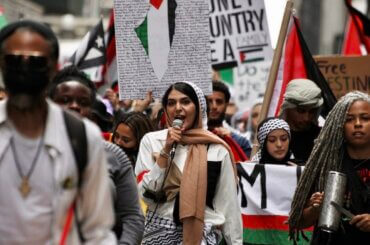
And just last night, when pro-Palestinian protesters attempted to disrupt Harris’ rally in Michigan — the state with the highest Muslim population in the United States — instead of listening to them, or pausing to give them space to air out their grievances, she immediately snapped back, “If you want Donald Trump to win, say that. Otherwise, I’m speaking” with roaring applause from the crowd. This came days after Democrats boasted a supposed “tone shift” that she would have when it comes to Gaza.
These are the choices Arab Americans have been given for president this year.
Arab Americans have already been expressing their frustration with the election for months, but it has reached a boiling point in the last few weeks — they feel unheard, disappointed, and most of all, angry with the current two-party system.
Mervat Saudi, a Palestinian-American mother who lived in Palestine for ten years, says she will “not be voting at all” this November.
“Everything that’s been happening, it hits a little too close to home for me,” she says. “I just feel like our voices aren’t being heard, and both parties, whether Democratic or Republican, are not in the best interest for my own people.”
Saudi, who is registered to vote in Michigan, says she did consider voting for a third-party candidate at one point, but cannot bring herself to the ballot box at all this year. The first time she ever voted was in 2020 for Biden because she didn’t want Trump’s Islamophobic policies to continue. Now, she says, “I don’t know if I’ll ever vote again.”
Saudi aligns with most Arab Americans in her swing state. Back in February, when Biden was still the nominee, at least 100,000 registered Democrats in Michigan voted for “uncommitted,” a protest vote in response to his support for the genocide in Gaza. The movement was most popular in the predominantly Muslim city of Dearborn, where “uncommitted” actually defeated Biden 56 percent to 40 percent.
Many of those voters felt overlooked by the electoral establishment in America. Saudi says she’s fed up with the outward racism of the Republican party, and the empty promises from Democrats. “You’re calling for a ceasefire and then you’re sending millions of dollars that next weekend? It doesn’t make sense to me,” she says.
Other Arab Americans are looking to third-party candidates for hope. Aicha Belabbes, whose father is from Algeria, says she might vote for Jill Stein this November.
According to a poll commissioned by the American-Arab Anti-Discrimination Committee, Green Party candidate Dr. Jill Stein is polling strong in the Arab American community at 45 percent due to her support for Palestine. Harris is trailing behind at nearly 28 percent, which is almost equal to the percentage of respondents (25%) who said they are either undecided, or will not vote at all.
Belabbes is registered to vote in Massachusetts, a blue state, but has historically voted for the Green Party because of their support for universal health care and student debt forgiveness. She doesn’t believe the Green Party is perfect, but doesn’t have much hope that Harris is different from Biden.
“If she really was against the genocide she would have resigned or made a vocal statement, but she hasn’t,” Belabbes says of Harris. “She’s made statements very recently that indicate that she wants to continue what’s going on.”
Laith Kayat, an Iraqi American who grew up in Michigan, says that he will also be voting for Stein. “I think at this point I’m quite skeptical and mistrusting of the Democratic Party,” he says. “Especially when it comes to their foreign policy. They have not shown that they care about the people in the Middle East or creating lasting peace. Instead, they continue to fund wars.”
Kayat argues that the two-party system “has to go,” and points to the lasting effects of the war on terror, which was started by Republican president George W. Bush, but intensified throughout Barack Obama’s presidency.
“It’s taken me too long to wake up to the fact that Obama continued the war on terror through drone strikes on civilians in the Middle East,” Kayat says. Obama embraced the U.S. drone program, and in his first year in office, oversaw more strikes (536 drone strikes in Pakistan, Somalia and Yemen) — than Bush did during his entire presidency (57). “And it was Obama that signed the $38 billion aid package to Israel.”
“Biden’s Israel policy has led to a genocide in Gaza and he continues to provide support diplomatically, militarily and financially to Israel. Because of this, I am completely turned off to the Democrats,” he says. “If you want a president who is anti-Israel or anti-war, the two-party system will leave you with zero options.”
Moné Makkawi, whose family hails from Tripoli in Northern Lebanon, says she will be withholding her vote this November. “I do not support either party,” she says, “because the idea of two separate parties is a fallacy.”
“They’re the same singular ruling class with shared interest and they’re fueled by racism, by capitalism, by neocolonialism and imperial interests abroad, so there is no difference between them in my eyes,” Makkawi says.
Ending the genocide is a priority for most Arab Americans, a stance that gets them called “selfish” online, where they are branded as “single issue voters.”
“The assumption is that we’re voting only on Palestine but the point to be made there is that Palestine is the lynchpin for American imperialist ambitions in the Middle East and therefore globally,” Makkawi explains. “Palestine is a climate issue, it’s an LGBTQ issue, it’s a gender issue, it’s a race issue, it’s a religious issue, it’s obviously a colonial issue. And that doesn’t even address the genocide.”
“But let’s say someone is only voting on the issue of Palestine,” Makkawi continues. “They’re still voting on a whole host of issues that Palestine encompasses. The mass murder and systemic erasure of a people isn’t just murder; it’s famine, it’s infanticide, it’s scholasticide, it’s the denial of entry of sanitary materials, it’s forcing women to give birth in unsafe and unsanitary conditions. It’s a whole list of things.”
Kayat agrees. “To call genocide a single issue is simply ignorant,” he says. “It is a profound mischaracterization to isolate Israel’s bulldozing of international law, with U.S. support, as a standalone concern when it is intrinsically linked to broader patterns of systemic oppression and violence. Genocide represents the most extreme form of human rights violation, and its repercussions are far-reaching.”
“When a state engages in a war against human rights, it doesn’t exist in a vacuum,” Kayat explains. He says Americans are already witnessing the reverberations of this dehumanizing foreign policy in their own backyard. “Police crackdowns on student protesters, mass arrests, and the ever-growing issue of mass incarceration are clear indicators of the parallels between foreign and domestic policies. The same structures of oppression that justify the detention and mistreatment of individuals overseas also support the disproportionate imprisonment of marginalized communities here at home.”
“I’m not not voting in this election just because of Palestine,” Makkawi says. “But if someone wants to accuse me of being a single issue voter, I think that genocide and ethnic cleansing is a righteous single issue to make your decision on regardless.”
Many Democrats on social media have repeated the statement that has been served to dissatisfied Arab Americans for decades: you need to pick the lesser of two evils. Makkawi has a simple answer: “the lesser of two evils is still evil.” Belabbes agrees. “I don’t know how you can say that Harris is the lesser of two evils when she has been part of the administration that has openly committed a genocide. It doesn’t get any more evil than that.”
“I find that there’s this weird rhetoric where people say ‘Well, if Trump were elected, he would genocide harder.’ And I’m like, that’s not how that works,” Belabbes says.
Kayat agrees and is unhappy with the accusatory rhetoric coming from Democrats. “There’s almost this tone of ‘You need to be grateful for what we’ve given you and that we don’t impose Muslim bans,’ but they’ve dropped more drone strikes on our countries than any other administration.”
Trump is not a popular candidate among Arab Americans either, due to his racist and Islamophobic rhetoric, but Makkawi makes the point that Harris’ past is not much different.
“Just look at her record as the Attorney General in California,” Makkawi says. “She failed to give transgender inmates gender-affirming care or put them in housing that aligned with their gender. She was someone who wanted to lock up the parents of truant kids rather than address the problems behind why kids were truant or late to school. So when we’re talking about racism and corporate greed, it’s also the same with Harris; the differences between her and Trump are insignificant for me.”
Kayat also says that Harris’ track record as a prosecutor, especially when it came to drug possession and incarceration, is what initially turned him off. “But then also throughout these last ten months of what we’ve seen happening in Gaza, she has done nothing to stop it. I don’t know how, as an Arab American, anyone can put that aside and put their vote for [Democrats].”
When asked what someone would have to do to earn his vote for president, Kayat said “they would have to stop sending aid to Israel.”
Makkawi, however, said it would be impossible for anyone to earn her vote. “There’s no way in which a candidate gets to this point in our electoral system without being sanctioned in some way by the system itself. Regardless of their individual personal politics, they are beholden to a system that is carceral, racist, capitalist, extortionary, sexist and deeply violent. It’s just like how there might be a cop who’s a nice person, but the system is the problem: the system is racist.”
Belabbes also believes that electoral politics will not guarantee people’s rights in this country. “Whether it’s reproductive or immigrant rights, any kind of civil liberties, these are things that we have to organize on a community level for,” she says.
“A lot of the people who I’m seeing say ‘Vote blue, no matter who,’ are not donating to their local abortion fund, are not organizing unions or supporting local harm reduction initiatives, are not donating to mutual aid,” Belabbes continues.
In addition to my conversations with Saudi, Belabbes, Kayat, and Makkawi, I also spoke to many more Arab Americans, whose families are from everywhere between Syria to Sudan. Almost everyone expressed that they had lost faith in the electoral system as a means for liberation. They said that whether it’s a Democrat or a Republican signing off on it, the bombs will still fall. And yet, they feel belittled when they demand more from leaders, or when they ask for the slightest bit of accountability.
After 10 months of genocide, and more than twenty years of America aiding the wars in Iraq, Palestine, Yemen, and more, most of the Arab Americans I spoke to repeated the same sentiment over and over again: ‘we have the right to demand better.’
“I don’t ever see myself voting for another president again,” Makkawi says. “The solution, as they say, is revolution. The whole system has to be changed and rebuilt and I think that there’s no other way.”

Kamala’s response was rude, arrogant and out of touch. The “uncommitted”/stay at home vote could take her down. Her lack of compassion for Palestinians seems deeply rooted.
Worthwhile read:
18 HOURS AGO
Here’s Why Two Protesters Interrupted Kamala Harris—in Their Own Words
“When people are demanding a ceasefire and arms embargo and an end to the genocide and you say that [means] we want Donald Trump to step in—it just shows a lack of accountability.”
https://www.motherjones.com/politics/2024/08/kamala-harris-hecklers-protest-detroit-rally-interview-gaza-michigan/
“So to me, as someone who keeps track of the ongoing issues in Palestine, the Republican Party and the Democratic Party are one and the same on this. And for them to constantly keep saying that we need to vote a Democratic member in and not the Republican Party, because they’re the lesser of two evils—and because one just has a less intense version of genocide (which I actually don’t find that to be true considering that the genocide is being aided by the Democratic Party right now). They just seem so concerned about a hypothetical genocide when there is an actual genocide that is happening in the current moment.”
The Green Party is here for you! Don’t vote for ongoing genocide. Vote for the change America needs: firing the corporations that run (and have ruined) our country and planet. GP.org
Fairness aside, there seems a given in American politics, no matter how hard hearted the Israelis become, Americans will not back those who are perceived to advocate for “driving them into the sea”. Politicians know that in spades.
Those who advocate for human rights will easier find success far more readily countering narratives than angling toward taking the system down.