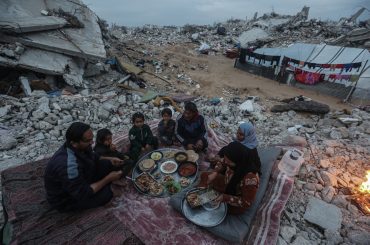
The war tugged on. Bombs fell relentlessly, louder and heavier than ever. For me, it wasn’t new. My neighborhood, al-Shuja’iyya, has been bombed countless times—2008, 2012, 2014, 2021—and between these, there were the periodic, moody airstrikes, unpredictable yet familiar. This was life in Gaza, which has been an endless cycle of survival and reconstruction. So, when the first airstrikes followed October 7, I thought it was just one chapter of the same grim story. I was wrong.
The death toll soared into the thousands, and the airstrikes were unrelenting. My father’s cigarette count climbed with every passing day. In Gaza, cigarettes aren’t a luxury—they’re a form of quiet self-punishment or a desperate attempt at stress relief. Stressors are everywhere, even before the war erupted. Soon, I knew, cigarette prices would skyrocket, another cruel paradox in our lives.
I’m Ahmed, 23, part of a family of nine. Two of my brothers live abroad: one is a teacher in Kuwait, supporting us financially, and the other is in Turkey, trying to migrate to Europe to provide for his wife and two sons. A week after October 7, my mom, sister, and four of my brothers evacuated to the Al-Rimal UNRWA school in western Gaza City. My father, 64, and I stayed behind—“the loyalists,” as we half-joked.
My father wasn’t afraid of death. He accepted it with a calm resignation, sometimes finding comfort in its inevitability. I, on the other hand, believed in putting trust in God and dismissing fear altogether. “Fear is an illusion,” I told him one night. He shook his head, his voice steady.
“Fear is real, my son,” he said. “Even prophets feared. Remember Moses when he was told to hold the stick? Fear exists just as much as courage does.”
I wasn’t convinced then. But on November 8, I learned the truth about fear.
An Israeli F-16 reduced our house to rubble in seconds. I was trapped between two collapsed walls, pinned in place by unforgiving concrete. For two agonizing hours, I was alone in the suffocating darkness, listening to the faint groans of destruction and distant cries. Fear gripped me, raw and inescapable.
Then, I heard him. My father’s voice called out from somewhere in the wreckage. He had been caught in the same airstrike but was searching for me amid the ruins. His hands, steady despite the chaos, guided me through the wreckage to the other side of the wall. That was the last thing I remember clearly before the second air strike silenced his voice and killed him. My brave father was gone.
ِAfter being pulled from the rubble, my pelvis and part of my spine were broken. When the ambulance arrived, I was rushed to al-Shifa hospital. I stayed for weeks receiving treatment before the Israeli army surrounded the hospital and bombed the same floor I was on. Death was insistent on following me like a shadow. As soon as the army surrounded the hospital, I was transferred with other patients and doctors to the European Hospital in Khan Younis.
My spine and pelvis needed surgery and the hospital I was in was barely functioning, mainly being used as a shelter. Finally, the Ministry of Health issued a referral that would allow me to get treatment in Egypt, which was not easy to get since they prioritize the most extreme cases. It didn’t work out though. Even though my brother was able to secure funds for my travel to Egypt, the Israelis soon took over the Rafah crossing and closed it, taking treatment out of the equation.
I needed to persevere with this non-stop struggle, I had no choice. Step by painful step, my health improved and then I could walk. Now, I sell homemade soap on the streets of Deir al-Balah to support my mom and brothers and sister, but also because I have no other choice. I think despite all this struggle, I can still overcome. We have always struggled in Gaza before October 7. But what I cannot handle is the very intimate fear that shook me that night.
Since that night, fear hasn’t left me. My memories before the strike feel like fragments of a dream—blurred and unreachable. I don’t remember much about my life before then. Perhaps if we return to the rubble, to the remnants of our home, some forgotten object might trigger a memory. For now, though, I live in the present, carrying the weight of the past I can’t recall and the fear I can’t deny.
Fear exists. It is real. My dad is right. And now, I understand