Areej Al-Qadi sits on the floor of Nasser Hospital in Khan Younis. In front of her are the bodies of her children. She looks at them in shock, her recitation of verses from the Holy Quran is interrupted by questions from a group of journalists surrounding her. She answers, then returns to singing a folksong, in which she says that she has offered everything she has to the homeland.
After a short period of calm, the mother explodes with anger, screaming and hitting the ground with her hand and shouting, “I have none of my children left!” Speaking to her dead son lying on the ground, she asks him, “Who will chat with me at night from now on? Didn’t you tell me, Abdul Aziz, that you would read the Quran with me every day? What should I do now without you?”
The Israeli army killed al-Qadi’s sons, Abdul Aziz Mahmoud bin Hassan 9, and Hamza Mahmoud bin Hassan, 6, while they were in a tent in the Mawasi area of Khan Younis, on Wednesday November 20. An Israeli airstrike targeted a tent next to theirs, killing four people on the spot, including al-Qadi’s sons. At the time, she was not in her tent and was not injured. With the killing of her sons, al-Qadi, a widow, now has no family left.
The airstrike on Wednesday was the sixth time since November 9 that Israeli airstrikes targeted tents in the Mawasi area. Al-Qadi and her boys were among tens of thousands of displaced Gazan families living in tents and makeshift structures in so-called ‘safe zones’ along Gaza’s shore. Like their neighbors in the tents, Al-Qadi had come to Mawasi after her family was displaced from their home in Gaza City, upon orders from the Israeli military to head to the Mawasi area “to save their own lives.”
But now, displaced Palestinians in Mawasi say that the area has become like any other area in Gaza, where the Israeli army bombs and kills people every day.
Louay al-Astal, a paramedic, was one of the people who were called to the scene where Al-Qadi’s sons were killed on Wednesday.
“We received a signal that a tent was being bombed in the Attar area of Khan Younis. We headed to the place, and were surprised that all the casualties were children and women. The martyrs were in pieces. We could not distinguish the martyrs from one another because the missile tore their bodies apart,” Al-Astal recounted to Mondoweiss.
“The area that was bombed is considered a safe area by the Israelis, and it has been bombed several times recently, even though the army is the one that identifies it as a safe place for civilians to go to,” he continued.
“But when a tent made of cloth and nylon is bombed with a missile, what do you expect to happen to the residents of the tent and the tents nearby? They will all be torn apart.”
Evacuation orders with nowhere to go
On November 12, the Israeli army warned the displaced people in Mawasi to evacuate their tents because it intended to bomb a tent in the middle of a crowd of shelters. The evacuation order was put on any tents within 500 meters of the tent that was to be bombed, which belonged to a displaced family.
However, despite the evacuation of residents, and due to the close proximity of the tents to one another, the bombing killed one person, and injured dozens of others.
The casualties occurred as a result of shrapnel from the Israeli missile, which also led to the destruction of dozens of surrounding tents. The bombing also led dozens of tents in the area to catch fire and burn to the ground, according to testimonies from eyewitnesses and families who had followed the Israeli evacuation order.
Ruweida Abu Taima, 36, stands in front of her tent holding a piece of shrapnel the size of an open book. She says her family were in their tent when the evacuation warning came. They left everything behind and fled in a hurry for fear of being bombed.
“After 15 minutes, the warplanes bombed a tent. When I returned to my tent, I found a large piece of shrapnel inside. If it had fallen on anyone, it would have killed them,” Abu Taima recounted.
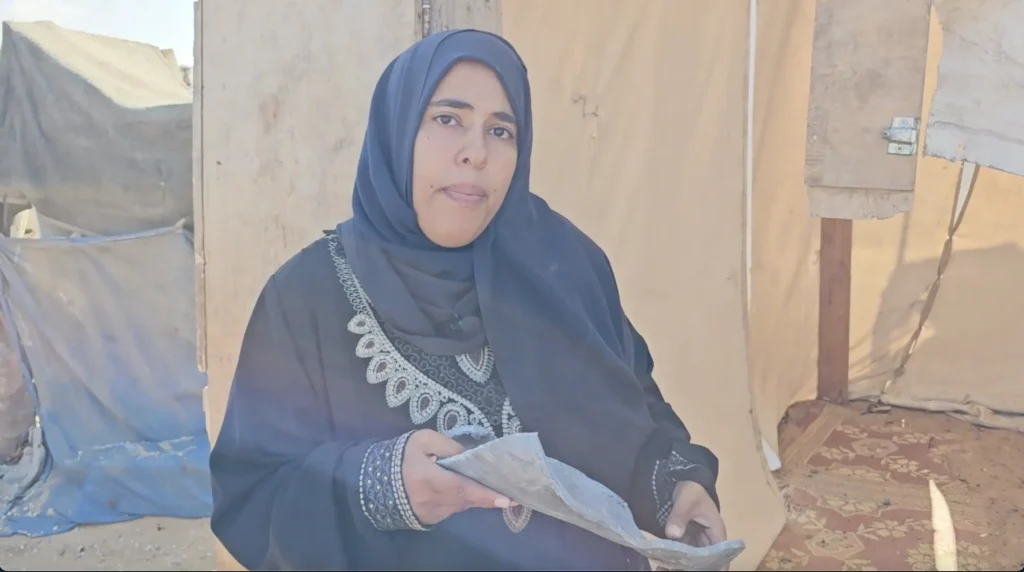
“We saw great and massive destruction. Many tents were burned, and a large number of people were injured by shrapnel. People did not have enough time to get out and get far enough away from the bombing site,” she said.
“People were running and bumping into each other out of fear. When the bombing happened, shrapnel started flying over our heads,” she continued.
That night, her family slept out in the open air for fear of another bombing.
“We miraculously survived this time. Every day we spend alive is just an escape from death.”
Everyone is a target, even in ‘safe zones’
Surrounded by a number of her female relatives, Areej al-Qadi tenderly strokes the faces of her six and nine-year-old sons. After al-Qadi’s husband was killed during the war, Abdul Aziz and Hamza were all she had left.
Recounting the hours before her boys were killed, al-Qadi says, “Abdul Aziz prayed the afternoon prayer and took a shekel from me to buy candy and play with his peers, but he left and didn’t come back.”
“Let the world see my children hear my screams; I have no one left,” al-Qadi cried, as the tears rolling down her face mixed in with the blood on her hands and face, traces from where she caressed the bodies of her children.
“Who will say ‘mother’ to me from now on?” al-Qadi asks before addressing the people around her: “The blood of my children is not more precious than Palestine; freedom has a price.”
In the 11 days leading up to the killing of al-Qadi’s children, the Israeli army targeted at least six tents for displaced people in different areas in Mawasi, Khan Younis, and near the Al-Aqsa Martyrs Hospital in Deir al-Balah. According to reports, most of the attacks killed civilian families of children and women.
Just two days before the attack that killed al-Qadi’s children, the Israeli army bombed a tent in the same area in Mawasi. The bombing targeted the tent of Khaled Abu Hassan, killing him, his wife Amani, and their three children while they were sleeping. The entire family was wiped out.
“They were in a displacement tent. The tent was bombed. It was not the first time that Israel bombed a tent of a civilian family, and it was not the last time,” Khaled’s brother Muhammad Abu Hassan, 29, told Mondoweiss.
“We found them in pieces. The children were cut up. They were not carrying weapons, nor were they resistance fighters. They were unarmed civilians. But this is the way of the Zionists,” Abu Hassan said from inside Nasser Hospital, standing next to the bodies of his brother and his family.
Pointing to the bodies of his brother and his family, Abu Hassan continues: “Let the world bear witness to these crimes; God will hold accountable every person who saw us being cut up and slaughtered and did not help us, and let every coward and normalizer with Israel bear witness that this is what Israel is doing.”
“For a year-and-a-half, children, women, and elderly people have been cut up in safe areas; if this is what happens in safe areas for Israel, what happens in combat zones?”
The killing of his brother and his family is not the first devastating loss Abu Hassan has experienced throughout this genocide. His father was martyred just two months ago, in September, in an Israeli bombing on Khan Younis. Despite his loss, Abu Hassan, 29, stands tall and says that nothing will deter Palestinians in Gaza from their struggle for liberation.
“We are steadfast and patient, and we will not blink, we will remain steadfast, and this is our path, and we will liberate Palestine despite the Zionists and Israel and Netanyahu,” he said defiantly. “They killed my brother and his family, and they killed my father during this war, but we will give birth to a thousand more for each one, and we will remain steadfast in our land.”
Talking to the body of his brother, Abu Hassan says, “We are all ready to sacrifice for this land until its liberation. Heaven is yours, my brother: you, your wife, and your children. Heaven is yours. You will see my father there. Give him our greetings.”
Hassan Suleih contributed to this report from Gaza.