
For more than a year, Palestinian blood has not stopped bleeding. Every minute that passes among the residents of the Gaza Strip an entire people are under constant bombing, death, and displacement. These are people who are afraid, hungry, and displaced in mobile tents that do not protect them from the heat of summer or the cold of winter, tents that are close together and separated by only a piece of cloth. On top of all this, the tents are bombed, and the displacement centers are transformed into pools of blood.
After October 7, the Gaza Strip has been transformed from the biggest open prison in the world to the largest mass grave.
All this is happening at a time when the world claims humanity and civilization, while Israel has been exterminating an entire people for more than a year, and no one is willing to stop this madness.
The number of martyrs in Gaza increases every day. With every martyr killed by the Israeli army, there is a story that can be told about him and his family who continue to bear the grief of loss and the suffering of continuing forward despite their pain. But not all stories are the result of a quick death from a bombing. Many others come from the slow deaths of those left to die from diseases they contract due to the effects of bombs, pollution, or the inhumane conditions in which Palestinians are forced to live in the Gaza Strip.
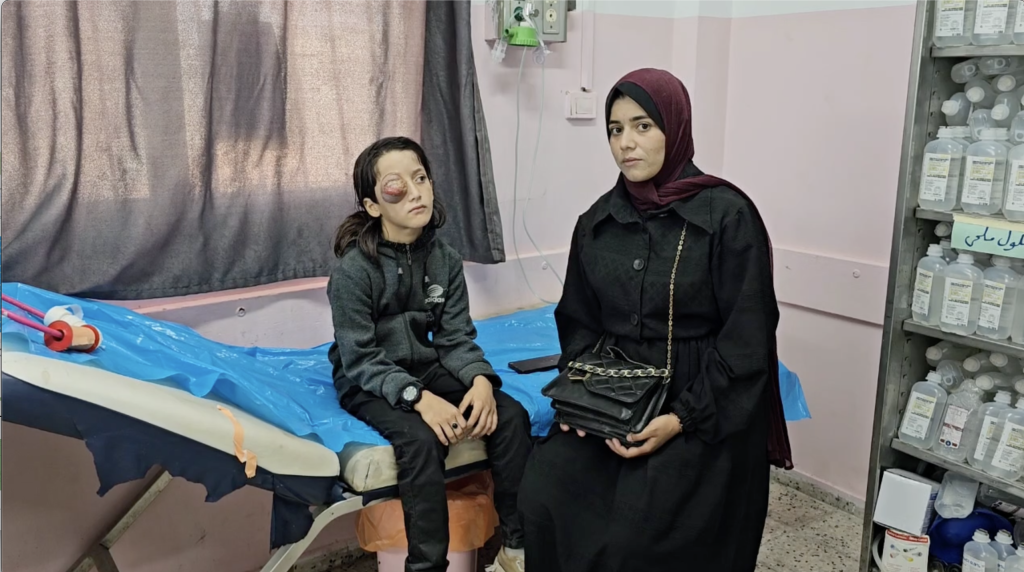
In Nasser Hospital in Khan Younis, the child Muhammad Sabra, 10 years old, sits next to his mother on the patient’s bed. His beautiful face and his light smile appear whenever his mother says something nice about him. His long hair falls on his shoulders, but what spoils the view of his face and his beautiful laugh is the sarcoma disease that causes a cancerous mass the size of a golf ball to cover his right eye.
“At first, a small tumor appeared in Muhammad’s eye, and the pain made it impossible for him to talk or concentrate. He complained of headaches and said his head was going to explode,” Muhammad’s mother, Raeda Sabra, told Mondoweiss. Over time, the tumor began to grow significantly, and when we went to Nasser Hospital in Khan Younis, doctors diagnosed him with a cancerous tumor. They said the cancer was throughout his body, not just his eye. The doctors also said that they could not do anything to help Muhammad due to the lack of resources. “They wrote him a medical transfer, but since the beginning of the war many who have needed transfers are still suffering and screaming to travel for treatment,” Sabra told Mondoweiss. “Will I see my son die in front of me because we are unable to transfer him to receive treatment outside the Gaza Strip?”
Sabra believes the disease appeared as a result of the problematic psychological conditions that the family lives in inside a displacement tent in Khan Younis. She says her son cannot obtain a painkiller due to the dire conditions that the health sector in the Gaza Strip.
“Whenever we go to a doctor, he says that his treatment is outside Gaza.”
Now, Muhammad suffers from more pain than cancer, as he cannot be exposed to sunlight and is forced to stay inside his tent. He also has become reluctant to meet his peers and friends because they comment on the tumor. Sometimes, they get scared and stay away from him, and other times, they continue to ask him about his eye and what is wrong with it, and he cannot answer every question.
“At first, Muhammad was normal despite the tumor, but gradually, when he saw his peers’ reactions and questions, he became embarrassed to leave the tent,” Sabra says.
If Muhammad’s treatment is delayed, it will be dangerous to his life. All we hope for is that Muhammad receives his medical referral, can leave Gaza for treatment, and returns to his normal self. “A beautiful boy, my love,” Sabra says, trying hard to smile in front of her son and make him smile as well in an attempt to raise his spirit.
Mahmoud Sabra, the child’s father, recounts his suffering every time he takes his son to a hospital, medical center, or doctor. Every time he takes his son to a doctor, the doctors say that his treatment is not in the Gaza Strip but outside it. The latest he has learned is that the matter is in the hands of the World Health Organization, which facilitates the movement of patients outside the Gaza Strip on a limited basis from time to time.
“We have contacted the World Health Organization repeatedly, and every time they postpone us, they say next week. We have been in the same situation for over two months, moving from one hospital to another and hearing the same talk and results. There is no treatment for him in Gaza,” says Mahmoud Sabra.
Dr. Ahmad Al-Farra, Director of the Pediatrics Department at Nasser Medical Complex, points out that the dilemma facing patients in the Gaza Strip now is the inability to be transferred for treatment abroad.
The doctor describes Ahmad’s case, saying that the cancer has taken over the eye chamber, and Ahmad has lost his vision in his eye, in addition to the tumor spreading throughout his body.
“Unfortunately, travel in these cases is deliberately delayed and obstructed by the Israeli occupation. Ahmad needs to be transferred as quickly as possible to have a chance to receive treatment outside the Gaza Strip due to the lack of capabilities in the Gaza Strip.”
There are hundreds of children with cases like Ahmad, all of whom are waiting for transfers abroad. But after the closure of the Rafah crossing, these cases are now facing a complicated fate.
“I would like to point out that the rates of treatment for cancer in children are good, meaning that if treatment is given early, they will recover quickly, and the child’s survival rate is high, reaching 80 or 90%, but delay may kill them slowly.”
“We appeal to the entire world and human rights and humanitarian organizations to pressure the occupation to expedite the rescue of these flowers [children] so that they can continue their lives normally. Their right to treatment and life is their right,” says Dr. Al-Farra.

