

This is Cairo, and the day was one we couldn’t have prepared for. Just the day prior was Egypt’s national holiday memorializing the October 6 War. The festivities include swarming the timeline with stories about the Suez Canal crossing, photos of Egyptian soldiers in the Sinai, and, most importantly, memes about breaching the Bar Lev line. However, little did anyone know that following the 50th anniversary of Yom Kippur, a similar nightmarish scenario to Israel presents itself once more, only this time, it manifests directly from the inside.
“The 6th of October is Egyptian, and the 7th of October is Palestinian,” was the sentence that most frequented my timeline after I woke up early in the morning. Clueless and confused, I searched for information on the matter. Finally, I came upon one of the al-Qassam Brigades videos and slowly realized what had happened. Egyptians reveled at the spectacle of a breached “Iron Wall,” as we do have a knack for breaching barriers — after all, who wouldn’t be delighted at the impairment of a standing symbol of colonial fascism and apartheid?
I’m positive that demand is low for more retellings on October 7. By now, we’re all familiar with Israel’s “twenty-nine equivalents of 9/11.” Let’s take a moment to ponder the Egyptian side and their reaction to Palestinian factions. How is it that the first country to normalize relations with Israel in the Middle East houses that magnitude of anti-Zionism? It makes even less sense, bearing in mind that Egypt considered Hamas a terrorist organization for a while. The answer to many would be antisemitism. Honestly, when hasn’t that worked? Crying antisemitism would be the unsophisticated attempt to answer why Egyptians hate. It is equally unsophisticated to completely discount antisemitism, but it brings you no closer to understanding the mentality of the majority of Egyptians.
I was born in Cairo and later grew up to be a kid with a rich interest in history and an equally rich hatred of politics. I was oblivious to the oxymoron here, not in contradiction with the age. In my defense, however, I grew up in an unstable region that was reaping the consequences of the War on Terror with the invasion of Iraq and Afghanistan. Not too long after, I experienced instability in my home country during the 2011 Uprising and later the 2013 coup d’etat. I spent most of my childhood with the news running in the background, but at times, it would be my sole focus, primarily because what was on would be inconceivably terrifying or depressing to any kid of that age.
At this point, I thought that humanity’s bleakest times were over; for an archetypal 21st-century kid, days of immense human suffering are pages to be turned over. There is no black plague to fear, Mongol invasion to anticipate, World War to fight, Holocaust to escape, and no Americans to shoo away. But this naivety would hastily wash away as I began to discern the news I always ignored. A civil war broke out in Gaza in 2007. The details were too hazy for a kid to grasp, but I understood that every time tension would escalate in Palestine, mass murder would occur.
Whenever the Palestinian conflict was mentioned, I always remembered a vivid image of a scared Palestinian child, Muhammad al-Durra, sheltering behind his father from bullets during the Second Intifada. Muhammad’s story was the personal story that could make me grasp the concept that every death was not merely a statistic. At this point, I understood that I’ve always been glossing over kids, no different than me, who suffer the consequences of politics that predated them and tragically outlived them. The generational hate I inherited wasn’t towards Israel, the nation-state of the Jews. It was towards Israel, the brutal occupation that systematically murders hundreds of children each year, the occupation that despises the idea of a Palestinian and of a Muslim or Christian Arab in general.
The story here isn’t drastically different from every Egyptian born between the late 1980s and early 2000s. On paper, the October War is a 50-year-old war that gives no reason for a newer generation to even remember it and care so much about memorializing it. In reality, however, a newer generation would’ve forgotten if every year didn’t beget dozens of new reasons to be gleeful at the humiliation of that occupation.
Forget the people. What about the Egyptian government? The president of the time was Anwar el-Sadat. He was a man who saw economic and diplomatic opportunities in aligning Egypt with the U.S. and its allies. This view grew insistently, especially with Egypt’s damaged economy going downnhill. The primary way this could be achieved was to rid Egypt of Soviet influence. Sadat’s policies mostly contrasted with his predecessor’s, Jamal Abdel Nasser, who was extremely popular for his socialist and pan-Arabist views despite the fact that they were both affiliated with the same party. After some time, Sadat saw that the first step towards this change would be making peace and normalizing ties with Israel.
This was a step that would eventually lead to the tremendous decline of Sadat’s popularity. Saad al-Shazly, a former Egyptian ambassador in Portugal, was a popular example of one of the high-ranking war veterans who opposed and publicly criticized the 1978 Camp David Accords and Sadat himself. Moreover, Sadat’s decisions and policies wouldn’t only be disputed within the Armed Forces; it would lead to the subsequent radicalization of some of its members, including Khalid al-Islambuli, a military personnel-turned-Islamist jihadist.
In 1981, on October 6, during a parade memorializing the Yom Kippur War, Anwar el-Sadat was fatally shot by Khalid al-Islambuli and other members of the Egyptian Islamic Jihad. Sadat’s policies were not to be rectified for years to come, however. Hosni Mubarak would go on to succeed Sadat in office and shortly would begin his 30-year journey of facing rightfully deserved internal scrutiny over Israel’s actions following Israel’s invasion of southern Lebanon. As you might guess, Mubarak didn’t offer more answers than Sadat when it came to the Palestinian cause.
Mubarak’s regime had two ways of dealing with this heat without suspending the peace treaty or damaging U.S. ties: denial or repression — needless to say, they chose repression. While Mubarak’s regime tolerated “some” amounts of criticism, it was its way at the time of bolstering the silhouette of “freedom of speech.” Media censorship even allowed for explicit anti-Israeli sentiments to be expressed in multiple mediums. Movies of the time included scenes of the burning or smearing of the Israeli flag. So, the non-communicated rule was that as long as these sentiments did not translate into action that wasn’t regime-administered, it was allowed.
It was ordinary for anti-Zionist protests to be organized following Israeli aggressions in Palestinian territories. For the people, it didn’t matter if a lot of these protests were a ploy for the regime to boast its “tolerance of dissent” to the U.S. and its allies; it was a way to express anger at Israel. For the regime, it didn’t matter if people were angry at Israel as long as the actions that resulted from this angst could be tamed from harming the peace treaty.
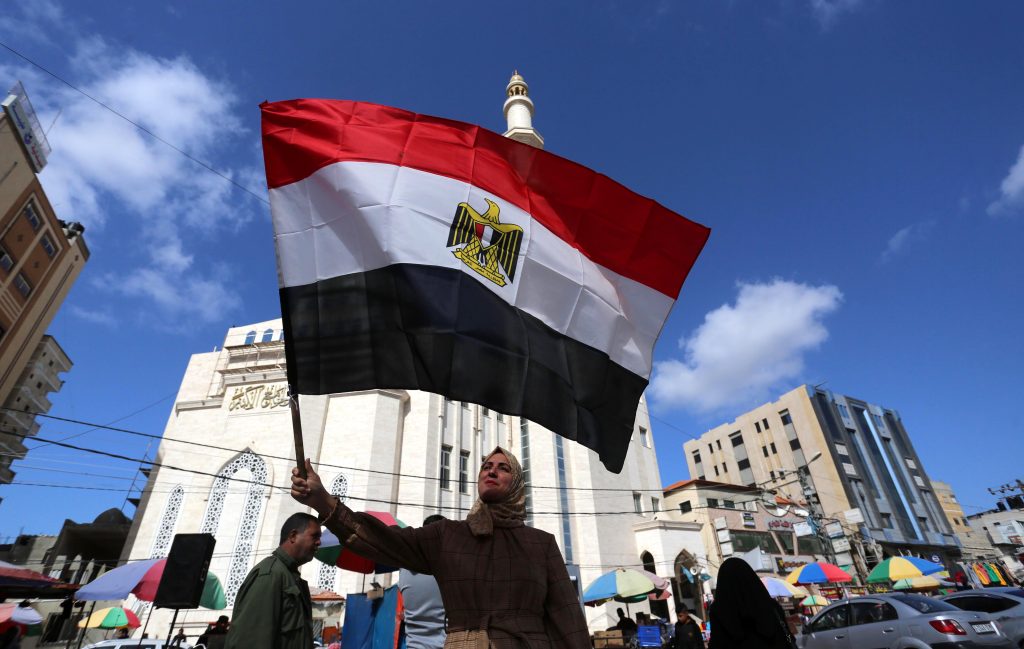
The revolution and after
In 2011, Mubarak’s infamous regime was overthrown by the national uprising, and in 2012, Egypt saw its first elected civilian president, Mohamed Morsi. Morsi barely won the elections with 51.7% of the total votes in what is lauded as Egypt’s first “real” presidential elections. Despite Egyptians welcoming the elections as an achievement, the reception of the results was mixed. Morsi was affiliated with the Muslim Brotherhood, a notorious and marginalized Islamist political group, the same Islamist group that Hamas branched out from in the 1980s.
Prior to 2012, Mubarak’s regime viewed Hamas as much of an enemy to Egypt as it was to Israel. As Morsi was affiliated with the Muslim Brotherhood, the regime’s view on Hamas changed almost 180 degrees once he took rule. Despite Morsi’s controversial views, it is undeniable that Egypt’s government was most interested in alleviating the pain of the Palestinian cause during his rule. In response to 2012’s Operation Pillar of Defense, Morsi remarked:
“We won’t leave Gaza alone, and we say to the aggressor that this blood will be a curse upon you and an incentive for all of the peoples of the region against you. Stop this travesty at once or you won’t be able to stand before our anger; the anger of the people and their leadership.”
Morsi’s regime did not settle for harshly-worded statements directed at Israel. Hesham Qandeel, former Egyptian Prime Minister, personally traveled to the Gaza Strip. These actions will be as far as Egypt’s solidarity will go for the next twelve years. In June 2013, people swarmed the streets, primarily dissatisfied with the government’s inability to stabilize the economy amid economic crises. The protests inevitably led to the ousting of Morsi by Abdel Fattah al-Sisi, who was the Minister of Defense at the time.
Since Sisi had amassed incredible popularity for the ousting of Morsi, it was a logical next step to take on the position of President of Egypt, which he did in 2014. Hamas was initially unsupportive of this change, and Sisi’s regime brewed and propagated anti-Hamas propaganda with the help of our national press. However, within a few years, Egypt and Hamas would bond over wanting to neutralize the presence of ISIS in the Sinai and Gaza.
With Sisi’s regime, we see the return of Mubarak and Sadat’s approach to Israel, albeit with a stricter approach regarding free speech. The government had finally realized that criticism of the peace treaty was criticism of the government itself, of which they are not ordinarily tolerant. We see an unprecedented strengthening of Egyptian-Israeli relations, which, to me, translates as even more and more desperation for U.S. and EU funds.
As you might’ve deduced, Egypt’s peace with Israel was indeed profitable, not just for Israel but for the U.S. as well. According to USAID, Egypt received about $30 billion dollars in investments from the U.S. over four decades since 1978. In 2021, Egypt received $125 million in economic assistance from the U.S. In September 2023, Blinken bypassed Congress and approved $235 million dollars in military aid to Egypt. The most recent dose of cash saw an immense increase, when the same administration approved another $1.3 billion in military aid just last September. These economic and military “handouts” are integral to Egypt’s crippled economy. By damaging relations with Israel or suspending the peace treaty, Sisi’s regime will be risking the abrupt halt of these funds, a vital lifeline of his regime’s treasury.
In the past year, we haven’t seen more reason for the Egyptian government to take solid moves than this time against Israel, and yet there was absolutely nothing. The silence is deafening, and with each statement following each massacre, it gets more maddening. But the truth is that our silence comes with a bill for the U.S. and its allies who continue to buy it from Egypt’s government. And, frankly, they excel in propagating silence and manufacturing helplessness. Let’s look at a few cases just within October 7 to the writing of this piece.
According to Amnesty International’s report about Egypt, 123 of those who publicly expressed pro-Palestinian sentiments, either by protesting, hanging signs, or simply writing comments on social media platforms, were arrested. One of these cases of arrests was as recent as last May, with the arrest of four university students who organized a simple movement called Egyptian Students for Palestine. This student movement primarily heralded calls for boycotts and the will to unite fronts with any pro-Palestinian movement, but they did not directly organize protests.
My theory is that the government feared that this movement might spur a wave of university campus takeovers across Egypt following the Student Intifada, which would be catastrophic for the regime.
Mohamed Abdallah, Ziad Basiony, Mazen Deraz, and Mohamed Ibrahim were arrested in May and kept in detention, facing bogus charges, in addition to denying them their final exams. The good development, however, is that the four students were released on July 22. The bad news is that there are still dozens like these students who were arrested for far less. One such case is Omar al-Ansary, who was arrested in April with four of his friends for hanging up a sign. Up until this point, no new developments have emerged in Omar’s case.
The fact of the matter is that Omar and many others aren’t asking for the impossible. Egypt has been enabling ethnic cleansing and genocide for decades, and all they require is that it stops. Last February, Egypt’s government threatened to suspend the peace treaty if Israel proceeded with the Rafah ground invasion. To us right now, Rafah’s catastrophic ground is a reality that Palestinians in Gaza have been dealing with since May, yet Egypt has yet to take any action against Israel. This goes on to show that every red line that Egypt, much like the world has for Israel, is only a false pretense.
This “threat” was as far as it had gotten. And when it comes to statements, it matters not the extent of the atrocity behind Israeli aggressions. It matters not the target either. Egypt seems to express the same pathetic amount of pretentious concern each time. What’s maddening is that I know for a fact our country has more leverage over Israel than this. Nonetheless, this leverage on Israel is withheld by the regime, and it seems that it is contingent on how the U.S. feels about Israel today. This renders Egypt complicit in the war crimes committed in Gaza.
We’re expected to shut up while witnessing this readily avoidable genocide unfold on a daily basis. They expect us to be the black swans of complicity, but truthfully, we’re not willing to do the dance — or at least I know I’m not. I’m not willing to pay the bill with my own sanity and integrity. It is appalling that even though Israel has shown our government more animosity in the past year than at any time before, their rifles are still pointed at us.
Yousef Zain al-Abdin
Yousef Zain al-Abdin is an Egyptian college student at Ain Shams University, majoring in English Language and Literature. He has freelanced as a writer in entertainment while self-publishing a small library of poems and short stories.

Good article to help explain Egypt’s lack of action in the Gaza genocide.
Great piece. Thank you Yousef. Egypt, the mother of all Arabs, will rise again. No doubt.