

What follows is necessarily asynchronous with reality, considering there is still so much that we do not know at this moment. One crucial exception is that the Assad regime is no more, and neither is Bashar Assad and his strongmen.
We should be happy for those who lived under the regime’s boot for decades. And I am, and so are most members of my family on the Syrian side, and my friends there, despite their concerns about the future and the lack of enthusiasm for Hay’at Tahrir Al-Sham (HTS) comprised primarily of Jabhat Al-Nusra (JAN), which for years since its inception viewed non-Muslims as second class citizens to be tolerated. That was until HTS had a public make-over after 2016 and “took back” some of their hardline positions. Despite all this, given the manner in which the regime’s leader abandoned his supporters and comrades, notably since 2020, even the self-respecting bonafide Syrian detractors of the militant opposition that ended up marching into Damascus are relieved Assad is gone. The takeaway that is likely to endure is the following: the sigh of relief we witness in Syria today does not contradict the profound concerns of many Syrians regarding the potential precarity of the coming months.
In the first intense days following December 8 when Bashar definitively left Syria, many observers correctly emphasized the Syrian people’s jubilation over a profound ambivalence towards prospects for the future. These concerns not only pertained to the forging of a new government but also to the challenges of development and Syria’s sovereignty, notably its relationship to the expansionism, belligerence, and military campaigns of Israel which continues to occupy and expand its presence around Syria’s Golan Heights. At this point, however, we are trying to analyze the news while we really still do not, and will not, know the full story for some time, especially regarding the trade-offs that took place before Turkey gave HTS the green light to mobilize.
The collapse of the Assad regime has undeniably brought a sense of relief and even joy to a large portion of the Syrian population. This newfound respite, however, is tempered by the considerable challenges that lie ahead. The path towards genuine liberation and sovereignty is fraught with uncertainty, not least amid continued aggression and expansion into Syrian territory by Israel, a threat that is not receiving any serious attention from Syria’s current strongmen.
The miscalculations and hubris of the Assad regime
There is a belief that the Assad regime, up to the moment of its downfall, continued to be an active agent in the Axis of Resistance, thus prompting some to continue to champion the regime until the last minute. Here, it is important to note that Syria has historically contributed indirectly to the Axis of Resistance as an enabler, with notable variance in intensity—e.g., compare its important role in 2006 to the diminished role in 2023-24. It’s also important to note that with Israel’s bombing campaign and the deadly pagers operations against Hezbollah in the fall of 2024, as well as its massive bombing in Syria of Syrian/Iranian military assets, including transport routes, the utility of the Syrian “lynchpin” or “bridge” to the Axis had been considerably diminished. Against this backdrop, the calculations and strategic posture of all actors involved here were altered, as became evident in November and December.
Today, many among the supporters of the resistance axis, are lamenting that the timing and substance of the swift surge, advance, and take-over by Hay’at Tahrir Al-Sham benefits Israel as it pursues its genocide in Gaza. The argument is that a disbanded resistance axis enables Israel to continue its genocidal campaign with even greater ease thus indicating that Assad’s removal could have been orchestrated, or signaled, by the United States and other allies, including Turkey, the party that has controlled HTS movements since 2018 in Idlib.
While all this might be true, this functional thinking elides the role that the Syrian regime played in precipitating its own demise and the fact that it should have anticipated the opportune timing of the mobilization. In fact, the failures of the regime extend back much further than the past year, or even past decade, but all helped lead to this moment.
Over the course of four decades of essentially uncontested rule, the regime was by 2011 primarily responsible for creating the conditions of an uprising, long before Jabhat Al-Nusra emerged, and long before the direct and massive intervention by a host of states and non-state actors–i.e., Turkey, the United States, Saudi Arabia, Qatar, and a plethora of totalitarian and other fighters, including ISIS.
There were challenges facing Syria during this time, and not all were within the regime’s control. The Covid-19 pandemic was devastating on multiple registers followed by a cholera outbreak and a drug-use pandemic featuring a massive trade industry that the regime benefitted from. Perhaps most significantly were the crippling sanctions imposed by the United States which were felt even more by ordinary Syrians—always a criminal habit of the United States vis-a-vis its regional adversaries. Yet, despite even these extenuating circumstances, the regime was not willing to take action to keep itself where it could. In particular, it refused to respond to any calls for reconciliation even from those who risked everything for its survival as an important, if junior, partner and lynchpin in the axis of resistance.
The regime gained the upper hand in 2016, since ending major hostilities, which signaled the end of the rebels’ hopes to topple the regime at that time. Since 2018/19, Syria has been engaged in late and low-level attrition-like conflict with the rebels. Simultaneously, its economic conditions have been exacerbated by the debilitating U.S. sanctions, and together with ongoing intervention by regional and international actors during the past nearly 14 years and counting. The irony is telling: none of the intervening states cared for Syrians’ well-being, and most (i.e., Turkey, Saudi Arabia, and Qatar) were either working with the regime, supporting it, establishing detente, or even chummy with it prior to the emergence of the Uprising. Only the United States was not supportive prior to the uprising, but its infinitely unprincipled record of propping up dictatorships and supporting the destruction or directly destroying Arab states/countries wholesale more than balances out the hypocrisy and unprincipled nature of the others.
The result of the uprising and international intervention has left Syria in a bleak condition featuring an unprecedented refugee crisis; more than six million refugees and an equal number of internally displaced persons have been unable to return. Yet, the Syrian regime has done nothing to alleviate these conditions, not even to rehabilitate its military defenses, despite the leadership’s possession of resources. Moreover, it did not ease its repression, allowed high levels of corruption, and refused any form of reconciliation with rebel forces despite entreaties from its closest ally, Iran, and of late, Turkey–though we know now that Turkey was buying time by letting the regime think all is well on the Idlib front.
If any ordinary observer can recognize Israel’s or the rebels’ opportunity to attack it, in light of the weakening of Hezbollah and Iran’s seeming restraint, surely the Syrian regime should have anticipated it, and been on guard.
Now, as we increasingly learn, Syria’s allies and neighbors, had been urging it to establish some sort of detente or reconciliation with the opposition rebels both publicly and privately, for the sake of stability, self-preservation, and, for some, the avoidance of precisely what was possibly an opportune move to revive a rebellion. But the regime’s hubris, tyranny, and deep corruption prevented it from lifting a finger or engaging in even the most minimal compromises regarding its near-absolute dominance, to begin crafting a Syria for (let’s say) most Syrians. While this position seemed rational given the regime’s reading of the geostrategic context in 2011, in November 2024 it was a gross miscalculation.
This combination of hubris and obstinance was not a new attitude. It has been in the making ever since Bashar inherited and consolidated power in the early 2000s when he embarked on “modernizing Syria” with neoliberal reforms laced with nepotism and corruption. This produced a new image of a rising Syria while redistributing wealth from the bottom up to a circumspect circle of beneficiaries almost wholly determined by the ruling class. Thus, the five years before the emergence of the uprising in 2011 was critical in the regime consolidating further political and economic power, along with the continuing festering of state and bureaucratic institutions.
By 2018-2020, after much bloodshed, destruction, and massive migration, and as de-escalation was underway, the embattled regime continued to exist along the same lines of command and authority it did directly prior to the uprising while being significantly weakened and isolated. The now uncontested family leader opted to neither save Syria from total collapse, nor rebuild state institutions, including the army, nor call for the repatriation of Syrians to rebuild anything, nor came out to address his people as a leader should in times of destitution, nor support measures for their improved livelihood, nor provide living wages for his defense forces (from family or state coffers), let alone state employees, all of whom stood by the regime for good or for ill.
Bashar just sat there. For a long, long time. He also sat there watching the Israeli and U.S. barbarian leaders administer a genocide in Gaza. He sat there like his Arab state counterparts, for the most part, save for administering a considerably decreased rate of armed munitions and supplies. Notably, the rapprochement starting in mid-2023 between Syria on the one hand and Saudi Arabia and the UAE raised the regime’s hopes of alternative anchors, which in turn raised eyebrows among friends and foes alike, including its natural allies, Iran and Hezbollah.
So, if anyone is upset about the timing of the fall of the Assad regime, and its impact on further undermining resistance to imperialism because it benefits the racist genocidal state of Israel and the repulsive hypocritical Western states, there is no one to blame but the always brutal and self-serving Syrian regime itself.
Finally, those who support continued resistance to Israel’s expansionist settler colonialism and the destructive domination of the United States policy in the region, do not weep for the runaway regime. The regime’s utility to resistance was increasingly diminishing. Various reports and signals indicate its own partners, Iran and Hezbollah, grew frustrated with its leadership as an increasingly emerging burden and potential dead weight because of the foregoing. More will be uncovered with time, it seems, but their actions, or lack thereof on the eve of its collapse, spoke louder than words and speculation, then and now. The question is will Syria’s new leadership exhibit a resistance stance, with or without Iran or Hezbollah?
Israel and the New Syria
I will hold my judgment or suspicion at the prospect of the new regime’s orientation toward Israel but I am not hopeful. Israel destroyed Syria’s entire military capabilities in 48 hours (continuing until the time of this writing), and Syria’s new strongmen issued a lukewarm statement of condemnation at the UN three days later. Moreover, it seems like everyone has an interest in what happens next–including the array of state and non-state actors who coordinated, supported, and helped with this cakewalk over Syrian cities (thanks to the run-away dictator), all of whom either support the colonial culprits, are eager to normalize with or avoid angering them, or are themselves the colonial culprits. What they do next will also matter.
Beyond the very real relief that Syrians are enjoying at the moment, indicators suggest that the worst may still lie ahead regarding Syrian sovereignty and prospects of liberation from Western domination for the region. This threatens to make the relief from the brutality of dictatorial rule short-lived.
These threats include subjugation to non-Syrian agendas (in the new “Democratic Syria”), further territorial divisions, further Israeli land grabs, continued Turkish control of parts of the north, resource theft on the Mediterranean, oil pipeline deals in exchange for Syrian compromises, and living under the boot of Arab capital, Western guns, and Israel’s whims.
So far, the writing is on the wall: even the right to respond to Israel’s debilitating strikes (which the fallen regime pathetically kept reserving) is not being invoked by the new Syrian leadership, even after one of the most blatant acts of war and erasure of sovereignty in modern times. In response, leader of HTS Ahmad Al-Sharaa states that Israel “clearly crossed the disengagement line in Syria, which threatens a new unjustified escalation in the region” but that “the general exhaustion in Syria after years of war and conflict does not allow us to enter new conflicts.” In addition to the equally delayed procedural statement of condemnation issued by Syria’s powers that be to the United Nations, this bizarrely delayed non-response does not bode well for both resistance to Israel’s actions or the independence of the new Syria so far, to put it mildly.
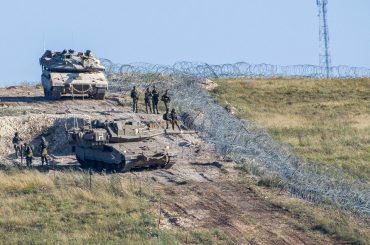

Re Israel’s historical relations with Syria, people here have pointed out that the hasbaric mythology that Israel is always just defending itself it just that, mythology. If you want a good exposition on Israel-Syria relations I suggest “Mythologies Without End” by Jerome Slater, a historian and poly-sci professor, particularly Chapter 12, “The Israeli-Syrian Conflict, 1973-2019. Here I’m quoting from pages 192-193:
…during this period Israel could have reached a political settlement with Syria on very favorable terms, for the moderate and pro-western governments that were then in power in Damascus offered to end the conflict with Israel and even resettle in their country most of the Palestinian refugees who had fled or been driven out of Israel in 1948, on the condition that Syria would retain its foothold along the river and the lake….However, Ben-Gurion was not willing to let Syria share those waters and refused even to enter into negotiations with Damascus. Indeed, at this point he had not given up Zionist expansionist goals….In the next few years there were a number of Syrian-Israeli military border clashes….Israeli military leaders, historians, and journalists have established that most of the clashes were initiated or deliberately provoked by Israel…it is worth repeating the candid admission of Moshe Dayan….that more than 80 percent of the clashes…had been instigated by Israel, so as to create a pretext for seizing more territory and diverting the waters of the Jordan river away from Syria…
I’d like to see Mondoweiss do a whole piece on the water situation, because a lot of the opposition to the “Jewish State” had nothing to do with anti-semitism, it had to do with Israel messing with the plumbing.
Bassam Haddad is so obsessed with his well-known hatred for the Assad government that he cannot fully admit the disaster. Israel now holds 400 sq km of Syrian territory. It has completely occupied Jebel al Sheikh (Mt Hermon) highest mt in Syria and strategic observation point. Its forces are 20 km from Damascus and less than that from the Beirut-Damascus highway, on which it can invade Lebanon at any time. It has occupied the Yarmouk River basin up to the Unity Dam and reservoir on the Jordan-Syria border, the most important water source in southern Syria. It has displaced tens of thousands of Syrians from the villages it has overrun. Israel stated its plans to double the settler population in the Golan, which it annexed in 1981, and it will not in the foreseeable future withdraw from it or any other part of Syria. Israeli TV crews enter Syria at will and report from Damascus.
Turkey has long de facto annexed areas along the north Syria border, installing Turkish administration, banking and commerce. It will likely annex large portions of north Syria, probably including Aleppo, never to be driven out.
The US, the Kurds and Turks are fighting over the northeast, Syria’s oil reserve and breadbasket, now lost forever. The ‘Rojava’ project so beloved in western academic circles was always a chimera, and the Syrian Kurds would have reunited with Syria, given time and absent outside interference. Now they will likely be conquered by Turkey, as shown on maps on Turkish TV, their vaunted autonomy and US alliance becoming the latest Kurdish hubris
Meanwhile Damascus is occupied by jihadi hordes, less than a decade after they were literally driven from its gates by the Syrian Arab Army. Haddad assures us that Syrians celebrate, but “lack enthusiasm” for the religious terrorists who now rule them. Christians cower in terror in their desecrated churches, Christmas is forbidden, Alawites are being slaughtered, tens of thousands have fled to Lebanon, Syrian Arab Army veterans are being slaughtered, govt offices looted and burned, incl the National Museum, storehouse of Syria’s priceless antiquities, the Passport and Immigration office, with its records of citizenship, the central bank. Haddad and his charmed circle can only “lack enthusiasm” and murmur that “difficulties for Syrian sovereignty and liberation from western domination may lie ahead”.
For an account by someone with deep roots in Syria and Palestine, much more sympathetic to the difficulties of Syrian sovereignty, independence, and resistance to foreign domination, see this interview with Beirut independent journalist Laith Marouf. I disagree that Russia “traded Syria for Ukraine” with the Trump admin; Russia is winning in Ukraine, doesn’t need deals, and would hardly trust the west. But otherwise Marouf is compelling and moving.
https://www.youtube.com/watch?v=Oea9i3EB1-k
See also this interview with former British intel and diplomat Alastair Crooke, on the reasons for Assad’s fall. There is no denying the deep problems of the Assad govt, but the Syrian people supported it through the initial stages of the uprising against it, which was violent from the start, part of an ongoing regime change campaign by the US and Saudi Arabia, which they agreed on around 2006. See Seymour Hersh, “The Redirection”, inter alia. The western liberal claim of a “non-violent revolution” that took up arms in response to govt repression is nonsense. Syrians supported the govt not from any love for Assad, but as the means of preserving the country and eventually creating something better. They won a partial victory, at great sacrifice, and the jihadis were bottled up in Idlib, where Turkey supported them and turned them into an army. Meanwhile Syria was robbed of wheat and oil by the Kurds and the US, and 90% of the population was impoverished, with 12 million in “food insecurity”, starvation. Indisputably, their sacrifice and support were squandered by the govt, for reasons unknown for some time, but Crooke’s views are as good as any current observations.
https://chrishedges.substack.com/p/the-fall-of-assad-and-what-it-means
Iran under the Shah was said to be under Western domination (despite having raised oil prices through the roof against U.S. wishes), but Iran under the mullahs receives much more admiration as the center of the “Axis of Resistance”, despite the fact that human rights violations under the latter are far greater than under the former.