

The commander-in-chief of the Izz al-Din al-Qassam Brigades, the military wing of Hamas, was confirmed dead on Thursday evening. Muhammad Diab al-Masri, most commonly known by his alias, Muhammad al-Deif, was killed while leading the fighting against the Israeli army throughout the war, said Abu Obaida, the spokesperson of the Qassam Brigades, in a televised statement on Thursday night. Abu Obaida also confirmed the death of a number of other members of the Qassam Brigades’ top military brass, including the deputy commander-in-chief, Marwan Issa, the head of logistics, Ghazi Abu Tamaa, head of the human force department, Raed Thabet, and the commander of al-Qassam’s Khan Younis Brigade, Rafe’ Salameh.
Muhammad Deif has been at the top of Israel’s most-wanted list for over 30 years, ever since he first became known to Israel’s intelligence apparatus in the early 1990s. He rose through the ranks of Hamas’s armed wing after Israel assassinated the cofounder of the Qassam Brigades and its first commander-in-chief, Salah Shehadeh, in 2002.
The leader of the resistance group earned his moniker “Deif” (Arabic for “guest”) due to his clandestine military activities and frequent moving between different Palestinian houses in order to avoid detection by Israel, becoming his nom-de-guerre. Deif survived several assassination attempts over the years and made a media appearance only once with his face covered in an Al Jazeera documentary in 2005. In 2014, Israel announced his killing after bombing his house, killing his wife, Wedad Asfoura, and their two children, 3 years old and 7 months old. Hamas, however, denied the death of Deif.
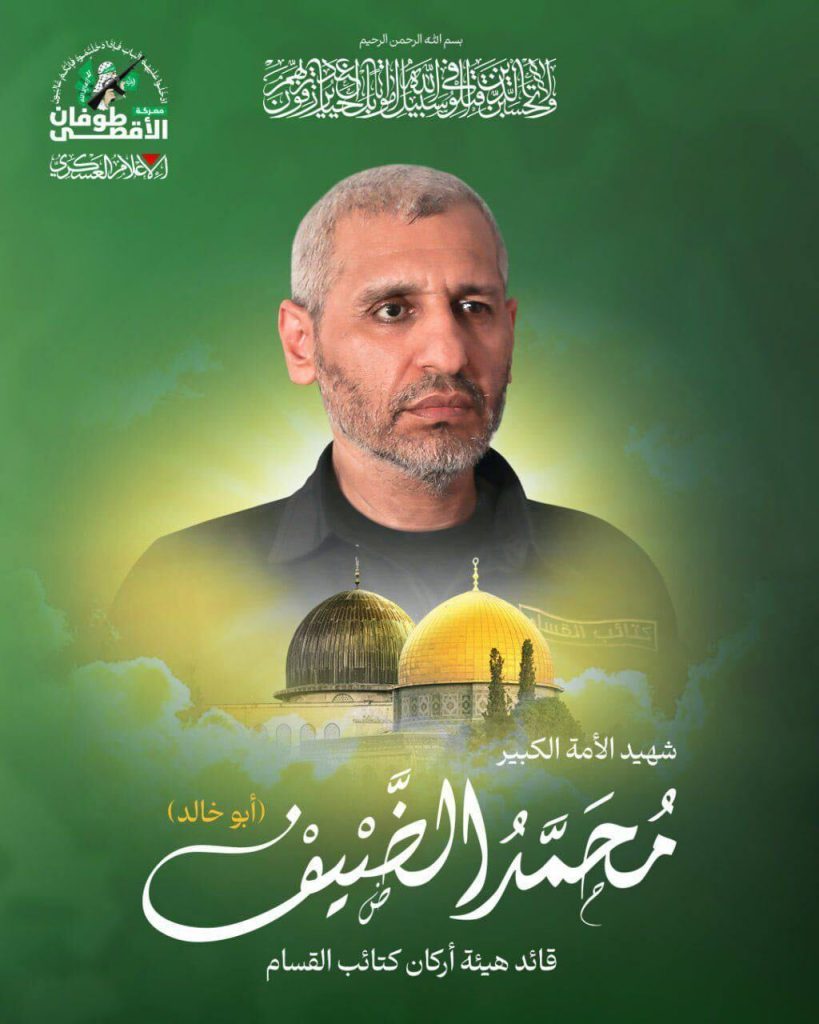
In a more recent Al Jazeera documentary, Deif appeared in never-before-seen footage dressed in military uniform with his face blurred as he was discussing plans for the October 7 attack. In the documentary, Deif can be heard speaking about the goals of “Operation al-Aqsa Flood,” asserting that “we can take the initiative in changing the course of history and be the first ones to do it at this point in time.” Deif’s image had hitherto been shrouded in mystery, with only a handful of outdated grainy photos attesting to his appearance as a young man. Earlier in the war, the Israeli army had released photos that it alleged were of Deif holding a wad of cash, which the army said it had found during military operations in Gaza. Following the official announcement of Deif’s death by Abu Obaida, the Qassam Brigades released a poster of al-Deif revealing his most recent likeness.
Israel had earlier announced the killing of Deif on July 13, 2024, following a massive bombing of a tent encampment in the Mawasi area in Khan Younis. Israeli warplanes dropped nine U.S.-made bunker-buster bombs on the crowded displacement camp, killing 90 Palestinians, half of whom were women and children, and wounding over 100 others. Palestinians continued to dig in the sand for hours in an attempt to retrieve the dead bodies buried. Hamas did not deny the killing of Deif at the time but said that the only official source for news on the fate of any al-Qassam leader was the military wing itself. Israel reaffirmed the killing of Deif in the bombing on August 1, but the Qassam Brigades again neither confirmed nor denied the Israeli assertion. It remains unclear whether Deif was indeed assassinated during the July 2024 bombing, as originally claimed by Israel, or at another point in the war.
Throughout the past 15 months, Israel has assassinated much of Hamas’s top political and military leadership. The movement had previously announced the death of Ahmad Ghandour, the commander of al-Qassam’s northern Brigade, and Ayman Nofal, the commander of the group’s central Gaza Brigade. Israel also killed Hamas’s politburo member Saleh Aruri in Beirut, its politburo chief Ismail Haniyeh in Tehran, and his successor, Yahya Sinwar, who was killed in combat in Rafah while fighting the Israeli army.
Killing Palestinian leaders has been an Israeli strategy since the 1970s, starting with the assassination of Palestinian writer, intellectual, and journalist Ghassan Kanafani in 1972 in Beirut, and followed in the same year by the killings of the poet Wael Zueiter in Rome, and the killings of PLO leaders Kamal Nasser, Kamal Adwan, and Abu Yousef al-Najjar in Beirut. Israel also assassinated the PLO’s second-in-command, Khalil al-Wazir (Abu Jihad) in Tunis in 1988, the founder of the Palestinian Islamic Jihad, Fathi Shikaki, in Malta in 1995, and the head of the Popular Front for the Liberation of Palestine, Abu Ali Mustafa, in Ramallah in 2001.
Israel has employed the strategy of assassinating Hamas leaders ever since the first failed attempt to assassinate its politburo member Khaled Mashaal in Amman in 1997. Since then, it has assassinated its founder Ahmad Yasin in Gaza in 2004, his successor Abdel Aziz al-Rantisi a month later, and al-Qassam chief Salah Shehadeh in 2002, who was succeeded by Muhammad Deif.

Re Hamas: I’m halfway through Peter Beinart’s new book, “Being Jewish After the Destruction of Gaza – A Reckoning”. It is superb. But about Hamas this is a quote from pages 42 and 43:
In November 1956, the Israeli military entered Gaza, then under Egyptian control, after Cairo blockaded the Straits of Tiran. In the town of Khan Younis, according to [Israeli historian] Benny Morris, “IDF troops shot dead hundreds of Palestinian refugees and local inhabitants of the town” while searching for weapons. A nine year old boy named Abdel el-Aziz al-Rantisi saw his uncle shot. “I still remember the wailing and the tears of my father and my brother”, al-Rantisi told an interviewer many years later. “I couldn’t sleep for many months after that….They planted hatred in our hearts”. Three year old Ziad al-Nakhalah witnessed the execution of his father. Three decades later al-Rantisi helped found Hamas. Al-Nakhalah now leads the smaller but equally militant rival, Palestinian Jihad.Over the decades this pattern has repeated over and over.
Thirty years of Middle East lies just keep coming back to bite usThe West’s ‘war on terror’ was built on a series of deceptions to persuade us that our leaders were crushing Islamist extremism. In truth, they were nourishing it
The story: Did you believe it 30 years ago when they told you that the Oslo Accords would bring peace to the Middle East? That Israel would finally withdraw from the Palestinian territories it had illegally occupied for decades, end its brutal repression of the Palestinian people, and allow a Palestinian state to be created there? That the longest runing sore for the Arab and Muslim worlds would finally be brought to an end?
The reality: In fact, during the Oslo period, Israel stole more Palestinian land and expanded the building of illegal Jewish settlements at the fastest rate ever. Israel became even more repressive, building prison walls around Gaza and the West Bank while continuing to aggressively occupy both. Ehud Barak, Israeli prime minister of the time, “blew up” – in the words of one of his own main advisers – the US-backed negotiations at Camp David in 2000.
Weeks later, with the occupied Palestinian territories seething, opposition leader Ariel Sharon, backed by 1,000 armed Israeli troops, invaded occupied Jerusalem’s al-Aqsa mosque – one of the holiest places for Muslims in the world. It was the final straw, triggering an uprising by Palestinians that Israel would crush with devastating military force and thereby tip the scales of popular support from the secular Fatah leadership to the Islamic resistance group Hamas.
https://jonathancook.substack.com/p/thirty-years-of-middle-east-lies
SAS ‘rogue heroes’ – or just rogues?
How many more shocking allegations about the SAS must emerge before the ‘who dares wins’ regiment is subject to transparency laws?
Key evidence held at UK special forces headquarters containing allegations the SAS had killed Afghans in cold blood was destroyed to prevent the military police from seeing it, an inquiry was told this week.
Senior special forces officers and defence officials were so desperate to cover up SAS activities in Afghanistan that the crucial data was deleted from an IT system at the “higher headquarters of special forces”, inquiry chairman Lord Justice Haddon-Cave said.
He noted how the data was “wiped before the military police could seize and examine it”. But he revealed that with “independent help” the inquiry had managed to get a back-up copy and intended to restore the data.
It was the latest testimony in an inquiry that has placed an unprecedented spotlight on an elite band of British troops that have a degree of protection from scrutiny greater even than that enjoyed by the security and intelligence agencies – MI5, MI6, and GCHQ.
The SAS has also benefited from naked hypocrisy. Officially there is a blanket ban on reporting the activities of the SAS and its naval equivalent, the Special Boat Service (SBS).
Yet defence journalists are discreetly encouraged to describe their derring-do, so long as they praise them as heroes, much as they are, in fact and fiction, on television.
https://www.declassifieduk.org/sas-rogue-heroes-or-just-rogues/
This decades-long line of Israeli assassination and murder just shows how self-defeating this policy is. All of these leaders were replaced, the resistance continues, and will endure. And what is true of the leaders is also true of the ranks. An Israeli official reportedly acknowledge that the resistance fighters that Israel killed in the current war have already been replaced by new recruits.