Editor’s Note: This reflection was written before the announcement of a ceasefire in Gaza on January 15, 2025.
I was born and raised in Gaza City in the neighborhood of al-Shuja’iyya, where I learned from a young age to serve my community. I would volunteer with the Red Cross and participate in first aid training courses. I was also a social researcher with local associations in Gaza that were assisting poor families by providing healthcare services or financial aid. Despite losing everything I owned in this war, I have not lost my volunteering spirit or my passion for helping others.
Before the war, life was stable. We had a routine life here in Gaza, just like anyone else in the world — work, studies, hobbies, friends and family. Everything changed with the war. Now there is no work, no education, and even stepping outside is impossible. Nowhere is safe. All we can do is count the days, waiting for a ceasefire to come into effect and for a permanent end of hostilities.
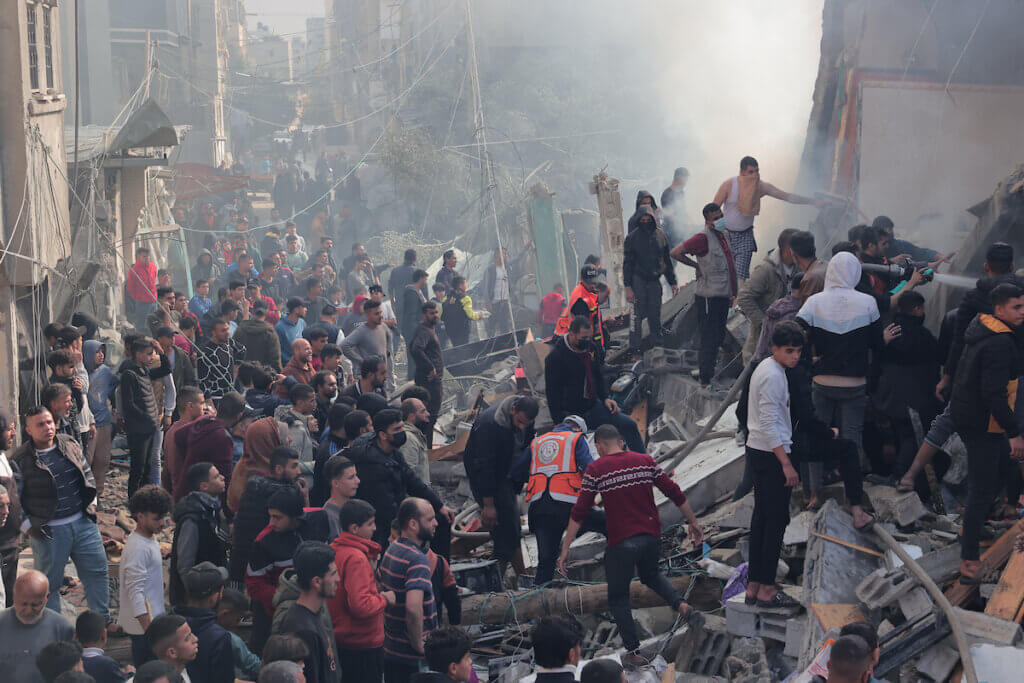
When the war began in October 2023, I joined the search and rescue team in al-Shuja’iyya. Our primary mission is to retrieve the injured from under the rubble and move them to safety after Israeli bombardments or attacks. Unfortunately, we often only recover dead bodies instead of survivors.
There are many of us who jump into action whenever a bomb strikes, whose names you will never know. First responders who work with minimal resources, sometimes in groups, sometimes alone, without any advanced equipment to assist us in handling these complex tasks. Despite this, we do what we can.
Every moment leaves unforgettable images in my mind: destroyed homes, women standing broken beside the remnants of their homes, barefoot children running through the rubble searching for their toys, and elders raising their hands to the heavens, pleading for mercy. These scenes, despite their harshness, are what push me to keep going.
‘Uncle, I’m alive’
One night in February 2024, we experienced one of the most harrowing moments of the war. We were huddled in a small room as explosions roared around us, sounding like relentless rainfall. But it wasn’t raining — it was Israeli bombs, burning everything in sight. The explosions were so close that I felt my heart would leap out of my chest from fear. Shelling went on for ten minutes that felt like an eternity.
When it finally stopped, we ventured outside to check on our neighbors. What we found was beyond devastating. Where was the Hassanin family? Where were the Mashharawis? Their homes were completely leveled, and there was no sign of life.
We began searching through the rubble, calling out the names of those we knew: “Ali! Ahmad! Khalil! Is anyone here? Can anyone hear us?”
Suddenly, a faint voice emerged from the debris: “Uncle, I’m alive… Please get me out… I’m scared.”
I couldn’t wait for rescue equipment to arrive. I started digging with my bare hands, ignoring the rubble and shrapnel scratching and cutting me open. Eventually, I managed to pull out a child — Mahdi Adas, the sole survivor of three families that were annihilated on Shuja’iyya Street.
That night left a deep scar on my soul. The lack of tools made it impossible for us to reach the bodies of some of the martyrs trapped under the rubble.
The massacre of Tabaeen
On August 10, 2024, we were waiting for dawn prayers at 4 am in the al-Daraj neighborhood of Gaza City when we heard a loud and terrifying sound. Israeli forces had bombed the nearby Tabaeen school.
I was in shock. I knew that my friend Hassan and his brother Ali had gone to the prayer area in Tabaeen. I called Hassan; mercifully, he was alive. He said that Israeli forces had bombed the prayer area and that he couldn’t find Ali.
I went with the rescue teams to the area to see what we could do. The scene was indescribable. Martyrs were everywhere; I saw the remains of children and other displaced people scattered all over. None of their bodies were left intact, pieces of human flesh were everywhere. At least 80 people were killed that day.
We managed to help some people get them to the hospital. One boy, around 16 years old, was in bad shape. His lower body had been crushed and his limbs were mangled. His left hand was amputated, and his other wounds were deep. I carried him to the hospital in my arms since the ambulances were full.
The area around the school was filled with smoke and the sound of crying and screaming. Ambulances arrived and we began to collect the human remains and place them in bags. We could not find Ali. Hassan asked what he should do now and how he should inform his mother of what had happened to Ali. Where did his brother go?
They gave him a 35-kilogram bag of human remains, presumably his brother’s.
This same school was targeted again on November 27, 2024. Seventeen Palestinians were killed in an Israeli airstrike that once again hit the school at dawn. Our teams managed to retrieve 10 bodies, including children, along with several injured individuals.
On every corner, a memory of horror
The volunteers I work with have become like family. We live together and support each other emotionally. The mere presence of people like them provides me with a sense of safety.
Yet the nature of our work as first responders is extremely dangerous, as rescue and civil defense teams have become direct targets of repeated Israeli attacks. There were many times when the bombings were very close to us, and I truly felt it was the end. I am still astonished at how I survived certain attacks. Every time I leave my home, fear grips me — I worry that I may never return to my family, the only thing I have left from my life before the war. I think about death often, as if it is near, but I always hope for safety and peace.
Yet this fear doesn’t stop me from doing my part. How can I sleep at night knowing that there are neighbors still trapped under the rubble, that some of them might still be alive? How can I close my eyes while there are lives I could help save? There might be a soul crying out for help, and I could be the reason they get a second chance at life. I cannot sit at home waiting for the day a ceasefire comes into effect to go out, help, and make a difference.
All of this has put me in a bad psychological state, making me feel despair and lose the meaning of life. Beneath every stone in Gaza lies an untold story, stories and scenes related to martyrs, the wounded, and the body parts we retrieve from beneath the rubble. On every corner, there is the memory of an incident and horrifying details that cannot be ignored or forgotten. Al-Shuja’iyya has turned into a ghost town, almost deserted by its people, the area largely destroyed. These memories will haunt me forever.
No matter how much I try to find the right words to describe what we are seeing and going through, it’s never adequate. But I want to share what we are facing, even if just to feel, in the slightest way, that someone is listening to us.
Right now, there’s nothing helping us except hope, prayer, and faith.