

In northern Gaza, where Israeli checkpoints have become sites of terror and humiliation, everyone fears the moment he might end up face to face with an Israeli soldier. Being forced to strip naked under the gaze of a sniper is a nightmare that has become a recurring reality for Palestinian men. For Mahmoud, 24, and his father Osama, 50, that moment came after enduring over 450 days of starvation, relentless bombardment, and repeated displacement.
“When I first approached the checkpoint, an Israeli soldier yelled at me, grabbed my hat, and threw it to the ground. I stayed calm. I had to stay calm, knowing any reaction could endanger my life.” Mahmoud told Mondoweiss, recounting the harrowing moment of his forced displacement from Jabalia, in the northern Gaza Strip, in November.
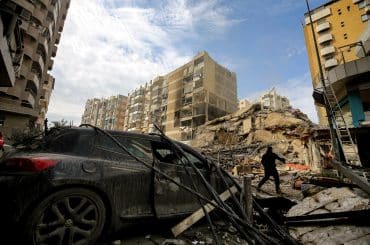
Their ordeal was part of a systematic Israeli campaign to empty Jabalia, a densely packed refugee camp in northern Gaza. Once a vibrant community, Jabalia has become the epicenter of devastation in Israel’s war on Gaza, its streets reduced to rubble and its residents forced to flee. Since October 5, 2024, when Israeli forces staged a large-scale advance into northern Gaza, thousands of families like Mahmoud’s have faced the agonizing choice between leaving everything behind or risking death.
For Mahmoud, leaving was not just the loss of home, but a surrender of dignity. His journey to the checkpoint was the culmination of weeks of survival under relentless airstrikes, dwindling supplies, with no place to hide. “They destroyed our lives and stripped us of our humanity,” he said.
‘This is the end’
Since the beginning of the Jabalia attack, Osama, a longtime resident of the camp, believed the Israeli military’s ultimate goal was to empty northern Gaza of Palestinians. “He knew we would never be able to come back,” his son Mahmoud said. “And he refused to make it easy for them.”
Despite his conviction to stay, Osama prioritized his family’s safety. On October 7, 2024 — a year after the war began, and just two days after the Israeli attack on Jabalia intensified — he urged his wife, two younger sons, eldest daughter, and three grandchildren to flee to western Gaza City.
Mahmoud, his eldest son, refused to leave. “I agreed with my younger brother that he would go with my mother, and I would stay with my father,” Mahmoud explained. “I couldn’t leave him alone.”
The pair moved from their fourth-floor apartment to Mahmoud’s grandmother’s abandoned ground-floor home, hoping it would offer better protection from the relentless Israeli bombardments. Safety, however, remained an illusion. Bombs rained down incessantly, artillery thundered in the streets, and stepping outside meant risking death by sniper or quadcopter strikes. Supplies dwindled. “We would hear injured people calling for help, but no one dared to enter the street, fearing sniper fire,” Mahmoud remembered.
As the situation worsened, with tanks advancing under cover of heavy artillery fire, Osama and Mahmoud fled their home on October 15 to Osama’s in-laws’ abandoned house in an area known as the Beit Lahia project. “We moved to another area in Jabalia, escaping tanks and enduring constant bombings,” Mahmoud recalled. Though the area was slightly removed from immediate fighting, danger was ever-present.
The father and son relied on the rations they had secured before the escalation for their survival. Markets were closed, and humanitarian aid was blocked. They had only essentials — rice, beans, and canned food. Cooking during the day and remaining silent at night became their routine. “At night, the only sounds were explosions,” Mahmoud said. Water was an even greater challenge. Fortunately, Osama had stocked water at his in-laws’ house before the assault, a foresight that saved them. Still, every drop had to be rationed.
Mahmoud and Osama had to evacuate again, spending a cold night out in the open without blankets, unsure of where to go. “Those days were the hardest of my life,” Mahmoud said. “I would fall asleep wondering if I’d wake up.”
After more than 45 days of relentless Israeli bombardment, Mahmoud and Osama eventually had no choice but to leave Jabalia altogether. The once-bustling community of Jabalia was now fragmented and desolate. Many neighbors had fled or been killed. Those who stayed behind were hiding in the ruins, sharing what little they had when they could. “We all became ghosts in our own neighborhood,” Mahmoud said. “Every sound, every movement felt like it could be the last.”
“Our neighbors encouraged us. They were also planning to leave the next day,” Mahmoud said. “They had mothers and wives, and we wanted to give them our phones and clothes to pass through,” as Israeli soldiers were less likely to strip-search women and seize their belongings.
“We left everything behind — our home, our belongings, and most painfully, my father’s sewing machines, which were our livelihood.”
On November 20, Mahmoud and Osama walked through the alleys of Jabalia camp, heading to the Israeli military checkpoint along Salah al-Din Street, the main road linking northern and southern Gaza. The checkpoint, guarded by Israeli soldiers, was a site of chaos and humiliation.
The soldiers ordered men to strip naked to undergo body searches. “I stood in line with 300 men, naked, holding up my ID,” Mahmoud said.
For six hours, Mahmoud and Osama stood in the cold surrounded by tanks, dust creeping into their eyes and lungs. The 300 men only had 20 liters of water to share among themselves. Some detainees were arbitrarily beaten or arrested, while others were not allowed to take anything with them when they left — not even their clothes.
“At that moment, I thought: ‘This is the end,’” Mahmoud said. But he and his father were among the few who passed through. “Walking away felt like being born again,” Mahmoud reflected.
Despite being ordered to keep walking, Mahmoud and Osama retrieved their clothes when soldiers weren’t watching and continued on foot for 5-and-a-half kilometers (3.5 miles). Finally, they reunited with their family in western Gaza, exhausted and in complete disbelief that they had survived.
Families separated
Yet not everyone shared Mahmoud and Osama’s fate. Among those detained at the checkpoint was one of their neighbors, 60-year-old tailor Abu Mohammed.
For weeks, his wife, Umm Mohammed, and their family stayed in their home near Kamal Adwan Hospital in Beit Lahia, refusing to leave. “Where could we go?” Umm Mohammed asked. “Everywhere in Gaza is unsafe.”
But as the attacks escalated, their survival outweighed their fears. On the bitterly cold morning of December 2, Abu and Umm Mohammed, their two younger sons, Mahmoud and Ahmed, their daughter Malak, their daughter-in-law Aya, and their toddler grandchild fled their home, while their eldest son, Mohammed, stayed behind. A machine technician at Kamal Adwan hospital, Mohammed felt obligated to stay behind and care for the wounded. “I can’t leave,” he told his family.
They parted in tears, uncertain if they would meet again.
At the checkpoint, Umm Mohammed watched helplessly as the men were separated from the women. She, Malak, Aya, and the baby passed through, but spent hours waiting anxiously for her husband and sons. Eventually, Mahmoud and Ahmed arrived at their temporary shelter in Gaza City hours later — but Abu Mohammed was not with them.
“I didn’t know whether to smile because my sons were safe, or cry because my husband was taken,” she said. “My sons didn’t even know where their father was taken or what they did to him.”
On December 27, her eldest son Mohammed thankfully made his way to his family in Gaza City, after enduring horror in Kamal Adwan hospital, which was once again ruthlessly targeted by the Israeli military at the end of the year.
The Israeli army besieged the hospital for almost a week, preventing anyone from coming in or out and blocking the entry of food or water to those inside. On December 26, Israeli soldiers forcibly evacuated the hospital, dragging every doctor, worker, patient, and displaced person to a besieged school nearby. After hours of detention and humiliation, Mohammed and others were released.
“I felt that we could almost have lost Mohammed as well,” Umm Mohammed said. “But thank God, we have him in our house.”
More than a month has passed since Israeli soldiers detained Abu Mohammed. “We communicated with humanitarian organizations and the Red Crescent to see if they could give us any information about my husband, but no news has come out so far,” Umm Mohammed said. “We also tried to contact those recently released from Israeli prisons in case anyone had seen my husband, but all efforts have been in vain.”
“He has no political ties,” Umm Mohammed insisted. “He’s spent his life sewing to support us.”
Abu Mohammed is one of dozens — if not hundreds or thousands— of Palestinian men detained arbitrarily since the beginning of the war. Though there is no official confirmation of the specific number of Palestinians detained and kidnapped by Israeli forces in Gaza since the October 2024, Palestinian prisoners rights group Addameer estimates that at least 10,400 Palestinians are currently held in Israeli prisons, the majority of whom are held incommunicado in conditions that human rights groups have denounced as “horrifying.”
Despite the uncertainty, Umm Mohammed clings to hope. “I still pray that tomorrow, I’ll wake up to hear him knocking on the door,” she said.
Washington, D.C. | http://www.adc.org | January 9, 2024 – After a complaint filed by ADC and CAIR-NJ last year, the Department of Education Office of Civil Rights (OCR) has directed Rutgers University to address probable violations of Title VI of the Civil Rights Act of 1964. The complaint alleged that Palestinian, Arab, and Muslim students at Rutgers are facing unlawful discrimination and identity-based censorship. The Department of Education agreed.
OCR found that Rutgers failed to sufficiently respond to reports of discrimination made by Palestinian, Arab, and Muslim students. Notably, OCR also determined that Rutgers likely violated Title VI by removing posters and memorials placed by Palestinian students to call attention to the ongoing genocide in Palestine because it selectively enforced university policies against Palestinian students. Furthermore, OCR found that Rutgers failed to protect its Palestinian, Arab, and Muslim students from hostile actions by third parties, such as doxing and harassment.
OCR also resolved complaints of anti-Semitic harassment made by Jewish students at Rutgers. ADC welcomes OCR intervention in legitimate complaints of such discrimination, but rejects any conflation of anti-Zionism with antisemitism. We demand that OCR and all other government agencies refrain from making such a conflation when addressing anti-Jewish racism.
To address these violations, OCR directed the University to review all policy and procedures to ensure compliance with Title VI; to conduct listening sessions with Palestinian, Arab, and Muslim student organizations; to submit all complaints filed by students in 2023-2024 to OCR for review; to submit all disciplinary actions taken against students and student groups in 2023-2024 to OCR for review; to train employees on discrimination on the basis of shared ancestry; to provide annual non-discrimination training for campus police; and to administer a climate assessment of the university as a whole. OCR also directed Rutgers to re-assess and redress the harm faced by a particular student who experienced anti-Palestinian, anti-Arab, and anti-Muslim discrimination. Rutgers will also be required to submit an audit of its 2024-2025 disciplinary records.
ADC Legal Director Chris Godshall-Bennett said, “Title VI exists to protect all students from discrimination on the basis of their race or shared ancestry. Palestinians are not an exception to this rule. Rutgers students deserve more from their university and we welcome OCR’s intervention to ensure that their rights are respected and protected. Nevertheless, the rights of students remain under attack and the conflation of anti-Zionism with antisemitism is a threat to both free expression and the fight against real antisemitism. ADC remains committed to ensuring our students can continue to lead the charge against genocide and apartheid without unlawful interference by their schools or the government itself.”
How I LOATHE israel and the Zionists…not forgetting all those enabling this horror.