

In his new book Perfect Victims Mohammed El-Kurd refuses the script that has long dictated how Palestinians must narrate their own oppression. The book is an act of defiance against the politics of appeal—the demand that Palestinians render themselves legible through suffering, through rehearsals of innocence, through performances of victimhood that are palatable to Western sensibilities.
In a world that demands we expose our flesh for them to believe in our deaths—yet even after acknowledging that we are dying, still finds a way to blame the corpse—El-Kurd’s book offers a fresh, unapologetic, and powerful critique of mainstream modes of representation and the years of Palestinian politics of appeal that have only served to concede too much. And yet, in rejecting this mode of appeal, El-Kurd constructs a different, more radical one: an appeal that does not seek permission, that does not sanitize, an appeal that is simultaneously an anti-appeal. It is an assertion of Palestinian dignity unshackled from the need for recognition, an insistence on a politics that does not hinge on the benevolence of an imagined audience. The book forces its readers into confrontation, unsettling the frameworks that govern solidarity, and exposing the psychic and ideological constraints that even the most well-intentioned supporters of Palestine operate within.
This conversation with El-Kurd is, in part, an excavation of these tensions—the contradictions of writing for an audience one refuses to appease, the struggle of narrating resistance without dilution, and the challenge of dismantling the very discourse within which one speaks. This interview was recorded, transcribed, and edited. It goes without saying: Buy your copy of El-Kurd’s book here.
Abdaljawad Omar: In your author’s note, you describe writing in the time of genocide as a torturous task. It seems that writing under the shadow of such immense violence is, for you, both an act of survival and resistance—an assertion, but also a deeply conflicting process. On the one hand, it is necessary, yet at the same time, you seem to wrestle with the written word and its impact, as though advocacy through writing is fraught with contradictions. Can you elaborate on this tension? I believe many Palestinians, myself included, share this struggle.
Mohammed El-Kurd: It’s a good question. I hesitate to call writing “resistance,” but yes, there is definitely the tension you describe. On the one hand, writing feels necessary, especially in English, because in the aftermath of October 7, the rhetoric surrounding Palestine was terrible—narrow, hostile to resistance, and full of concessions. There was such an overwhelming rejection of Palestinian armed resistance, and even when the discourse was nominally supportive, it often came with so many qualifications that it diluted the meaning of solidarity. In that atmosphere, you feel compelled to write—not necessarily to engage in conversation but to infiltrate a space dominated by these compromises.

At the same time, you recognize the limitations of language. In the absence of weapons, in the absence of rifles, words often feel inadequate. Additionally, writing about an ongoing struggle, when everything is still unfolding, feels almost audacious—perhaps even arrogant. How can you analyze something while people are still being murdered and martyred? There is also the question of distance. Though parts of the book were written in Palestine, most of it was written in New York. That physical separation raises questions about authority—about what it means to write from afar while others are living and dying through the events you’re describing.
But ultimately, I recognize the merit in writing, especially in an environment so hostile to Palestinian resistance.
Abdaljawad Omar: I feel the same way. Writing can serve both as some sort of intellectual engagement and as a deeply personal necessity, but it also carries an internal contradiction—the need to write and the simultaneous discomfort with doing so.
Mohammed El-Kurd: Absolutely. That’s why I made it a point in the book to implicate myself in what I was writing. It’s easy to stand at a distance and critique—to wag a finger at others and point out their shortcomings. But I wanted the reader to see that I, too, am implicated in these contradictions.
For example, there is a chapter in which I critique the way international citizenship is overemphasized in Palestinian narratives. I use the case of Omar As’ad, an 80-year-old Palestinian man who was blindfolded, handcuffed, and left to die by the Israeli military. While writing about him, I found myself searching for an article that confirmed he had also been beaten—because, in my mind, his suffering wasn’t “enough” unless there was an additional layer of brutality. I realized that even I had internalized certain patterns of emphasizing Palestinian suffering to make it more “legible” to a Western audience. Including that realization in the book was important to me—not as self-flagellation, but to be honest about the ways in which we, too, are shaped by the ideological frameworks we critique.
Abdaljawad Omar: In the opening chapters, you invite the reader into your living room, presenting the book as an intimate conversation. But I would argue that you don’t quite bring them into the living room—you place them on the balcony, or perhaps you leave them standing at the door. It’s an invitation, but a cautious one. There is hospitality in the book, but also a wariness, which I think is rooted in the history of colonial disruptions to Palestinian traditions of hospitality. In other words, and as you know, in our culture, welcoming a guest is about making the stranger familiar. But what happens when the stranger is also a settler, someone who aims to dispossess you? Colonialism turns hospitality into a site of betrayal. I think your book reflects that ambivalence. On the one hand, you invite the reader in, but on the other, you make it clear that their presence is conditional. It’s not an easy invitation. You are not appealing to the reader in a conventional way, and yet, in rejecting the appeal, you create a different kind of appeal. Can you speak to that tension?
Mohammed El-Kurd: That’s a really interesting reading. I hadn’t consciously tied the metaphor of hospitality in the book to the broader Palestinian tradition of hospitality, but it makes perfect sense.
There is definitely a conditionality to the invitation. I tell the reader they are welcome, but as they progress through the book, it becomes clear that they are on thin ice. The hospitality is not unconditional. Perhaps this reflects a broader historical pattern—how Indigenous peoples around the world extended generosity to settlers, only to be repaid with betrayal. We’ve seen it in Palestine, where settlers like Yosef Weitz were welcomed into our homes before orchestrating our dispossession.
For me, writing this book was an act of rebellion against everything I was taught about speaking to the West.
Mohammed El-Kurd
For me, writing this book was an act of rebellion against everything I was taught about speaking to the West. Growing up in Sheikh Jarrah, where my home was taken by settlers, I was constantly performing for diplomats, journalists, and NGO representatives. I learned a script—not because anyone explicitly taught it to me, but by watching my grandmother, my father, my aunts, and others perform it. It was full of qualifiers, disclaimers, and reassurances, designed to make Palestinians palatable to Western audiences. This book was my attempt to shed that performance entirely.
Of course, there are remnants of it—perhaps that’s unavoidable. But my goal was to present an uncompromising, dignified assertion of Palestinian existence and struggle. I reject the idea that we must appear pathetic or miserable to elicit sympathy. Power is more compelling than powerlessness. Dignity is more compelling than victimhood. The book is ultimately persuasive—but through an anti-persuasive strategy. It refuses to plead, and in doing so, it demands recognition on our own terms.
Abdaljawad Omar: One of the striking elements of your book is its centering of Palestinian figures who are usually erased or vilified in Western discourse—fighters, men, those deemed “ungrievable.” Your refusal to use gender-neutral pronouns when speaking about Palestinians, for instance, feels like a deliberate rejection of the sanitized narratives that emphasize only women and children. Why was it important for you to center these figures?
Mohammed El-Kurd: Because it’s necessary. For years, people have critiqued the rhetoric that centers “women and children” in discussions of Palestinian suffering, but those critiques are often followed by justifications—“Palestinian men too, because they are gentle fathers and engineers.” That completely misses the point. The problem is not just the erasure of men—it’s the erasure of fighters, of those deemed frightening, of those who do not conform to the image of the perfect victim.
The book’s argument—that we reject the politics of humanization and appeal—is easy to agree with in theory. But the real test comes when we apply it to figures whom Western audiences find difficult to empathize with.
The book’s argument—that we reject the politics of humanization and appeal—is easy to agree with in theory. But the real test comes when we apply it to figures whom Western audiences find difficult to empathize with. By centering them, I challenge the reader to confront their biases. Do they truly believe in Palestinian liberation, or only in a version of it that conforms to their sensibilities?
Even the use of the pronoun “he” instead of gender-neutral pronouns throughout the book was a deliberate choice. It was a rejection of the demand that Palestinians only be spoken about in ways that make them digestible for Western audiences.
Abdaljawad Omar: One of the book’s central arguments is encapsulated in the phrase “Even if.” Why did you choose to begin with that phrase? What message does it carry?
Mohammed El-Kurd: The argument of the book is quite simple, really. It’s not an original argument—I’m borrowing from Black radical traditions, from feminist arguments about sexual violence. The idea that we should reject humanization as a precondition for justice has been articulated before. The challenge was in illustrating it in a tangible way.
So I begin with “Even if.” Even if there were weapons hidden under al-Shifa Hospital, it should not be bombed. Even if Palestinian fighters hid among civilians, they still have the right to resist. Even if Palestinians harbored resentment towards Jews, they still should not be under occupation. Even if… even if… even if… There is nothing Palestinians could do that would justify Zionist colonialism. The goal is to shift the frame, to make it clear that Zionism is the problem, not Palestinian behavior.
The “Even if” argument is about refusing to play defense. It’s about refusing to answer to Zionist moral tests, refusing to plead our case in a way that conforms to colonial expectations. It’s a rejection of the performance Palestinians are forced into—the constant demand that we prove ourselves worthy of liberation.
Abdaljawad Omar: You also draw contrasts between figures like Shireen Abu Akleh and Ghroub Warasneh, between those who receive global outrage when they are murdered and those whose deaths barely make the news. Do you think there is a hierarchy of mourning?
Mohammed El-Kurd: Absolutely, there is a hierarchy of mourning. We can say, in theory, that all Palestinian martyrs are equal, that we don’t distinguish between them. But in practice, that’s not how the world works.
Shireen Abu Akleh was an American citizen, a journalist. Because of those factors, she received an exceptional level of attention. There was global outrage over her assassination, investigations, diplomatic statements, even a limited acknowledgment by the U.S. government. But compare that to someone like Ghroub Warasenh, a Palestinian journalist from Hebron killed under similar circumstances. Her story was buried.
And that’s not just about media bias—it’s about material conditions. It’s about how power operates. My own neighborhood in Sheikh Jarrah became internationally known not because we ran the best media campaign, but because it happens to be in East Jerusalem, surrounded by embassies and international organizations. The geography itself made it impossible to ignore.
So it’s not just about double standards. It’s about the broader mechanisms that determine whose suffering is visible, whose death is considered tragic, and whose resistance is seen as legitimate.
Abdaljawad Omar: One of the undercurrents in the book is a critique of Palestinian elites. I feel like you toned it down somewhat, but it’s there. You mention figures from the intellectual and political class, and the epilogue seems to be directed as much at Palestinians as it is at an external audience. What is your issue with the Palestinian elite?
Mohammed El-Kurd: God bless them. But they don’t realize that, often, they do more harm than good. They set the terms of engagement, they define the boundaries of what is “acceptable” to say in public discourse, and in doing so, they shrink the scope of what is possible for Palestinian liberation or more precisely its discourse.
A lot of the so-called representatives of Palestine in international media and academia come from privileged backgrounds. They have the resources and connections that allow them to occupy those positions. And I’m not saying that’s malicious, but their class background often blinds them to realities on the ground.
More broadly, elites in colonized societies often end up serving as the managerial class of colonial rule. In Palestine, we see this most clearly with the Palestinian Authority, but it extends beyond that. When a poor Palestinian collaborates with the occupation, they are rightfully ostracized. But when elites collaborate in more subtle ways—by accepting the logic of the occupation, by policing the discourse, by making compromises for their careers—they are not held to the same standard.
There is also the fact that Palestinian suffering creates opportunities for certain people. A Palestinian academic, journalist, or NGO worker can say the exact same thing that Western leftists say about Palestine and be celebrated simply because they are Palestinian. That kind of identitarian logic allows elites to capture the struggle for their own benefit.
Abdaljawad Omar: One of the stylistic elements I found striking in the book is the way you shift between different tones—sometimes poetic, sometimes analytical, sometimes intimate, sometimes sarcastic. There are moments of sorrow, moments of indignation, and moments of humor. The book moves fluidly between lyricism and critique, making it both a deeply layered text and an accessible one. That’s a difficult balance to strike—depth and simplicity at the same time. You also shift between personal and collective pronouns—between “I,” “we,” and “they”—when referring to Palestinians. Why did you choose to write in this way? Were these choices intentional from the start, or did they emerge naturally as you wrote?
Mohammed El-Kurd: The shifts in tone weren’t entirely intentional at first. I started writing the first two chapters in a very poetic, lyrical way—partly because I wanted the book to be a literary work, something well-written and enjoyable, and partly because, selfishly, I care about language being beautiful, musical, and precise. But as I progressed, I noticed that my writing moved between different registers quite naturally, and I ultimately leaned into that.
Some readers prefer straightforward analysis, others connect more with personal narrative, and some are drawn to lyrical prose. I didn’t want the book to be confined to a single mode of expression. Structurally, I started with a more theoretical foundation, and as the book unfolds, the argument takes on more tangible, concrete forms. That transition was deliberate—I wanted to move from abstraction to reality, from ideas to lived experience.
As for the shifts between “I,” “we,” and “they,” that was a reflection of Palestinian fragmentation. It can be difficult to speak in collective terms when the Palestinian experience is so divided—between Gaza, the West Bank, Jerusalem, Haifa, the diaspora. Our realities are different, our struggles shaped by different conditions. Sometimes, “we” feels accurate; other times, I have to step back and say “they” because I do not share a particular experience.
I should also admit that, in some cases, the use of “they” was a legal decision. There were moments when I wrote in the first person—where I said, “I picked up the rifle,” for example—but I was advised to change that for legal reasons, particularly given U.S. and UK laws regarding material support for terrorism. I debated whether to follow that advice, but in the end, I kept some of those shifts because I liked the rhythm they created.
Abdaljawad Omar: That’s interesting. I also see a deliberate rejection of academic conventions in your style. The book is deeply analytical, but it doesn’t follow the rigid structures of academic writing. It has an almost spoken quality at times—like you’re having a direct conversation with the reader. Did you consciously avoid an academic approach?
Mohammed El-Kurd: Absolutely. I’ve never been an academic—I’ve written maybe ten academic essays in my life, and I don’t have the training to write in that style. But more than that, I didn’t want to. The book needed to be readable, needed to have rhythm, needed to break from the formulaic structures that dominate writing about Palestine.
That’s why I gravitated toward a style that blends different registers—lyrical passages, polemical critiques, personal reflection, political analysis. When I was writing, I had Discourse on Colonialism by Aimé Césaire in mind. While I have some ideological disagreements with him, I admire how he shifts between poetry and sharp political critique, sometimes even directly calling out individuals by name before returning to lyrical passages. That kind of fluidity spoke to me.
In the end, I wanted to write the book in the only way I know how—by blending what I love about poetry, what I find most compelling in political writing, and what I’ve learned from my own experiences engaging with audiences in different settings.
Abdaljawad Omar: The book isn’t just about Palestine—it’s about what Palestine says about the world. The struggle isn’t just about ending Zionist colonialism; it’s about how the global order is structured. What does it mean to be in solidarity with Palestine, not just as a national liberation struggle, but as part of a larger question about the order we all live in?
Mohammed El-Kurd: You’ve put it perfectly. People in the West often treat Palestine as something distant, as if it’s an unfortunate tragedy unfolding in their peripheral vision. But Palestine is not an anomaly—it is a reflection of how the world works.
The struggle against Zionism is a struggle against the world order that allows it to exist.
The weapons used against us in Gaza are exported to police departments in the U.S. The surveillance technology tested on us is sold to authoritarian regimes worldwide. The logic of racialized dispossession, of erasure, of settler-colonialism—it doesn’t stop at Palestine.
The question of Palestine is not just a question of justice for one people. It’s about the future of the world. What kind of world do we want to live in? If the genocide in Gaza is an indicator, then we are heading toward a world of total surveillance, AI-driven warfare, and mass displacement. The struggle against Zionism is a struggle against the world order that allows it to exist.
Abdaljawad Omar: In the book, you dedicate your work to Omar, who is imprisoned. You also mention him throughout the text. As we speak, we are seeing some prisoners being released, and of course, the hope is that Omar will soon be among them. What does this dedication mean to you?
Mohammed El-Kurd: I wanted to dedicate the book to Omar as a small gesture of gratitude for all that he has taught me, for the ways he has challenged my thinking over the years. But beyond that, it was also necessary for me—to remind myself why I was writing in the first place.
There were moments when I questioned the purpose of writing, when I felt paralyzed by the sheer magnitude of what was happening in Gaza and by the knowledge that language, ultimately, cannot stop bombs. But remembering Omar, remembering Palestinian prisoners—who are not only political captives but also symbols of our collective struggle—gave me clarity. The book needed to emphasize how deeply personal all of this is.
The distance from Palestine, from the immediate struggle, can create a sense of detachment, and I wanted to resist that. Including Omar in the book was one way of grounding myself in what actually matters. I don’t know if he will read it when he is released, but I hope that when he does, it brings him even the smallest moment of joy. That’s really the highest ambition I have for this dedication and book.
Abdaljawad Omar
Abdaljawad Omar is a writer and Assistant Professor at Birzeit University, Palestine. Follow him on X @HHamayel2.
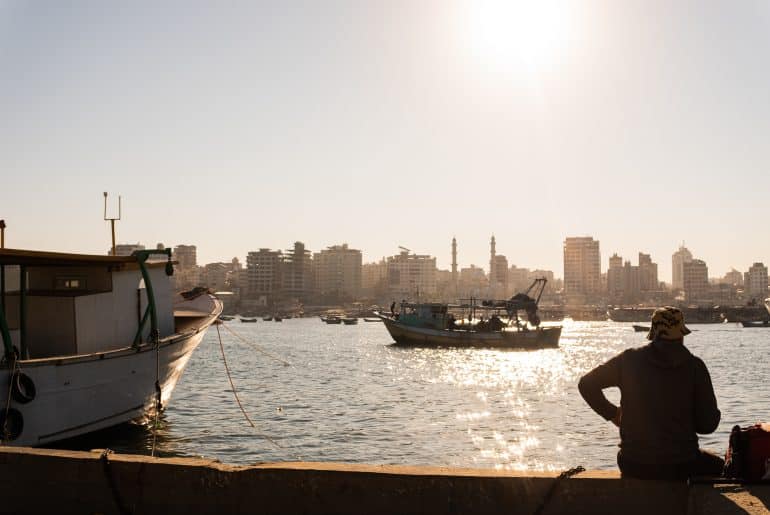
Gaza–Woman
Lives where bulldozers rest on clouds
Her hospital bed is her homes rubble,
nothing left of her husband but a bloodied beard.
Nothing around her but refrigerators in trees
furniture defiled,
shards of a life, disfigured,
She holds onto the concrete reef
Like it’s a blanket, like it’s Mary’s sage
There is no life without pushing, no life in siege
Her tongue is a minaret chanting God’s name
in angry prayer
The rockets, like rain, tell her to push,
Her thighs spread, pushing out a purple sky,
rubbled and silent
She weeps,
cries her inability to mourn another,
She imagines the umbilical cord,
a noose.
From the book Rifqa by Mohammed el Kurd, exerted from Three women page 43
Rifqa a book everyone should read, Jerusalem Woman is a masterpiece.
El-Kurd is as usual one of the only English-language Palestinian writers (along with Joseph Massad and a few others) who have rightly called out the Palestinian nouveau riche comprador elite in the West. I would only criticize him for going soft on them here: “But they don’t realize that, often, they do more harm than good.”
Anyone who has worked in the non-profit / academic cesspit that passes for Palestine solidarity knows that that is a lie and they realize entirely what they are doing by selling out the cause and validating anti-Palestinian narratives that El-Kurd has condemned here. They just don’t care. For them it’s a pay check.
A few years ago I encountered a young Zionist who had clearly grown up in the Jewish Zionist bubble. He brought out the old argument, which older and wiser Zionists have abandoned, that the Arabs weren’t make proper use of the land.
I said, “Here’s a thought-experiment. You are a brilliant violinist, but can only afford an inferior instrument. Your neighbour, who doesn’t play the violin – or even worse, plays it badly – owns a Stradivarius. You break into his house and steal the Strad. You are caught and tried. Your defence is that he wasn’t making proper use of it.”
The kid said, “You have a point.”
Exactly right. This has been seen over centuries and the British empire used it to outsource colonial rule to local elites, obviating the need for expensive British staff to enforce empire. The solutions to what is an imperial conflict in Palestine will be found only in the working class rediscovering its class solidarity with – impossible as it currently seems – the working class in Israel, so that together it can overthrow the ruling class.