

When Ramadan began during the ceasefire in Gaza this year, all of us in Gaza pinned our hopes on Eid. It was supposed to be the first joyful occasion after a war that had stripped us of happiness.
For Gazans, this Eid was supposed to be a symbol of resilience and hope after months of war. But once again, Israel made sure to crush even our smallest dreams.
As always, the Israeli occupation could not bear to see us finding hope again, despite all its efforts to destroy us. Knowing how important this Eid was to us, it decided to crush any chance of survival in the most brutal way. In a single night, while we were asleep in our homes, at 2:00 a.m., all our plans and preparations were shattered.
We all woke up to the sound of missiles. It felt like we had been thrown back in time, back to the nights when waking up to a rocket hitting the house next door had become normal—but this time, with even more fear and pain.
My orphaned nieces and nephews woke up, asking if the neighbors were testing fireworks for Eid. They knew what the sound of missiles was. They knew the answer. But this was their way of rejecting reality. We couldn’t answer them. We just stayed silent and cried.
But war alone wasn’t enough to make life unbearable. All the crossings—our lifeline—were also shut down, cutting off essential supplies. Within a single day, goods disappeared from the markets, and prices skyrocketed, especially for anything related to Eid preparations.

Despite all of this and despite our deep disappointment, our commitment to keeping Eid traditions alive did not change.
Despite the dire financial situation in Gaza—where most families have no income—parents did everything they could to keep their promises to their children, ensuring that this Eid would be different from the last.
For many children, their greatest fear when the war returned wasn’t the bombings—it was the thought of not being able to celebrate Eid.
Markets filled with fathers wearing anxious expressions, unable to afford a proper meal, while their excited children pointed with sparkling eyes at Eid outfits. But with prices soaring—where a single child’s outfit now costs over $100 due to the blockade—most families could only buy clothes if they sacrificed other essentials of life.
Celebrating Eid during war is not just about new clothes or our own happiness—it has become a way to defend our culture and traditions.
However, celebrating Eid during war is not just about new clothes or our own happiness—it has become a way to defend our culture and traditions. In Gaza, we have been making Eid cookies for generations, and now, baking them is an act of resistance and proof of our existence.
Despite the high cost of making them during wartime, families support one another in gathering the necessary ingredients. Those who have extra dates share them with others in exchange for semolina—both essential ingredients—so that everyone can prepare them and place them on the Eid table, even if there are no visitors.
For families who have lost loved ones—and in Gaza, that is the majority—even attempting to celebrate feels like a luxury they can’t afford. Eid, once a time for family gatherings, has become another painful reminder of their loss.

A Palestinian family prepares traditional cookies in preparation for Eid al-Fitr, which marks the end of the holy month of Ramadan, in a shelter for displaced people in a UNRWA school in Khan Younis, southern Gaza Strip, on March 28, 2025. (Photo: Doaa el-Baz/APA Images) 
A Palestinian family prepares traditional cookies in preparation for Eid al-Fitr, which marks the end of the holy month of Ramadan, in a shelter for displaced people in a UNRWA school in Khan Younis, southern Gaza Strip, on March 28, 2025. (Photo: Doaa el-Baz/APA Images)


On the morning of Eid, instead of visiting relatives, those who remain go to the cemetery to visit their martyrs. Instead of giving children Eid money, they place flowers on graves and pray for the souls of the departed. And instead of baking cookies for celebration, they bake them as a charity for their souls, distributing them in their memory.
Children of the martyrs now dream of a different kind of Eid. My orphaned niece and nephew only wished for one thing this Eid: that the army wouldn’t advance again near the cemetery where their father was buried.
Children of the martyrs now dream of a different kind of Eid. My orphaned niece and nephew, whose fathers were killed in the war, only wished for one thing this Eid: that the army wouldn’t advance again near the cemetery where their father was buried—so they could visit him in the morning and show him their Eid clothes.
Mariam, my four-year-old niece, asked me, “Should I look at the grave or at the sky when I talk to my dad?” She and her cousin argued over which grave they should visit first—their father’s or his.

But the war didn’t just take away our loved ones, nor did it only bring the suffering that Gazans endure. It changed everything about Eid, bringing pain into every detail of our lives.
Instead of waking up to the sound of Eid takbeers and children playing in the streets, we now wake up to the sounds of airstrikes that begin at dawn, reminding us of the constant threat.
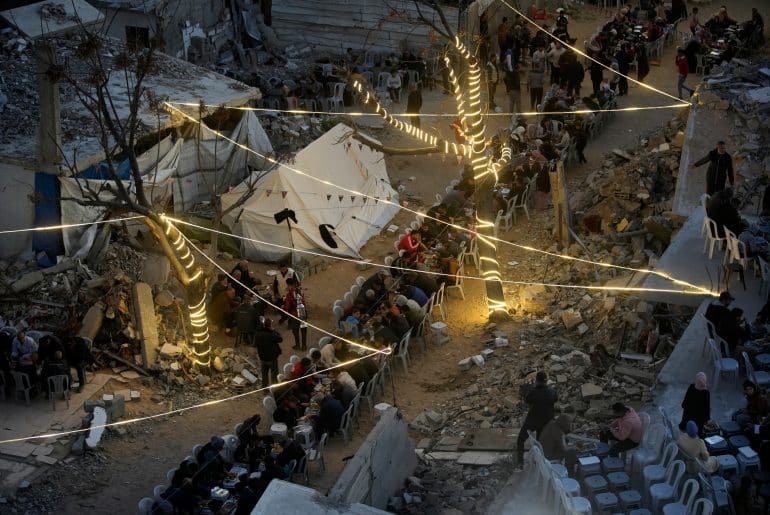
We used to go to Eid prayers together—family and friends, praying in mosques and large open spaces. But now, after half the mosques have been bombed and the other half closed for fear of airstrikes, Eid prayers are held in schools and shelters.
Despite all the efforts Gazans make to create joy out of anything, the happiness remains incomplete and hesitant.
Leaving the house to greet relatives has become another fear, as bombings increase significantly during Eid. Some families, with members spread between the north and south of Gaza, are denied any opportunity to gather. The Israeli occupation’s forces advanced again to the Nitzarim checkpoint, splitting Gaza in half and blocking access for cars via Salah El-Din Street. As for Al-Rasheed Street, it is long and exhausting for people to walk, making it impossible to go and return on the same day. Once again, these families were deprived of celebrating together.
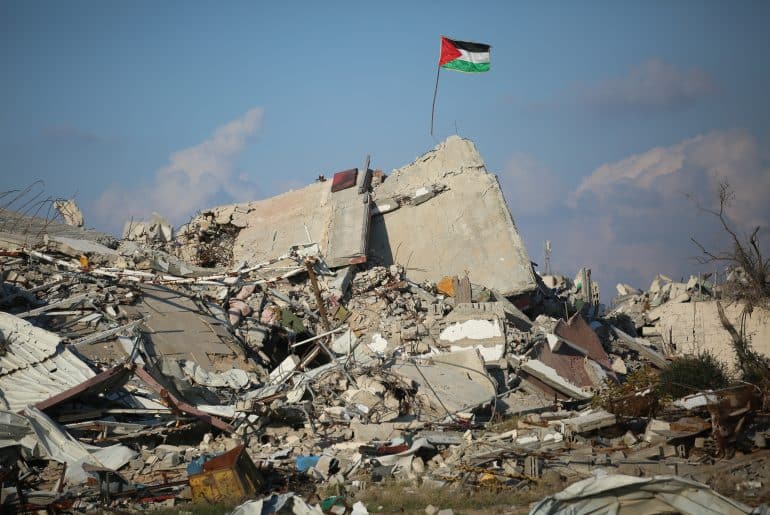
Despite all the efforts Gazans make to create joy out of anything, the happiness remains incomplete and hesitant. Next to one home trying to bring the spirit of Eid, another is opening a mourning tent, and loved ones find their houses reduced to rubble. No matter how loud the Eid takbeers or festive songs are played, the sounds of bombings and the cries of mothers who lost their children are louder.
Yet, even as Gaza’s joy remains stained with blood, we refuse to let it disappear.
Hala Al Khatib
Hala Al Khatib is a Palestinian writer and poet from Gaza who studies English literature. Her writings have been published with Al Jazeera, We Are Not Numbers, and Electronic Intifada.
Israel ‘executes 16 rescue workers shot in pit’
Red Crescent and Civil Defence teams report horrifying war crime siteTeams of Red Cross/Red Crescent workers and Palestinian Civil Defence crews have reported finding the mass grave of sixteen of their colleagues who had been shot and dumped into a pit by occupation forces in Tel al-Sultan, southern Gaza. The workers had been missing for four days and witnesses reported that they were made to kneel at the edge of the pit before being shot and falling in, according to local journalist Motaz Azaiza.
All the Red Crescent teams’ equipment – ambulances, medical kits – had been destroyed, along with the Civil Defence crews’ fire trucks.
The known martyrs’ names are:
Red Crescent Team:
Ezz Al-Din Shaath
Mustafa Khafaja
Saleh Ma’mar
Mohammed Bahloul
Ashraf Abu Labda
Mohammed Al-Hayla
Rifat Radwan
Asaad Al-Nasasra
Raed Al-Sharif
Civil Defense Team:
Fouad Al-Jamal
Youssef Khalifa
Anwar Al-Attar
Zuhair Al-Farra
Sameer Al-Bahabsa
Ibrahim Al-Maghari
Israel has constantly targeted medical and rescue workers in Gaza – and Lebanon – for murder, most notoriously in the case of the two paramedics who tried to save 6yo Hind Rajab. The paramedics’ bodies were found close to those of Hind and her family, riddled with tank bullets, more than a year ago after days passed during which rescue teams were unable to reach the area.
The United Nations has reported and condemned atrocities including torture and summary execution of women and children. The BBC, other UK media and the British government have ignored most of these atrocities, including this latest horror.
https://skwawkbox.org/2025/03/28/israel-executes-16-rescue-workers-shot-in-pit/
Video: satellite imagery shows Israel detaining ambulance and rescue vehicles before massacre
Sixteen Red Crescent and Civil Defence workers were made to kneel at edge of pit then shot – IOF is blocking attempts to recover bodies
Satellite imagery obtained by the Al Jazeera news station’s Sanad fact-checking unit shows Red Crescent and Gaza civil defence vehicles clustered where their sixteen crew members were detained by Israel – and then executed, despite their mission having been first cleared with the occupation before it began, in front of the pit where their bodies were dumped and then located four days after they went missing:
https://skwawkbox.org/2025/03/29/video-satellite-imagery-shows-israel-detaining-ambulance-and-rescue-vehicles-before-massacre/
Thank you Gamal for your info. on Red Crescent Ambulance team! As Jeffrey St. Clair said at Counterpunch: Israel/US gives new meaning to the War on Cancer:
>>+ The real issue at stake: Last week, Israel wired the last cancer hospital in Gaza with explosives and blew it up. This week, the US bombed a cancer hospital in Yemen. They’re giving new meaning to the War on Cancer (hospitals).
MARCH 28, 2025
Roaming Charges: The Goldberg Variations
JEFFREY ST. CLAIR
>>@SilentlySirs
Tel Aviv on Fire!
For the first time ever — protesters are carrying cut-off effigies of Netanyahu’s head and those of other extremist ministers, throwing them on the ground and chanting:
“We want their execution in the blood of our sons!”
The rage is boiling. The people have had enough.
The image from War Monitor is horrific.
>>War Monitor
@WarMonitors
Children wearing Eid clothes and their father holding Eid money to distribute to them.
An entire family was killed when Israeli warplanes bombed a tent housing displaced people west of Khan Yunis, in the southern Gaza Strip.
Israel kills 64 in Gaza on Eid; bodies of 14 missing medics recovered
By Lyndal Rowlands
31 Mar 2025
“Palestinian officials say Israeli forces have killed at least 64 people, including children, in Gaza on the first day of Eid al-Fitr.
The Palestine Red Crescent Society (PRCS) has recovered the bodies of eight medics, five civil defence workers and a UN employee, a week after their vehicles came under Israeli fire near Rafah in southern Gaza.
The International Federation of Red Cross and Red Crescent Societies (IFRC) has condemned the killings, saying the “devastating incident” represents the single most deadly attack on its workers anywhere in the world since 2017.
Gaza’s Health Ministry says at least 50,277 Palestinians are confirmed dead and 114,095 wounded in Israel’s war on Gaza. Gaza’s Government Media Office updated its death toll about two months ago to more than 61,700, saying that thousands of people missing under the rubble are presumed dead.”
https://www.aljazeera.com/news/liveblog/2025/3/31/live-israel-kills-64-in-gaza-on-eid-bodies-of-14-missing-medics-recovered