

While having tea in the village of Jaba in the southern Jordan Valley, Rabbi Arik Ascherman’s phone rang. An Israeli settler was grazing his flock on private Palestinian land in the nearby Bedouin village of Mukhmas. Ascherman, founder and director of the Israeli human rights NGO, Torat Tzedek, drove to Mukhmas, donned body armor, and confronted the settler and his sheep with a siren-blaring bullhorn in an attempt to push the settler off Palestinian land.
Settler attacks like these have become routine in recent years throughout the Jordan Valley. The violence, ranging from stone-throwing to livestock theft to slashing bales of hay, is perpetrated by settlers from surrounding, newly-erected outposts — settlements built without official authorization from Israel’s government and therefore illegal under Israeli law. In Mukhmas, for instance, four outposts, established within the last three years, now encircle the pastoral community and wreak havoc daily.
“After October 7, it has become more violent,” Khader Muhammad Musa Ka’abneh, a Mukhmas resident, told Mondoweiss. “They honk their horns in the middle of the night to scare the kids. They park their cars right where we park. They graze their cows on our land.”
In the village of Jaba, an outpost was established in February 2025, and within 10 days of its construction, settlers raided and burned down two homes and a car as well as injuring several residents during the attack. Ever since, settlers have regularly assaulted Jaba — throwing nails on the road to puncture Palestinian tires, hurling stones into the village’s homes, and driving their sheep up to Jaba’s houses.
Amid the daily violence, shepherds in both villages have stopped grazing their livestock out of fear they will be stolen by settlers. On numerous occasions, settlers graze their livestock next to Palestinian flocks and then capture the Palestinians’ animals in the process. Now, Palestinian shepherds keep their sheep and goats locked up.
“We Bedouins don’t have a society. Our lives are centered around our flock,” Abu Yousef Ka’abneh, head of Jaba village, told Mondoweiss.
Now that way of life feels threatened.
“Our flocks are shuttered in and we have to buy feed for them while their flock is just going everywhere and eating from the olive trees, eating everything,” Abu Yousef Ka’abneh said.

A joint settler-state effort
The violence is part of a new settler strategy that has emerged in the occupied West Bank. Since 2022, settlers have established shepherding outposts near Palestinian villages and then systematically harassed the residents. The goal of this strategy is simple: expulsion.
“They just want to destroy and deport the people,” Khader Muhammad Musa Ka’abneh said.
While Ka’abneh refuses to leave his home despite the escalating violence, in other areas, the settlers’ methods have worked.
In July 2022, the Jordan Valley village of Ras al-Tin was entirely expelled because of enduring violence from surrounding settlers — the first time such a displacement has occurred. Two and a half years later, more than 60 Palestinian shepherding communities in the West Bank have been similarly displaced, according to Israeli advocacy group Peace Now, with settlers then seizing 14% of the West Bank through shepherding outposts.
In May 2023, Mondoweiss reported on the ethnic cleansing of the Bedouin community of Ein Samiya, also comprised of the Ka’abneh clan. That same clan also resided in Wadi Siq, making up the largest Bedouin community on the eastern slopes of the central West Bank, but on October 12, 2024, it ceased to exist. As reported by Mondoweiss, armed Israeli settlers invaded Wadi Siq and forced the Palestinian families to leave at gunpoint.
While agricultural settlements aren’t a new idea, with some outpost farms cropping up in the 1980s and 1990s, the rate of their establishment has dramatically accelerated.
“It was never a systematic way of taking over land as it is now,” Hagit Ofran, from Peace Now’s Settlement Watch team, told Mondoweiss. “2017 is the beginning of these kinds of shepherding communities, but it was much slower — five, ten of those [built] every year. And now, it’s almost every week, another one.”
Ofran attributes the rapid development of these farming outposts to state support. According to Peace Now’s December 2024 joint report on shepherding outposts with Kerem Navot, an Israeli NGO monitoring land policy in the West Bank, Israel’s government assists in two key ways. One is awarding grazing contracts to settlers from the Settlement Division of the World Zionist Organization, a non-governmental body financed by the state. Through these agreements, the Settlement Division has allocated 80,000 dunams (nearly 20,000 acres) of West Bank land — a little over 12% privately owned by Palestinians or within the Palestinian Authority’s jurisdiction — to settlers for grazing purposes. In turn, settlers then use these contracts to establish outposts, often on land not even designated to them through the Settlement Division.
Secondly, the Settlement Division and the Israeli ministries of Settlements, Agriculture, and Negev and the Galilee funnel tens of millions of shekels to these outposts annually so the settlers can buy essential equipment to maintain their farms, such as generators, solar panels, lighting poles, fences, animal pens, and the purchase of livestock for grazing. Since 2019, Israel’s Agriculture Ministry and the Ministry of the Negev and the Galilee have provided tens of millions of shekels to agricultural volunteer programs run by non-profits, which send their volunteers to these shepherding outposts.
“The first step is to clear Area C from Palestinians,” Ofran, who co-authored the Peace Now-Kerem Navot report, said. “They’re also attacking Palestinians in Area B to make a Palestinian presence in the West Bank much smaller, and to push the Palestinians into smaller spaces in the West Bank so that the Israelis will have more land.”
The West Bank was divided into Areas A, B, and C when the 1993 Oslo agreement came into effect. Area A is exclusively controlled by the Palestinian Authority and is mainly comprised of Palestinian metropolitan areas, while Area B is a mix of Israeli military and PA control and Area C is only under the Israeli military’s authority, and primarily inhabited by Palestinian shepherding villages.
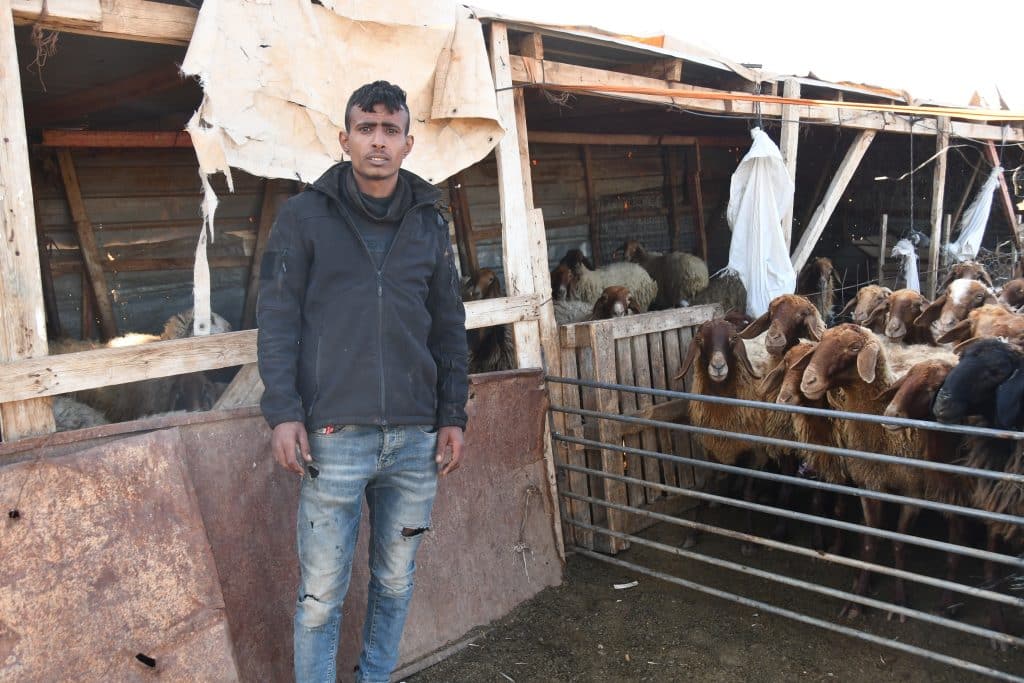
While the Israeli state doesn’t explicitly state that the aim of these farming outposts is the complete expulsion of Palestinians from the West Bank, it goes hand in hand with the government’s broader policy of annexation, which does aim to drive out Palestinian communities from areas slated for annexation. What’s more, the settlers are blatant in their intentions regarding ethnically cleansing Palestinians from their land, as noted in a recent conversation that Jaba resident, Ahmad Ka’abneh, had with a settler.
“He told me, ‘You guys should leave. We want to take over your place,’” Ahmad Ka’abneh said. “I replied to him, ‘I’ve been here 30 years, my brother and neighbors, around 50 years. You guys are new here — 40 days max — why don’t you leave?’”
Jessica Buxbaum
Jessica Buxbaum is a freelance journalist based in Jerusalem covering Palestine and the Israeli occupation. @jess_buxbaum



I can’t help wondering if these “settlers” actually have a clue about farming and livestock.