

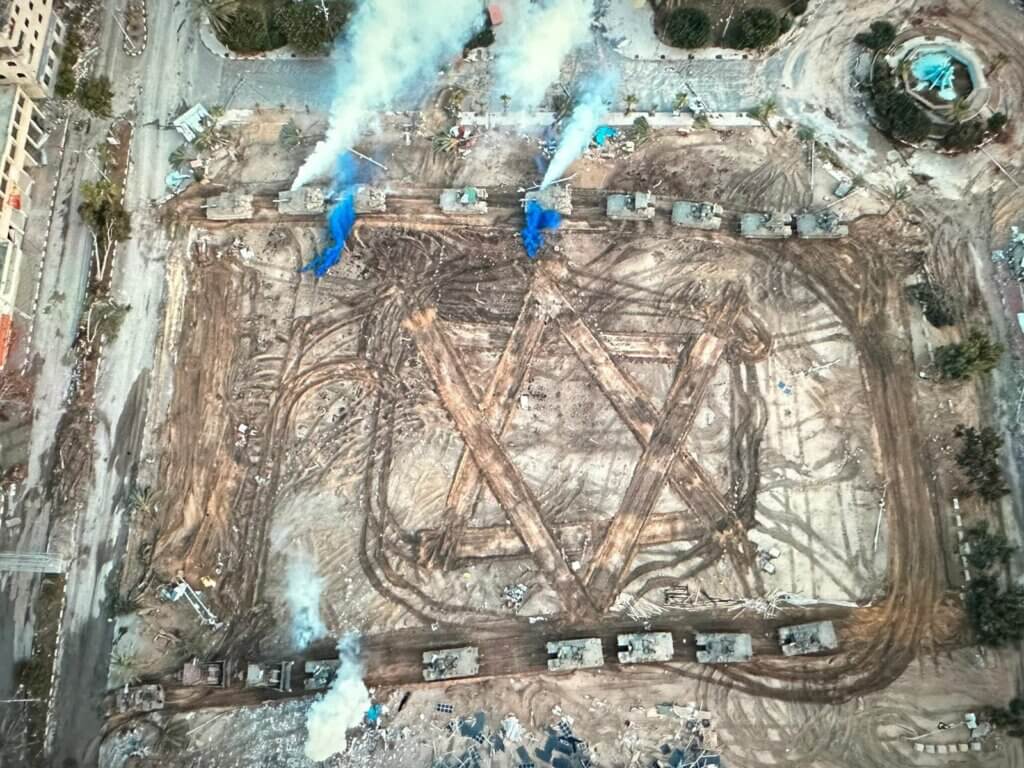
For the past 20 months of genocide, the Israeli military has regularly carved the Star of David into Palestinian soil, spray painted them onto walls and buildings like on Jenin’s Freedom Theater and the Qatari Consulate, drawn them onto children’s books and Islamic texts, shaved them onto the heads of Palestinian political prisoners, and emblazoned them across military equipment. Several recently released Palestinian political prisoners were forced to wear shirts with the Star of David on their chests. In a November 2024 Mondoweiss essay, Anna Lipman wrote that she stopped wearing her Star of David necklace because “it has become a symbol of supremacy and fascism.”
These spectacles of Jewish supremacy are not new. Even before this latest and accelerating chapter of Israel’s genocide of Palestinians began in October 2023, the Star of David was regularly weaponized by Israeli soldiers and settlers as a form of intimidation, land theft, and overt physical violence. When I was in East Jerusalem in the summer of 2018, I saw many Palestinian homes that had been stolen and occupied by Israeli settlers. The doors were spray-painted with the blue six-pointed star. In August 2023, a Palestinian man in East Jerusalem was beaten and branded with the Star of David. To avoid calling this Jewish Supremacy denies the motivations behind Israel’s genocide in Gaza, as well as the reality that Israel fails to be the inclusive democracy it claims to be. It is instead an occupying colonial force that operates as a theocratic Jewish ethnostate.
In order to understand Israel as a Jewish supremacist state, we have to go back in time, more than 50 years before its founding. While Zionism as a cultural and ideological project is much older (and Ghassan Kanafani’s On Zionist Literature is an excellent cultural history), the creation of political Zionism can be traced back to the thinking of several late 19th-century Jewish thinkers, most notably Theodore Herzl, an Austro-Hungarian journalist. There has been much scholarship on Herzl’s life, writings, and ideology, and this essay tackles none of those things in depth. Instead, I focus on several excerpts of Herzl’s writings on Zionism and the Jewish State because they are both foundational Zionist texts and the blueprints of Jewish supremacy.
Herzl began imagining a Jewish supremacist state around the time of the first Zionist Congress of 1897. Despite its mythology, Israel was not created because of the Holocaust. Even so, early European Zionists like Herzl were developing plans for a Jewish state against the backdrop of Europe’s “Jewish Question.” It’s important to note that, in the late 19th century, things were very bad for Jews in Europe. But this “Jewish Question” was not Palestine’s problem until Zionists made it so.
Throughout his writing, Herzl was explicit about his Jewish supremacist project. His ideas were emerging from a sense of alienation. Modern European identity was established through the white supremacy and anti-Blackness of European colonialism and the trans-Atlantic Slave trade. Alongside this identity, modern European belonging was established through the rise of the Nation State. These two ideologies forged a white supremacist nationalism, which Jewish people in Europe were cast outside of. They were neither interpellated into whiteness nor able to establish a simple nation-based identity. This “Jewish question” in Europe led middle-class and wealthy Jewish people like Herzl to develop a political form of Zionism that could borrow the logics of white supremacy (that Jews in 19th-century Europe were excluded from) and develop something entirely their own – a Jewish supremacist state.
In building towards this project, Herzl entered into alliances with political figures who were clear in both their racism and hatred of Jews. On June 9, 1895, he wrote in his diary: “First I shall negotiate with the Tsar regarding permission for the Russian Jews to leave the country…. Then I shall negotiate with the German Kaiser, then with Austria, then with France regarding the Algerian Jews, then as need dictates.” Herzl offered these governments a solution to their Jewish Question: send the Jews, who (especially in Eastern Europe) were often working class and engaged in revolutionary and anarchist social movements, to Palestine. This strategy echoes in contemporary Jewish Zionist partnerships with white supremacist and Christian nationalist individuals and organizations. From the Anti-Defamation League to Hillel International to Israel’s far-right government, part of the Zionist project has always involved such profane partnerships. These alliances rear their heads anytime far-right and Christian Nationalist actors, from the Heritage Foundation to the Trump administration, claim to be silencing calls for Palestinian liberation and an end to the genocide in the name of Jewish safety. As I have written elsewhere, this weaponization of antisemitism is a cover for genocide.
In 1902, Herzl penned a letter to Cecil Rhodes, a white supremacist British colonialist, diamond magnate of De Beers, and early architect of what eventually became the apartheid system in South Africa. Writing of “the idea of Zionism, which is a colonial idea,” he requested Rhodes’s help colonizing historic Palestine: “It doesn’t involve Africa, but a piece of Asia Minor, not Englishmen but Jews… How, then, do I happen to turn to you since this is an out-of-the-way matter for you? How indeed? Because it is something colonial. I want you to… put the stamp of your authority on the Zionist plan.” By “not Englishmen but Jews” Herzl reveals the internal logics of his plan to substitute the construction of white British supremacy with Jewish supremacy.
Herzl’s decision to approach Rhodes was far from coincidental. In addition to being a project of Jewish supremacy, Zionism was an explicitly capitalist enterprise. In his 1896 pamphlet “The Jewish State,” Herzl’s plan for the creation of the state hinges on the creation of a “Jewish Company.” To explain how this company would function, Herzl asks:
What is gold-digging like in the Transvaal [area of South Africa] today? Adventurous vagabonds are not there; sedate geologists and engineers alone are on the spot to regulate its gold industry, and to employ ingenious machinery in separating the ore from surrounding rock. Little is left to chance now. Thus we must investigate and take possession of the new Jewish country by means of every modern expedient.
It’s important to note that Herzl’s choice of Palestine for Jewish colonization was more about strategy than any personal connection to the region he might have held. While he was also considering Argentina and East Africa, he knew that since there were already Jewish people in Palestine and Palestine held religious importance, the work of mass emigration would likely be easier: “The very name of Palestine would attract our people with a force of marvelous potency.”
Even before the establishment of the state of Israel, it was clear that this collision of Jewish Supremacy and capitalism would be deadly for Palestinians and that deadly violence, dispossession, and occupation is the central horrors of the Zionist state. For this reason, many Jewish people were against colonizing Palestine and connected these worries with the horrific implications for Jewish people, as well as Palestinians. In 1918, at the British Socialist Party Conference, J. Wolfe, on behalf of the Jewish Social Democratic organization, said:
Further, while in conformity with the general principle, of internationalism, the Conference … emphatically repudiates the right of the Allies forcibly to annex Palestine from Turkey so as to turn it into a so-called ‘independent’ Jewish State, as such an act is opposed to the principles of non-annexation and the self-determination of nationalities accepted by the international democracy, more especially since the Jews form but an insignificant minority of the population of Palestine, and its fate must be decided by the inhabitants of Palestine itself. The Conference sees in the declaration of Mr. Balfour a veiled attempt at the annexation of Palestine, and also a means to enlist the assistance of the Jews the world over for the Imperialist ends of Great Britain and its Allies.
If you are thinking, “these arguments are over 100 years old, how is this relevant today?” consider the following.
In 2018, the Knesset passed the Jewish Nation-State Law, which articulated very clearly that Israel was the nation-state of the Jewish people alone and, by implication, not of all its citizens (i.e. Palestinian “citizens” of Israel). The Jewish Nation-State Law is merely a clearer articulation of Israel’s founding structure. Despite this, most American Jews remain steadfast in their position that Israel is the “only democracy in the Middle East.”
The realities on the ground are far from a democratic utopia. By design, Israel employs two forms of institutionalized racism – racism against Palestinians and racism against Jews who are not categorized as “white” (ie, Ashkenazi, or of European descent). This institutionalized racism is at the heart of the Jewish supremacist Zionist project in occupied Palestine, as shown throughout Ariella Azoulay and Adi Ophir’s The One-State Condition: Occupation and Democracy in Israel/Palestine. Azoulay and Ophir reveal how the State of Israel creates a double exclusion of Palestinians – both as non-Jews and as non-citizens. Despite those who claim equality is possible within a future “reformed” Israeli state in occupied Palestine, this book reveals how such institutionalized inequality has actually become its own unique system of government. Occupation is the entire structure of the system of rule. This means that in pursuit of justice and equality, Israel cannot be reformed, it can only be dismantled and destroyed through the decolonial work of land back and the Palestinian right to return.
Liberal Zionists in both Israel and the United States claim to be horrified by the far-right turn both countries have taken. However, for those of us who are positioned in “the West,” what we are seeing now is that the liberal facade shielding colonial violence and inequality has fallen and the rot at the center of both projects is finally as clear to the colonizers as it is to the colonized. This is the inevitability of supremacist societies.
Liberal Israeli society may claim that settlement expansions, the blockade of Gaza, and even the genocide are temporary conflicts that will eventually be resolved when the liberal order is restored. In the United States, these same arguments are made about the U.S. southern border policies, the militarization of the police, and the dispossession of native land. But these policies are the heart of who these two countries are. Just as we call out white supremacy in the United States, we must call out Jewish supremacy in occupied Palestine.
Maura Finkelstein
Maura Finkelstein is a writer and anthropologist. She is the author of The Archive of Loss: Lively Ruination in Mill Land Mumbai, published by Duke University Press in 2019. Her recent essays have appeared in The Markaz Review, Mondoweiss, Middle East Eye, Al Jazeera, and the New Arab.



I do not agree with the framing in this article. Certainly Israel is based on Jewish supremacy, but it is different from White supremacy.
The Zionist project was and is not capitalist. For instance it was prepared to pay a lot for land in Palestine, not for profit, but to make it eternally Jewish. The Zionist project is driven by ethnonationalism, not by economics.
Also, Israel’s Jewish supremacy vis-a-vis Palestinians mainly concerns the ownership of the land, and any other Jewish supremacy springs from that.
Also, the main step in decolonisation is complete equality for Jews and Palestinians.