
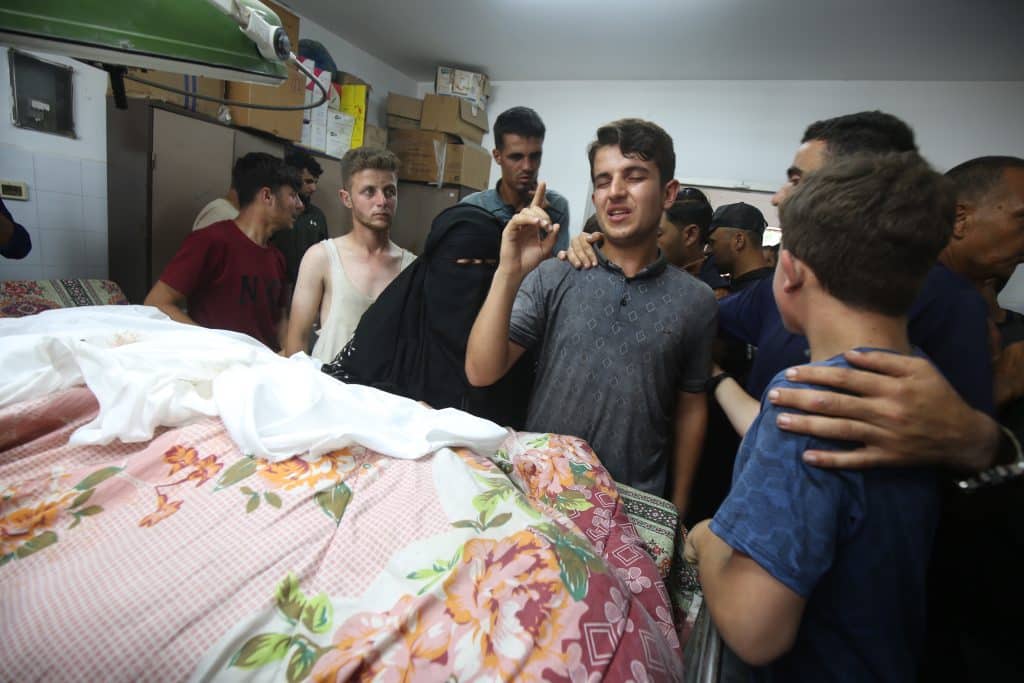
Over 20 years ago, when the Israeli army was invading cities in the West Bank as part of Operation Defensive Shield, I witnessed my mother trying to adapt to a situation that was anything but normal. Israeli Apache helicopters fired toward Ramallah from a few kilometers north of the city, and they were visible from our house. My mother would stay awake at 1 a.m., looking from our bathroom window at the warmachines spitting their fire, and then run to the living room, where the TV was on, to watch the Palestinian Authority headquarters in Ramallah get bombed by that same helicopter. My mother, who is not Palestinian and had never lived in such a situation, thought that I was asleep. I wasn’t.
Years have passed, and as a journalist, I have met many mothers in Palestine. Mothers of slain Palestinian youth, mothers of prisoners, mothers of displaced children whose homes have been demolished. In all this time, I learned something about Palestinian mothers: in order to keep their strength and the strength of their families, they don’t take in the calamities of life under occupation all at once, instead choosing to absorb them piece by piece.
For example, if a son or daughter is detained, they focus on the fact that they haven’t been sentenced yet. When they are sentenced, they think of the fact that they are still alive and that they will eventually be released. If they lose a home, they focus on the fact that they didn’t lose a family member.
And when they do lose a child, a brother, or a husband, they think about how they didn’t lose all of them. They console each other by repeating that the child they lost is respected and venerated by the rest of the community, and they compensate for their pain of loss with the honor of having given a child to Palestine. This is why they always have a reason to thank God, even in the worst and hardest of situations. Palestinian mothers have taught this coping mechanism to the rest of society.
This is why one of the most common words one hears in Palestine following a tragic event is “‘aadi,” Arabic for “that’s normal,” or “it’s fine.”
It doesn’t mean that things are actually “normal,” but rather that we can still survive and overcome the present moment.
A few weeks ago, when the war raged between Israel and Iran, my mother was awake at night on our balcony, frightened, watching Iranian missiles fly across our sky. I was awake too, but this time, I was by her side. In an attempt to calm her down, I found myself whispering, “‘aadi.”
My mother couldn’t bear hearing the word and burst out in anger at me. “No, it’s not fine! It’s war! Nobody in their right mind would say in the midst of a war that it’s fine!” she yelled.
Some minutes passed by in silence before my mother brought her emotions together, then looking at me and whispering back: “‘aadi, it’s fine.”
My mother is not Palestinian. She chose to marry a Palestinian, live in and raise her children in Palestine, but she didn’t do it thinking that she was signing up for living in the midst of war and occupation. “What is fine is that we are living here,” she said the next morning, and added nothing else. But I understood what she meant.
What my mother understood is that Palestinians say “it’s fine” in order to adapt to enduring occupation, war, and all kinds of hardship in their country, because it is not their fault. They did not choose hardship. They did not look for a place where there was war and occupation. The war and occupation came to them, not the other way around. And that is why, as irrational as living in the midst of war might seem, those who belong there view leaving their homes as beyond the pale of “normal.”
And yet, Palestinians do leave, like all peoples, searching for safety — that is how my parents met in the diaspora — but they never cut ties with home. They always look for an opportunity to go back and plant a seed of life right there. And as long as they can still endure hardship in their country, they say to themselves, “aadi,” it’s fine. It is a reminder that what remains constant is that we belong here.
As a journalist and writer, it’s my job to reflect on these things, pouring more words about them than most people would, but for most Palestinians, it doesn’t need a lot of philosophy or much explanation. We just bite our pain and move on. That is how, for decades, we have survived all attempts to ethnically cleanse us and have preserved our identity.
For almost two years, the world has been watching how Palestinians in Gaza practice this capacity to endure, adapt, cope, and move on, in the most extreme of conditions. Many don’t understand it, and many are astonished, while others prefer to dismiss or ignore it. Understanding this Palestinian capacity to resist is important for any realistic solution for the future — and by “realistic,” I mean the complete opposite of offering Palestinians housing in Europe or Africa, or building a “Riviera” over their homes.
This is why the Palestinian culture of life through hardship and in spite of death requires explanation. And that’s why we report on it for you here at Mondoweiss.


Thanks, Qassam. That resilience is what we in the UK often refer to as the “Blitz spirit”. I’m sure the same spirit exists in other places subjected to terrible sieges, e.g. Leningrad. Of course, it gets mythologised and the worst horrors locked away only to emerge in PTSD nightmares. It can produce great art: Shostakovich’s mighty Seventh Symphony, or – perhaps less familiar – Ralph Vaughan Williams’s Sixth Symphony.
Those things can commemorate, but they cannot bring back what is lost. Here’s a little gem of a song that embodies resilience, sumud.
https://www.youtube.com/watch?v=RJPmAHSwnS4
Warriors for Greater Israel armed Hamas from its founding. Provided money for the weapons and tunnels being used against the IDF today.
Seems armed resistance is preferred over political resistance by both sides. Not hearing much about Marwan Barghouti’s release, or visions for co-existance.