
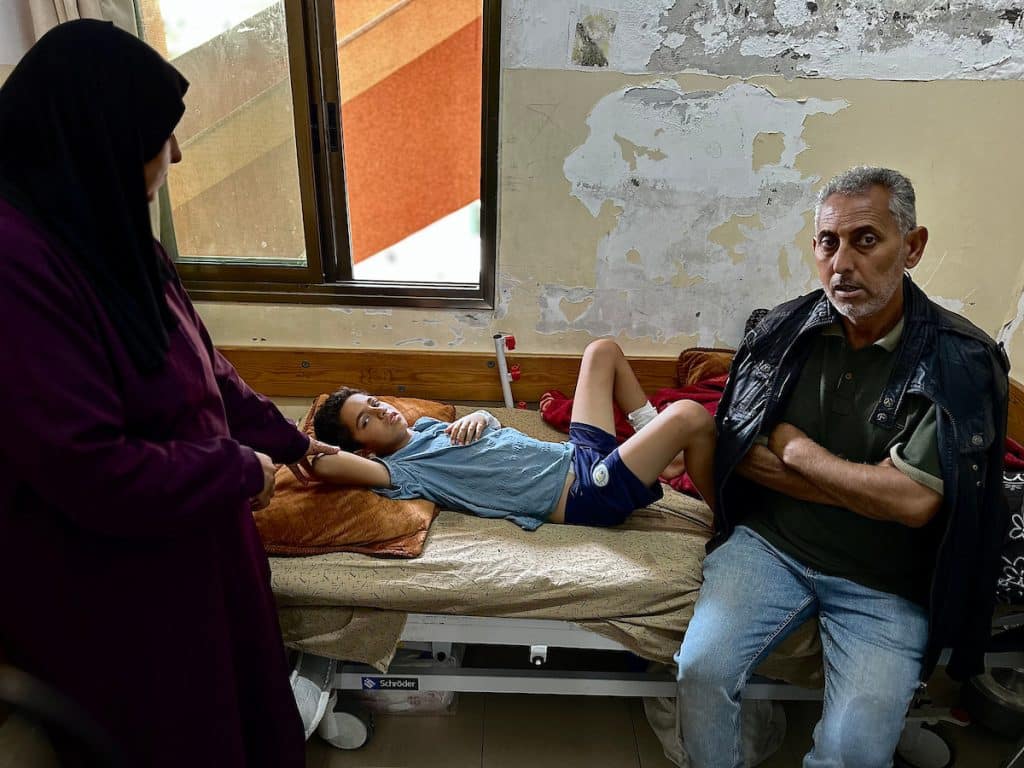
The U.S. State Department’s decision this weekend to halt all visitor visas for people from Gaza, which includes the medical-humanitarian visas that have brought injured children to American hospitals, will cost Palestinian lives. Officials say this process will be subject to a “full and thorough review”. For a child with infected burns or a deep trauma wound, a pause is a verdict on their life. The freeze did not arise from new intelligence or any novel identification of problems in the temporary visitor visa pathway. It followed a social-media panic with the circulation of mischaracterized videos of injured children arriving under the care of a U.S. nonprofit being labeled as a “security threat,” rhetoric amplified by political allies. The State Department then announced it was stopping visas while it re-examines procedures.
The racism and misinformation at the heart of that panic deserve naming. Some have labeled the process of evacuating children with amputations and burns as being potentially linked to terrorism and even characterized their joyful cries as “jihadi chants.” That is textbook dehumanization: take a population of wounded kids and code them as a threat to justify exclusion. Many have commented on the chain reaction from such posts to the administrative action. The line from a viral smear to a federal policy that blocks chemotherapy, skin grafts, or prosthetics for children should shame us, and the speed with which it occurred.
It also wildly overstates the scale of what has actually happened. In total, many of the NGOs running these U.S. transfers report a few dozen total children to date, not a “flood”. Individual city stories have been about twos and threes: a pair treated in Dallas; several children welcomed in Boston. This is the opposite of a large-scale pipeline; it’s a narrow, highly vetted corridor that exists because Gaza’s health system has been shattered.

To understand how few make it here, you have to understand the pathway. First, a physician in Gaza refers a child for care that no longer exists at home. The case goes to a Ministry of Health committee, then to the World Health Organization (WHO) for medical triage. Only after a receiving hospital issues a formal acceptance, often after weeks of back-and-forth with surgeons, translated records, and imaging, does the family usually even begin the paper chase: passports, exit permissions from the Israeli military’s Coordinator for Government Activities in the Territories (COGAT), Jordanian clearances when the bridge route is used, U.S. visa appointments, and finally a WHO-escorted convoy. Each step is a separate queue with its own failures and reversals; a single “not yet” in any queue can kill the case.
The numbers give us a picture of why this corridor matters. According to WHO and OCHA, as of mid-August more than 14,800 people in Gaza need urgent medical evacuation outside the Strip. Since October 2023, about 7,560 patients, including roughly 5,248 children, have been medically evacuated abroad, with most of those transfers occurring before Israel’s closure of Rafah last year made departures far rarer and slower – in fact, a 92% decrease was recorded in successful evacuations thereafter. On August 13, the WHO managed to move 38 patients, 32 of them children, to care options in Belgium, Italy, and Türkiye. Such operations are far smaller than the need. Pausing the U.S. share of that global effort may look like a minor adjustment from Washington, yet for an injured child in Gaza, it reads as a door slammed shut – and possibly a death sentence.
American hospitals have long accepted international charity cases. Pediatric centers have taken on many cases from around the world, because these are areas where some U.S. teams are among the best in the world and where outcomes can be life-changing and transformative. Now, it is only anti-Palestinian racism and Islamophobia that are preventing U.S. hospitals from playing a similar role with children from Gaza. Other countries and regions have been accepting far more cases than the United States. Since October 2023, the top five referral destinations have been Egypt, the United Arab Emirates, Qatar, Turkey, and EU countries. The cases include children with trauma wounds, patients with cancer, congenital anomalies, cardiovascular issues, and even ophthalmology-related needs.
Behind every statistic is a child and a clock. We have seen and heard of many such cases. For example, Fatima (anonymized name for safety), a child with multiple burn injuries, cleared one hurdle after another: hospital acceptance in the U.S., COGAT approval, a slot on a convoy list. Starvation and infection outpaced the paperwork. She died just days ago, after being pushed from one evacuation list date to another as her body gave way. Another girl whose cases moved with unusual speed from referral to hospital acceptance to even getting family clearances was now seeking an expedited passport to submit her DS-160s when the U.S. freeze hit. Try explaining to her mother that a stranger’s tweet now stands between her child and a reconstructive surgeon.
And yet, these are not isolated incidents or tragedies. Gaza’s health system has been bombed, besieged, and starved into dysfunction. Key Palestinian medical specialists have been killed or abducted by the Israeli military, and hospitals where care could have been provided have been repeatedly attacked. That is why children who could once be treated locally now need referrals abroad for prosthetics, complex orthopedics, neurosurgery, oncologic care, and skin reconstruction. The pathway is not some loophole, rather it is one of the only viable medical options for these children. Prior to the current genocide, 50-100 patients were leaving Gaza daily for medical treatment abroad.
The pathway is, in fact, fraught with ethical dilemmas. Children are frequently separated from their caregivers or loved ones, and families are separated or torn apart as some relatives are denied exit approval (often men) by Israel, leaving others to stay behind. We have met such families and children who have come to the U.S., have heard from their stories and the trauma they have endured – the physical scars and the psychological ones – and the ones that cannot even be named.

What should happen now is simple. First, immediately reinstate the processing of medical-humanitarian visas for children and their companions. Second, we should push towards affirming the right of return for these children – many families fear never being able to return to Gaza after accepting treatment abroad, with some even choosing to stay in Gaza out of such fears. Third, restoration of medical corridors for Palestinian patients in Gaza to occupied East Jerusalem and the wider occupied West Bank, so that they do not need to leave their country and homeland just for treatment if it is available. Finally, stop letting demagogues dictate whether a Palestinian child gets to live. The moral bar here is not high.
How sad it is that the government in Washington can be spurred by a bad-faith tweet to close a lifeline for children, any shred of decency as Americans should compel us to open it.
Depraved, cruel.
This is shameful and racist and heartless. Little Marco Rubio and the US State Department are getting smaller and smaller by the hour. If Rubio believes in a Christian God, the gates of Heaven won’t be opening for him. Hell is where he belongs.
Unconscionable! How can these people look themselves in a mirror…live with themselves? Face their god without any remorse?
I posted a link to the NY Times report about Laura Loomer yesterday, together with a link to the UN page of The Office of the Special Representative of the Secretary General for Children in Armed Conflicts. It explains that even the US government consideres this one of the grave breaches that IHL requires signatories to investigate and prosecute as criminal offenses:
Denial of Humanitarian Access
The denial of humanitarian access during conflict is one of the six grave violations identified and condemned by the UN Security Council. The six grave violations form the basis of the Council’s architecture to monitor, report and respond to abuses suffered by children in times of war. Ending and preventing these violations is also the focus of the Special Representative’s work and advocacy.
Humanitarian access is crucial in situations of armed conflict where civilians, including children, are in desperate need of assistance. Denial of humanitarian access entails blocking the free passage or timely delivery of humanitarian assistance to persons in need as well as the deliberate attacks against humanitarian workers
Prohibition under international law
Denial of humanitarian access to civilians, including children, and attacks against humanitarian workers assisting children are prohibited under the 4th Geneva Convention and its Additional Protocols and may amount to a crime against humanity and a war crime. Moreover, it is a principle in customary international law.
The denial of humanitarian assistance to civilians trapped or displaced by conflict has always been a reality, but it is increasingly being used as a tactic of war. Examples abound of children trapped in besieged areas, or deprived of access to food, water and medical assistance, including vaccines. This is the only grave violation against children that is not a trigger for listing in the annexes of the annual report of the Secretary-General on children and armed conflict. The international community is encouraged to examine options to facilitate access to civilians, including children, in need and to ensure respect for international humanitarian law.
FROM THE GUARDIAN (EXCERPTS): . . . In a pair of posts on the social network on Friday, Loomer had shared video of badly injured Palestinian children and their family members arriving in Houston and San Francisco this month, along with false claims that their shouts of joy were “jihadi chants” and that they were “doing the HAMAS terror whistle”.
Loomer also falsely claimed that she had “exclusively obtained” the two video clips she shared. One was copied from a medical aid charity’s public Instagram account and the other was from the Houston Chronicle’s YouTube channel.
After misrepresenting the children, including amputees arriving to get prosthetic legs, as “Islamic invaders from an Islamic terror hot zone”, Loomer demanded to know “who at the US State Department under @marcorubio signed off on the visas for Palestinians from a HAMAS hot zone”. . .
. . . “Why would anyone at the State Department give visas to individuals who live in Gaza, which is run by HAMAS?” Loomer wrote, before falsely stating that “95% of GAZANS voted for HAMAS.”
In fact, Hamas got 44% of party list votes in the 2006 Palestinian legislative elections across Gaza and the West Bank, and lost three of the five districts in Gaza to the secular Fatah party. There has been no election since then.
After the visa program was halted, Loomer declared victory. “This is fantastic news,” she wrote in response to the state department announcement. “Hopefully all GAZANS will be added to President Trump’s travel ban. There are doctors in other countries. The US is not the world’s hospital!”
Republican Congressman Randy Fine explicitly commended Loomer after the visa change was announced, in a sign of her sway over some US policy. “Massive credit needs to be given to @LauraLoomer for uncovering this and making me and other officials aware. Well done, Laura,” Fine wrote on X. . .
. . . Paul Graham, co-founder of the Silicon Valley startup incubator Y Combinator, wrote on X after the visa halt was announced: “If Laura Loomer had been around in 1940, she’d have been trying to prevent Jewish refugees from entering the US. You know she would. And if Trump had been president then, she’d have succeeded.”
ENTIRE ARTICLE – https://www.theguardian.com/us-news/2025/aug/16/gaza-children-visas-medical-care-laura-loomer