


Last week, the U.S. State Department revoked visas for leaders of the Palestine Liberation Organization (PLO), including Palestinian President Mahmoud Abbas. That effectively blocked them from attending the upcoming United Nations General Assembly session in New York.
Abbas had hoped to address the assembly, where France and Saudi Arabia are planning to co-chair a meeting intended to salvage the long-dead and mythical “two-state solution.” The assembly is also expected to see a number of European states respond to Israel’s genocide in Gaza with recognition of Palestinian statehood. Of course, the recognition is largely symbolic and ineffective, given that no Palestinian state actually exists, thanks to Israel.
The U.S. claims its decision is based on “security concerns,” but this is obviously nonsense. A delegation from the PLO or Palestinian Authority presents no security issues. On the contrary, Abbas has lost all the legitimacy he once had many years ago due to his kowtowing to Israeli demands and American pressure in the vain hope that this would win the Palestinians some concessions toward self-governance.
The entirely predictable, and predicted, outcome of the PA’s quisling behavior is that Israel and the United States, under successive administrations and through years of congressional formations, routinely degrade and condescend to it, and offer it no boon or rewards for its genuflection.
The PA has seen Israel seize its tax revenues, and it continues to be demonized as a terrorist organization by virtue of nothing more than being Palestinian. Meanwhile, the Palestinian people living under its threadbare “authority” have lost all faith in the PA after years of “security coordination” with Israel, corruption, ineffective governance, and significant human rights violations against Palestinians, often in service of Israeli concerns and interests.
So no, it is not about the PA being a security threat. This was about sending messages to states recognizing Palestine as a state, and laying the groundwork for continuing the Gaza genocide and moving annexation forward on the West Bank.
When Reagan tried to stifle Yasser Arafat
This isn’t the first time the United States has abused its position as custodian of the United Nations building in New York to prevent a Palestinian leader from addressing the General Assembly. But the circumstances and, especially, the result, were very different the last time.
In November 1988, as Ronald Reagan was serving out the lame duck period of his second term as president, Secretary of State George Shultz denied visas to Yasser Arafat and his PLO delegation, preventing them from addressing the UN General Assembly. The technical excuse Shultz invoked — security concerns — was the same one the current Secretary, Marco Rubio, is using to block Abbas from speaking at the UN.
Other circumstances were markedly different.
Where the decision to bar Abbas came entirely from the administration, Shultz’s decision was largely a response to congressional pressure, which, in turn, resulted from the near-panic gripping Israel at the time.
The Israeli election had occurred only weeks before, and the top two parties — Likud, headed by Yitzhak Shamir, and the Labor alignment led by Shimon Peres — were nearly tied, with neither having a clear path to a governing coalition.
Within that political instability, the First Intifada had put unprecedented pressure on Israel. For the first time, people in the United States and Europe were seeing Palestinians striking, demonstrating, protesting, and being met with disproportionate violence by Israel. These scenes led some people to finally start seeing Palestinians as human, rather than as “terrorists.”
Arafat and the PLO were trying to capitalize on this moment. In the West, this was cynically referred to as a “charm offensive.” The term was used to imply that Arafat was crafting a ploy to gain sympathy and win concessions, while hiding a secret plan to drive the Israeli Jews “into the sea.”
51 senators had signed a bipartisan letter to Shultz calling for Arafat’s visa to be denied. Many in the State Department and National Security Council disagreed with the decision, both because they saw it as setting back the “Mideast peace process” and because they correctly saw it as an abuse of the United States’ position as custodian of UN headquarters. Fearing the political headache, Shultz put off the decision until after the election, but still denied the visa.
In response, the UN voted to move the General Assembly gathering to Geneva. Only the U.S. and Israel were opposed, and Arafat made his historic address to the General Assembly.
Mahmoud Abbas is no Yasser Arafat
Yet nothing similar seems to be brewing in response to the latest U.S. decision. That could change, but there’s no sign of it yet, and if that holds, it tells us two things.
First, it tells us that both the Saudis and the Europeans increasingly and accurately see Abbas and the PA as weak partners. Part of the U.S. motivation in this decision is to undermine the French-Saudi effort to unite much of the world around support for the two-state solution. As illusory as that idea is, the international community has, heretofore, always featured the PLO and PA in that vision. Now, it seems they recognize that Abbas and his cronies are incapable of delivering, and are eager to see a new leadership that will fight Hamas, negotiate with Israel, but also be capable of projecting the ability and the domestic legitimacy to govern a theoretical Palestinian state.
Regardless of whether one is realistic and acknowledges that the two-state solution is dead or holds on to this shattered dream, it is obvious there is no future for the Palestinian national movement, in whatever form, under the current leadership of the PLO.
Second, it tells us that no one thinks Abbas’s address at the UN would matter much. This is the biggest difference between the current situation and 1988.
Back then, Arafat had something to say, and everyone knew it. Israel feared it, but most of the world was eager to hear Arafat, expecting him to do just what he did: extend an olive branch to Israel and, essentially, agree to the terms the United States had laid down for accepting the PLO as an interlocutor and representative of the Palestinian people.
In fact, Arafat did just that. While the U.S. at first tried to equivocate, Arafat reinforced and clarified his renunciation of violence and acceptance of UN Security Council Resolutions 242 and 338, and the Reagan administration eventually acknowledged this. The door was opened to the Mideast Peace Process, as much of a sham as that turned out to be.
Abbas not only has nothing of any significance to bring to the proceedings, but it has also long since been clear that he has no strategy at all for dealing with an increasingly radical Israel and an increasingly hostile United States. All he is likely to do is air the clear grievances, describe the genocide in Gaza, and decry the move toward annexation in the West Bank.
While there is value in having a Palestinian leader say such things, they would merely be echoes of points that are sure to be raised by others. And even the value of a Palestinian leader saying them is somewhat muted by the complete collapse of Abbas’s stature both at home and abroad.
Why is the U.S. intent on thwarting Abbas’s speech?
If Abbas is so ineffectual, why even bother to stir up a public debate by denying the visas to him and his team? While the Trump administration has curtailed all Palestinian visas, it would have been a routine matter to approve Abbas and his team’s visas on an individual basis. Not only did they choose not to do so — they made a show of that decision.
The primary target of this decision was not Mahmoud Abbas. Rather, it was the various Western states that announced that they will recognize the State of Palestine. Particularly since they made their declarations not on matters of principle, but rather as a gesture of response to Israel’s genocide in Gaza, the U.S. responded petulantly with a gesture of its own, one tantamount to raising a middle finger at these states that have the temerity to take action that Israel and the U.S. do not approve of.
That the issue of recognition is an ineffectual response to the genocide in Gaza is not important to Israel and the U.S., which are working in complete lockstep on this point. Israel has, for many years, reacted hysterically to relatively minor issues. This has the effect, win or lose, of sharply deterring more significant actions. They’ve done it for decades because it works very well.
The refusal of the visas reinforces efforts to equate the PA with Hamas in the minds of Americans and Israelis. This, it is hoped, will pave the way for the grandiose plans Trump has for Gaza, and Israel has for the West Bank.
In Gaza, Trump is trying to revive the “Riviera on the Mediterranean” idea that he floated at the beginning of his term. It was unworkable and unrealistic then and remains so, but he and his son-in-law, Jared Kushner, are still trying to make it come true.
To do that, Trump wants to get the idea of eventually bringing the PA back into Gaza out of the discussion. Even people in his own administration continue to see the PA as a pliable and palatable alternative to Hamas, as evidenced by U.S. Ambassador to Israel Mike Huckabee — whom no one would think of as a friend to the Palestinian people — trying to convince Israel to release tax revenues and save the PA from collapse.
Arab states are unlikely to buy into this line of thinking, but Trump hopes it will become widespread enough in the U.S. and in right-wing circles in Europe that even the Saudis will see it as giving them some cover to cooperate with Washington. Again, this bizarre scheme has virtually no chance of success, but that doesn’t stop Trump, Rubio, Kushner, and their pet poodle, Tony Blair, from pursuing it.
The visa denials are just step one
For Israel, delivering Abbas the coup de grace is a precursor to enacting the plan that Bezalel Smotrich just submitted for the West Bank. You can see it below.

The green area within the border is the West Bank. The yellow areas are the major Palestinian cities on the West Bank: Hebron, Jericho, Ramallah, Nablus, Jenin, and Tulkarem. Notably absent is Bethlehem, which is absorbed into the rest of the green area — which would be completely Israeli and open for settlement. In due course, it would lead to the ethnic cleansing of Palestinians from those areas, under the euphemism of “voluntary migration.”
It hardly needs to be pointed out that the cities would not last very long under these circumstances. Isolated as they would be, and having no economic or security threshold, they would resemble Rafah before long.
How could this plan be brought about? The same way as it was in Gaza. Using October 7 as a pretext, and with the PA being seen in Israel and the U.S. as tantamount to Hamas, similar operations could be launched. It might need to be more gradual. It might, one hopes, face more serious opposition even in the U.S. and Israel (the latter since it would be much more dangerous for Israeli civilians than the slaughter in Gaza has been). But it can be done, and Israel has already begun taking steps in this direction.
Indeed, according to the far-right Israel Hayom newspaper, which serves essentially as a mouthpiece for the Netanyahu government, Israeli Foreign Minister Gideon Sa’ar discussed with Rubio several steps toward Israel annexing the West Bank, of which the denial of visas to the PA team was only the first.
European recognition of a Palestinian state that, at best, hasn’t been a real possibility for a great many years, is not going to do anything to stop the genocide in Gaza or the Israeli annexation of the West Bank. Mahmoud Abbas and his quisling compatriots are a major part of the problem, but no part of a solution. The contrast between the response to Arafat’s and Abbas’s visa denials, and the performative and empty response to the genocide in Europe and the Arab leadership, makes it clear that there is no significant opposition to the complete destruction of the Palestinian people on the world stage.
Unsurprisingly, then, it is up to the people, the one force supporting Palestinian rights that is growing — and doing so by leaps and bounds — to make the difference.
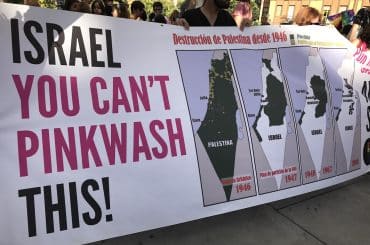
Yes, it is the people of the world that must shame their political leaders into finally doing the right thing. The Palestinians must have their own State, Both Israel and the United States have lost the right to dictate what the Palestinian people can and can’t do.
This is a classic case of building a massive grass-roots movement to bring about tangible moral change in this endless conflict. The boat flotillas and frequent peaceful protests are part of this growing wave of civil action.