

As the genocide in Gaza began its third year, there was some hope — one can’t really call it optimism — that the end might finally be in sight. Wednesday evening, the United States announced that Hamas and other Palestinian factions had accepted the initial parts of U.S. President Donald Trump’s 20-Point Plan. Specifically, they accepted the exchange of hostages and the first redeployment of Israeli military forces, along with an end to Israel’s offensive actions.
Yet, while Palestinians, especially in Gaza, celebrate, hope is tempered with the experience of two years of temporary pauses, which were just limited downscales of Israel’s violence, after which the slaughter returned with even greater ferocity than before.
Trump’s “20-Point Plan” has some potential for truly ending the genocide. But that potential is limited by its vagueness and its dependence on the United States to apply and maintain pressure on Israel.
Trump’s plan and motivations
Trump’s plan explicitly disregards the rights of the Palestinian people. It establishes foreign rule over an ostensibly Palestinian technocratic administrative apparatus but requires that current Palestinian representatives — in this case, Hamas, a body that has never been, nor ever claimed to be, representative of the entire Palestinian nation — agree to that foreign rule. Vague allusions to the possibility that there might one day be a path to a mythical Palestinian state do little to mitigate this reality.
Ironically, and despite the fact that Hamas has already made it clear that they have neither the authority nor the willingness to agree to such a thing, this demand might be the very reason the plan could stop the genocide even while the broader proposals on governance are doomed to failure. The inclusion of such an overarching demand enabled Hamas, with the support of key Arab states, to respond positively to the first part of Trump’s proposal while providing the justification for “further negotiations” on the rest.
A variety of factors have influenced Trump’s most recent moves regarding Gaza, all of them being the typical, self-centered motivations we have grown accustomed to.
Trump has evinced an obsession with winning the Nobel Peace Prize. The award itself is important to him, but what it is really about is his desire to be seen as an expert diplomat and leader, however unearned such recognition may be. In his various attempts at mediation in other conflicts, the U.S. role was often minimal, and some of those he claims to have resolved have not actually ended.
By contrast, the United States under Trump has been deeply involved in international diplomacy around Gaza, and Trump believes that if he can stop the genocide, or at least appear to have done so, he will get credit for “peace in the Middle East.”
Pro-Israel, not necessarily pro-Netanyahu
Trump’s plan, while proposing permanent subjugation for the people of Gaza, also thwarts Israeli Prime Minister Benjamin Netanyahu’s maximalist ambitions there. It explicitly states that Israel, though it may maintain a “security buffer zone” along Gaza’s northern and eastern borders, will not occupy or govern Gaza. It also surrenders the idea of ethnically cleansing the Strip.
These are major setbacks for Netanyahu and his far-right allies. Trump’s plan to have a governing board that he will head and that would include the war criminal and former UK prime minister, Tony Blair, will allow him to keep a foot in Gaza after his presidency (assuming he leaves it) and establish the beachfront resort he and his son-in-law, Jared Kushner, desire. But it leaves the maximalist Israeli dreams dead.
That’s not accidental. It wasn’t necessary for Trump to include a long-range governance plan in his proposal. He could just as easily have stuck to conditions to end the “fighting” and installed a temporary administrative body from the Arab states to administer Gaza, along with the security force from Arab and Muslim states, he had already gotten some of those states to commit to providing.
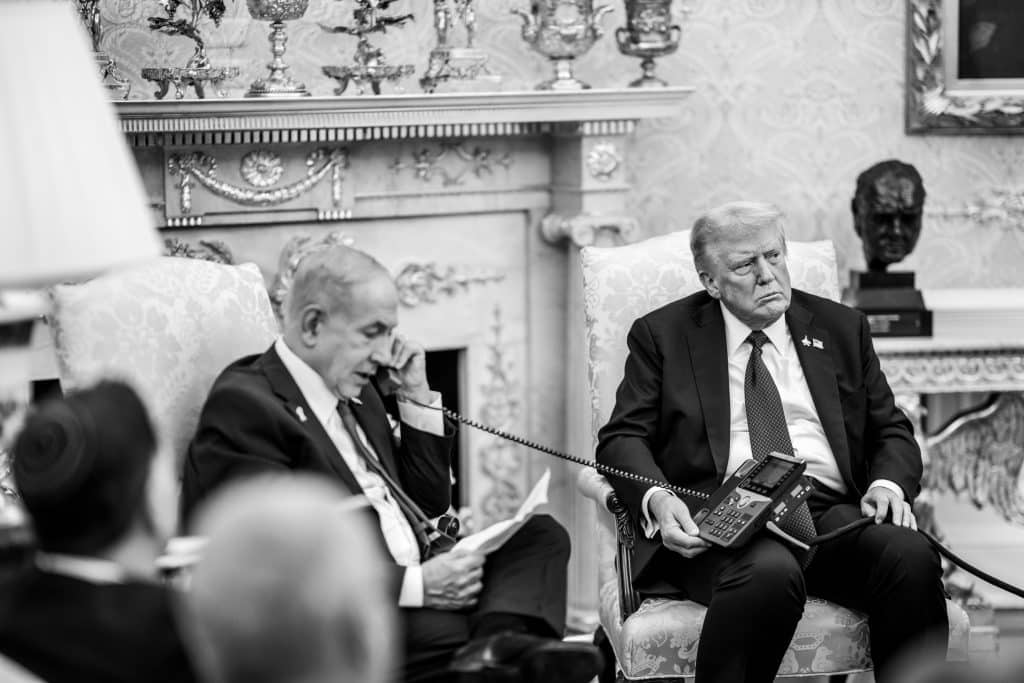
Trump’s decision to explicitly call on Israel to quit most of Gaza and exclude it from governance was a rebuke of Netanyahu’s decision to bomb Qatar, an action Trump was obviously unhappy with. He first responded by forcing Netanyahu to read a scripted apology to the Qatari Emir over the phone, in front of the media. Netanyahu denied that the Americans scripted the apology, but it was a denial that only confirmed the initial report’s accuracy. The images, released to the media by the White House, of a scowling Trump holding the phone while Netanyahu, cowed and whipped, read his lines as directed, said it all.
Trump will only go so far
The question of whether or not Trump can push Netanyahu to end the genocide is clear; he can. The questions that we cannot answer are whether he will recognize it when Netanyahu acts to undermine any agreement and how far he is willing to go to stop Netanyahu from doing so.
Early returns are not promising. When Hamas responded to Trump’s proposal by essentially agreeing to exchange all of the remaining hostages and to exclude itself from the administration of Gaza after the genocide ends (something Hamas had repeatedly announced it was willing to do), Trump called on Israel to stop the bombing.
For a brief moment, Gaza was quiet. But the Israeli attacks quickly resumed, and Trump has ignored them. This is true even though ongoing Israeli attacks — which are directed toward areas where hostages are being held — make it much more difficult to gather the living hostages and the bodies of the dead. Trump tacitly acknowledged this reality by backing off his demands that the hostages be released within 72 hours, which would have been impossible even under the best conditions there can be in the devastated Strip.
That’s a bad sign. As it stands, Trump’s plan is unclear about the timeline for Israel’s withdrawal after the first phase. The initial withdrawal line does not move Israeli forces very far from where they are now, but it is supposed to happen when Hamas releases all remaining hostages.
Subsequent withdrawals are supposed to be based on “progress on the ground,” which is not clearly defined. Nor is it clear how much input Israel will have into that determination. This is currently the main sticking point for Hamas. It represents a departure — no doubt a change Netanyahu negotiated in his White House meeting—from the understandings the Arab and Muslim states had when they agreed to support the Trump plan as well.
It is also why Netanyahu is not putting up a fight. He is, of course, not eager to anger Trump again. But he also has every reason to be optimistic that Israel will be able to thwart further withdrawals and will then easily find a pretext to resume the genocide. He expects that Trump will, at that point, be willing to leave Israel to its own devices in Gaza, pocketing the perceived “credit” for freeing the hostages.
Will Trump recognize that Netanyahu is not a partner to this plan, even though the overwhelming majority of Israelis are willing, many even eager, to stop the genocide if it means freeing the hostages?
The recent report of Trump scolding Netanyahu, saying, “You’re always so fucking negative. This is a win. Take it,” indicates that Trump doesn’t understand that the genocide was always the point for Netanyahu, not the hostages, whom he wrote off as the cost of doing business on October 8, 2023.
That myopia doesn’t offer much hope that he will see through any of Netanyahu’s schemes to undermine the ceasefire.
If Netanyahu refrains from again angering any of Trump’s Gulf allies, any efforts to unravel Trump’s plan have a good chance of succeeding.
Hamas’ leaders are not stupid. They know that they are taking an enormous risk by sacrificing the last bit of leverage they have in the hostages…Hamas is taking that risk.
While Qatar and the other major Gulf players would like to see a return to a diplomatic process that can keep the Palestinian issue quiet, they have demonstrated repeatedly that they are unwilling to employ the political resources necessary to really push for an end to Israel’s dominance of the Palestinians. It simply isn’t that important to them, contrary to their frequent rhetoric that is meant more for domestic consumption and as virtue signaling to the Arab and Muslim world, rather than a reflection of actual concern for the Palestinians.
The 20-Point Plan makes no mention of the West Bank, where Netanyahu is sure to escalate if he is forced to back away from Gaza. Trump’s Gulf friends may not really care if Palestinians get a state, but they very much want to see a return to the days when a sham “peace process” allowed business to proceed and pushed the question of Palestine to the back burner, where it would only flare up for brief periods.
Netanyahu has also gotten the message from his far-right allies that they are not going to bring down the government in response to the Gaza truce, though they will not support it. They realize that if they call for new elections now, they are likely to find themselves in the opposition. That would mean they lose control over Israel’s West Bank policy, and that is something they don’t want to risk.
Still, none of this bodes well for the future in Gaza. It is very likely that Trump will press Israel for the initial withdrawal to get the hostages back. But Hamas’ leaders are not stupid. They know that they are taking an enormous risk by sacrificing the last bit of leverage they have in the hostages. Even without the most extreme far-right pressuring Netanyahu, he will still try to avoid letting control of Gaza slip away. Hamas is taking that risk.
But they also recognize that the hostages were never a real deterrent to Israel’s murderous onslaught. Since the last brief pause in the genocide ended, they have become even less of one. So, they’re not really giving up that much leverage. They don’t have any to speak of.
The situation in Gaza is desperate, even by the standards of the past two years. Everyone is simply waiting for death to claim them, whether by an Israeli weapon, by starvation, or by diseases that are flourishing in an area where the most basic standards of hygiene and sanitation are impossible. Hamas is out of options and willing to make concessions it wouldn’t otherwise make. Meanwhile, the people of Gaza are overjoyed at the potential end of the slaughter. But the injustice of their reality will quickly erode that joy, even if the ceasefire holds.
Hamas must hope that the global revulsion at Israel’s genocide—which is continuing to expand quickly and manifest in more unrest and protest than ever—will enable the kind of pressure that will be necessary to prevent a resumption of the genocide. And it just might do so.
The wild card, as always, is Trump. There is no reason to believe he is even considering threatening the arms supply to Israel, which would ensure that Israel bends to whatever demands he makes. But that’s not the only tool at his disposal, as we’ve seen with his recent pressure on Netanyahu. But will he use those others?
And even if Trump is vigilant and sincere (two very dubious assumptions), he has a notoriously short attention span and an even shorter supply of patience. If Netanyahu simply drags his feet long enough, Trump might focus elsewhere.
The Israeli captives are expected to begin getting released this weekend, in exchange for some of the Palestinians Israel holds prisoner, in addition to some of the thousands it kidnapped from Gaza over the past two years, to which the world has always been indifferent. Israel has reportedly begun an initial pullback of its troops. That will be time for the people of Gaza to perhaps catch their breath a bit. It will not yet be time to celebrate the end of the genocide.

After carefully reading the BBC summary of the proposed peace deal** I think the best characterization of it comes from Americas Finest Newspaper:
https://theonion.com/israel-agrees-to-go-back-to-killing-palestinians-on-less-frequent-basis/
Israel Agrees To Go Back To Killing Palestinians On Less Frequent Basis….
As part of a historic ceasefire agreement with Hamas following two years of war, the Israeli government reportedly agreed Thursday to go back to killing Palestinians on a less frequent basis. “In line with the terms of the deal, Hamas will release all remaining Israeli hostages, and Israel will still murder innocent Palestinian civilians on a regular basis, but at a slightly slower pace than we have been of late,” said Israeli Prime Minister Benjamin Netanyahu, ratifying the accord that would temporarily promote the systematic discrimination, dehumanization, and persecution of the Palestinian people over their outright genocide. “Once the hostages are freed, we will dial down the attacks on Gaza hospitals, schools, and aid centers by roughly 10%, give or take. I have had my staff lay out a less rigorous schedule for committing atrocities, and in the down time, the IDF can always fall back on horrific maiming practices and general torture. It was a major concession on my part, but I have been convinced that it’s the only way to get our people home safe, and for Israel to continue committing human rights violations without consequence.”…
**
https://www.bbc.com/news/articles/c70155nked7o
So will the world simply forget the mass killing and move on as if nothing happened, now that we have a ‘peace deal’? Here’s your answer:
Two Years On: People Injured and Traumatized During the “Great March of Return” are Still Struggling….Mohammed, 35 and father of three, from Beit Hanoun, was shot with a live bullet in the leg during the first “Great March of Return” (GMR) demonstration on 30 March 2018. “I went through 25 surgeries, but I’m still in pain,” he told OCHA. As a result of his disability, Mohammed lost his job as a construction worker and the economic situation of his family began to deteriorate. “My wife couldn’t bear with my situation and with the poverty, so we got divorced. My life is nothing but a misery.”…While the vast majority of protestors have acted in a peaceful manner, during most protests dozens have approached the fence attempting to damage it, burning tires, throwing stones and Molotov cocktails towards Israeli forces and flying incendiary kites and balloons into Israeli territory; the latter resulted in extensive damage to agricultural land and nature reserves inside Israel and risked the lives of Israeli civilians. Some incidents of shooting and throwing of explosive devices have also been reported….Israeli forces responded by shooting tear gas canisters, some of them dropped from drones, rubber bullets and live ammunition, mostly by snipers. As a result, 214 Palestinians, including 46 children, were killed, and over 36,100, including nearly 8,800 children have been injured. One in five of those injured (over 8,000) were hit by live ammunition.[3] During the same period, one Israeli soldier was killed and seven others were injured during the demonstrations.
https://www.un.org/unispal/document/two-years-on-people-injured-and-traumatized-during-the-great-march-of-return-are-still-struggling/
The best analysis i read on the subject. It as well shows us what kind of world we now live in, or more accurately what kind of world we discovered we were living in. Lies exposed. And we are supposed to be the wise creatures of the earth, the best!
Israeli Officials Are Openly Saying They Plan To Resume Attacks On Gaza
Caitlin Johnstone
Oct 12, 2025
“Israel’s top officials are openly declaring that they intend to terminate the Gaza ceasefire after they get their hostages back.
Defense Minister Israel Katz has posted a tweet in Hebrew which machine translates as follows:
Hamas has not agreed to any demilitarization or destruction of its tunnels. There is no way to demilitarize Gaza and neutralize Hamas of its weapons against their will without continued warfare, something Israel has demonstrated it cannot do without killing shocking numbers of civilians.”
https://www.caitlinjohnst.one/p/israeli-officials-are-openly-saying