

Total and lasting “forever” peace. Not just for Palestine, but the entire Middle East.
That’s what U.S. President Donald Trump promised at the signing of the Gaza ceasefire deal in Egypt last week. One way the plan differs from previous incarnations of the “peace process” is that it abandons the framework of the two-state solution as the accepted way of resolving the Palestine question.
Historically, the U.S. model for integrating Israel into the region was the establishment of the Palestinian Authority (PA) in 1994 after the Oslo Accords, which was given limited governing responsibilities over the West Bank and Gaza with the nominal assumption that it would be the precursor to a Palestinian state.
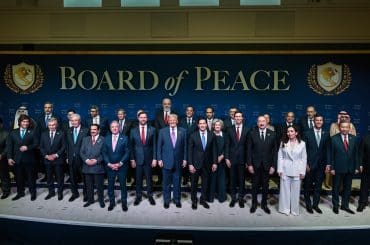
Trump’s plan tries to bypass all of this, putting Gaza under the administration of a U.S.-led board of “peace” headed by Trump himself. The PA has no clear role in running the Strip — at least not according to Trump’s 20 points, which mentions that the PA would have to undergo a series of “reforms” that could, in some unspecified future, establish “a path” toward Palestinian self-determination. During the reconstruction phase, the West Bank and Gaza would be politically split.
Israel has made its rejection of a Palestinian state official policy. But it is also a matter of national consensus across the Israeli political spectrum, as recently articulated by Benny Gantz, a member of the opposition, in the New York Times.
It goes back to well before October 7. In 2018, the Israeli Knesset passed the Nation-State Law, which explicitly stated that the right to self-determination between the Jordan River and the Mediterranean Sea belonged exclusively to the Jewish people. Since October 7, this position has only been further entrenched: in July 2024, the Knesset passed a law rejecting a Palestinian state, and just last July 2025, it passed a law allowing the government to annex the West Bank.
Simultaneously, Israel escalated its campaign of economic and financial strangulation of the PA, withholding Palestinian customs money that Israel collects through its control of borders on behalf of the PA, representing at least 60% of its national budget. Israel’s hardline Finance Minister, Bezalel Smotrich, has also repeatedly threatened to cancel a waiver Israel grants to Israeli banks that allows them to deal with Palestinian banks, which would likely cause the collapse of the Palestinian economy.
All these actions have made it clear that Israel wants to collapse the PA, even if it has served Israel well in the past. Now that the Trump plan essentially underwrites Israeli actions, it leaves the PA’s future as uncertain as ever.
The rise of the Israeli maximalists
The uncertainty surrounding the PA’s future did not begin with the events of October 7 or the subsequent war in Gaza and the region. In September 2023, nearly a month before October 7, Israel’s National Security Minister, Itamar Ben-Gvir, told Israeli media that Palestinians should not have any form of autonomy, that they should not have the right to vote or “run their own lives,” and that the PA should be dissolved. At the time, the PA was already facing what was described as the worst financial crisis in its history, which had been ongoing for a year. But in the aftermath of Gaza’s destruction, and amid conflicting attempts to translate Trump’s plan into concrete measures, the fate of the PA now depends on this critical moment.
Since the beginning of Israel’s war on Gaza two years ago, Israeli Prime Minister Benjamin Netanyahu has repeatedly insisted that the PA will have no role in governing the Strip in the future. Yet the calls by Ben-Gvir and the Israeli far right to abolish the PA altogether are not so easy to implement.
The PA runs civil affairs in the West Bank, responsibilities that would otherwise fall to Israel. It also sustains the image of a peace process on which most Western countries and the UN base their official positions, anchored in the rhetoric of a “two-state solution.”
But nominal Western support for a two-state solution was never meant to actually implement it. Rather, the function this support has ended up performing has been to maintain the political rationale for supporting the continued existence of the PA. The demands of the maximalist Israeli far right have placed this in jeopardy.
If Trump’s “peace” plan, if one can call it that, is to have a chance, it would need some European buy-in, especially in funding and bankrolling the so-called “reforms.” That puts it at odds with the maximalist Israeli position.
Last Monday, as the leaders of 20 countries met in Egypt’s Sharm al-Sheikh to sign the Gaza ceasefire deal, the President of the European Council, Antonio Costa, told the media that the EU would increase its aid to the PA by 1.6 billion euros. He added that European intervention will focus on humanitarian aid, police training, governance, border control, and PA reforms, to ensure that “in the future, Palestine will be a democratic state, free of terrorism.”

The new global consensus
The PA has already adopted a political platform that recognizes Israel, rejects armed resistance, and commits to security cooperation. But the PA is also part of a larger Palestinian political spectrum. Even if there aren’t elections, the PA is still bound to operate in relation to other Palestinian political forces. This sets a bare minimum “floor” that the PA is obliged to maintain, which is the rhetorical insistence on a Palestinian state with East Jerusalem as its capital, and perhaps as an afterthought, paying some lip service to the right of return. Decades of Palestinian struggle since the Nakba have made it impossible for the PA to rhetorically sidestep this political ethos, even though it has done virtually everything on the ground to render it materially meaningless.
In other words, the PA cannot abandon its pretenses to being Palestinian and representing some notion of Palestinian nationhood. This is what Palestinians fear the “reforms” are about — turning the PA into a self-governing and apolitical body shorn of any remnants of Palestinian national culture and memory.
In August of last year, the PA signed an agreement under Egyptian auspices with the rest of the Palestinian political forces in Cairo, including Hamas. The agreement stipulated the creation of an independent, apolitical, technocratic, and entirely Palestinian commission to run Gaza. Hamas accepted handing over the control of the Strip to this commission.
The commission would have answered to the PA, and would have been formed by presidential decree. This would have guaranteed the political unity of Gaza and the West Bank during the transitional reconstruction phase. The hope was that this could lay the foundations for Palestinian statehood in the future. Trump’s plan was about preventing that.
Meanwhile, the PA is expected to receive financial relief from Arab and European countries to keep functioning, all under the banner of a two-state solution. This is happening even as Israel expands settlements in the West Bank, undermines Palestinian demographic and geographic continuity, and intensifies raids on Palestinian towns and even PA-administered cities.
Even though the PA attended the Sharm al-Sheikh summit — touted as a turning point for peace in the region — it didn’t have any role in the negotiations or the signing of the ceasefire. The emerging middle ground between the Israeli far-right vision of eliminating any Palestinian political entity and the traditional two-state framework is becoming increasingly clear: a self-governing Palestinian body that relieves Israel of its responsibilities as an occupying power, maintains internal Palestinian control, preserves the existing order, but holds no real political authority. This is the newly emerging de facto Western consensus.

Perhaps it is time to do away with the PA…it has been too beholden to the West and not really standing up for Palestinians – betraying them too often. The entire corrupt West needs to stay out of this…it is Palestine which belongs to Palestinians.
Regarding the Trump plan Peter Beinart has some observations:
The Trump deal doesn’t destroy Hamas but it does further Palestinian dispossession…… “This deal could have been done a long time ago,” writes longtime Israeli hostage negotiator Gershon Baskin, “Hamas agreed to all of the same terms in September 2024.”….Back then, Israel justified its refusal to accept such a deal because it claimed Hamas was not yet “demolished,” which Netanyahu had pledged to do after the October 7th attacks. But if demolishing Hamas means destroying its fighting force, that goal remains unfulfilled today. Israel has killed many Hamas leaders and fighters. But by slaughtering as many as 100,000 Palestinians in Gaza, it has also pushed more Palestinians in Gaza to take up arms. As former Secretary of State Antony Blinken suggested this January, “Hamas has recruited almost as many new militants as it has lost.” …. Last year, Israel expropriated more Palestinian land in the West Bank than it has in any year since it conquered the territory in 1967. The UN estimates that since October 7th, 2023, Israel has pushed more than 10,000 West Bank Palestinians off their land…..The message from both Washington and Jerusalem is clear: There is no future for you { Palestinians ] here.
What Israeli “Victory” Looks Like
The Palestinian Authority was an illegal attempt to establish an Israeli Sphere of Influence or puppet regime under permanent belligerant occupation. The ICJ has ruled that Palestine’s political institutions have been under an illegal belligerent regime since 1967, and all UN member states have an obligation to stop interfering with the Palestinian peoples right to establish a government of their own choosing, control their territory, and national resources. FYI, all states have the right to arm themselves for self-defense and to enter into regional defense agreements (i.e. states enjoy sovereign equality with or without UN membership).
FYI, Article 2(4) has always stipulated that its prohibitions apply to any stste, not just member states: “All Members shall refrain in their international relations from the threat or use of force against the territorial integrity or political independence of any state, or in any other manner inconsistent with the Purposes of the United Nations.
The PA has been irrelevant since the State of Palestine was admitted as a full member state to UNESCO, the ICJ Statute, International Tribunal for the Law of the Sea, International Criminal Court, Geneva Conventions, Arab League, Islamic Conference, Non-Aligned Movement, UN Economic and Social Council Western Asia, and as UN Observer state.
‘One-state solution’: Voices in favor of binational state for Israelis, Palestinians growing
Prominent Israeli voices, on both the Right and the Left of the political spectrum, are in favor – but with vastly different aspirations for what such a unified country would look like.
Jerusalem Post/Jerusalem Report
‘One-state solution’: Voices in favor of binational state for Israelis, Palestinians growing
Prominent Israeli voices, on both the Right and the Left of the political spectrum, are in favor – but with vastly different aspirations for what such a unified country would look like.
OCTOBER 16, 2025 14:43
Updated: OCTOBER 17, 2025 01:30
Discussion of a “one-state solution” to the Israeli-Palestinian conflict has returned with the publication of a new book co-authored by Robert Malley, a former Middle East adviser to Democratic US presidents; and Hussein Agha, a Palestinian peace negotiator.
Malley and Agha are the latest in a long line of critics of Israel, arguing that the goal of creating two states – Israel and Palestine – which has underpinned international peace efforts since the signing of the Oslo Accords in 1993, is no longer achievable due to Israeli settlement policy.
“The era of the peace process, of the two-state solution, has vanished,” they declare in Tomorrow Is Yesterday: Life, Death, and the Pursuit of Peace in Israel/Palestine.