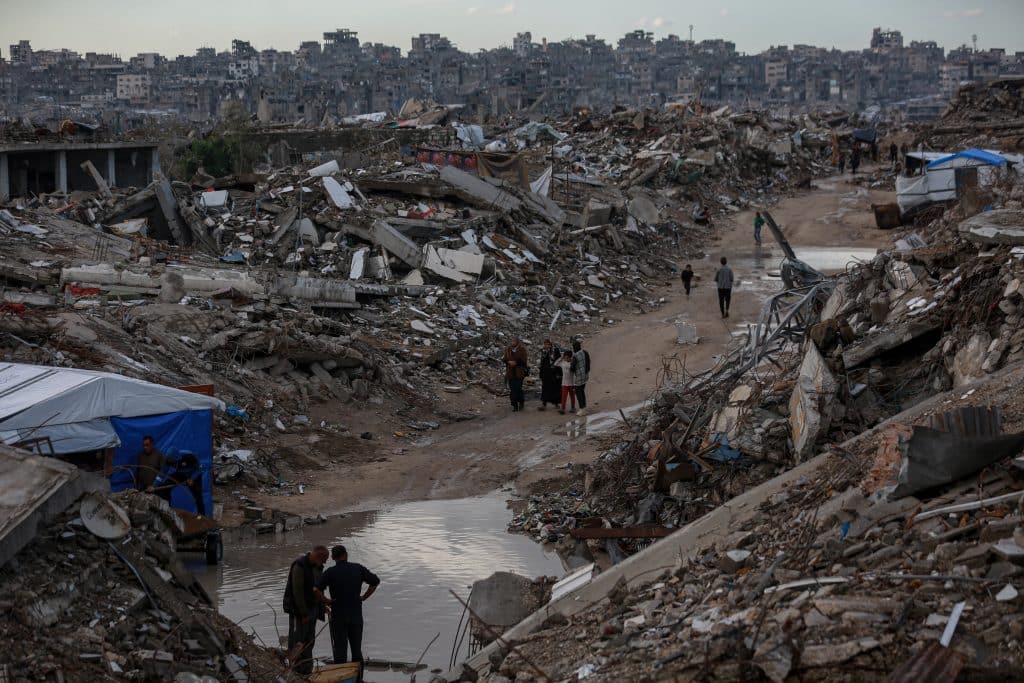
In the past few weeks, rain fell on the displacement centers in Gaza. Many tents flooded as water entered them and soaked through the mattresses. People’s living quarters were essentially rendered unusable for two or three days until the sun could dry them out.
While watching footage of the flooded displacement camps, I spotted the tent of my colleague, Muhammad Jarboa, a reporter for an Arab TV channel. We used to work together in different areas when I was in Gaza.
I often saw him in Rafah and Khan Younis. He used to live in Rafah before it was destroyed, and now he lives in a tent like everyone else. When I later saw him speak on TV about the flooding of tents, it felt as if he was describing his own daily life.
People assume that Palestinian journalists are among the hardest-working in the world. They are not wrong; being a Palestinian journalist is a difficult and often painful mission because the stories we tell are about the death of our own people. The testimonies we record are often painful to hear, and we revisit them frequently. Speaking to people face-to-face is not easy; we have to listen, feel, imagine what they went through, keep asking questions, and at the same time, hold back our own tears.
Journalists in Gaza also live with a constant inner struggle: how can they stay strong and composed while witnessing so much suffering? How can they separate their emotions from their work? The truth is, they cannot be completely separated from each other. The people’s pain is their pain, and their tears are close to the surface. But they try to stay steady so they can continue their work.
As a result of all this pressure, Palestinian journalists often suffer from writer’s block. The reports we write are not just events; they are stories about people we usually know personally, as if we are writing a personal obituary.
But being a journalist born and raised in Gaza gives me the strength to face what I face every day, because our reports also provide us with courage, because we believe that our mission is to speak about everything happening to our people.
When I speak with my colleagues who work in the field across the Gaza Strip and ask them what gives them the strength to continue, they tell me that people in Gaza rely heavily on journalists. They see them as one of the groups that help raise awareness about their plight.
We experience what residents experience too, but we choose to talk about their stories first. And in fact, when we talk about their pain, we are also talking about our own.
Working as a field journalist in Gaza is to live a life of danger and pain. The journalist is subject to the same conditions to which their people are: the cold, the fear, the soaking tents, the bombings, the loss.