

Fatima Salem waits outside anxiously, as rescue crews dig through the rubble of her family’s home in Gaza City on December 15th. With bated breath, she clings to the hope that all 60 of her family members – brothers, sisters, nieces, nephews, and grandchildren – who were buried under the rubble after an Israeli airstrike targeted their building, will be rescued.
But this was not a typical rescue operation, and Fatima was not waiting for signs of life. She knew everyone was dead. That’s because the airstrike on her family’s home happened almost exactly two years ago, on December 19, 2023, just two months into the genocide.

The 60 members of the Salem family are some of an estimated 10,000 Palestinians whose bodies remain trapped under the extensive rubble across the Gaza Strip. Due to two years of active Israeli bombardment, the targeting and killing of civil defense crews, and the lack of heavy duty machinery required to excavate the tons of concrete rubble, rescue missions in Gaza have been largely stalled.
But on December 15, the Civil Defense in the Gaza Strip announced the start of a long recovery process of bodies that have remained under the rubble for two years. The operations are focused only on the areas in the Gaza Strip not actively being occupied by the Israeli military, which accounts for roughly half of the territory.
The first rescue mission was for the Salem family in Gaza City.
“Here I lost every person dear to me; they are the closest people to me—my brothers and sisters and their families. I lost everyone in this place,” Fatima Salem cried. When she heard about the rescue mission, she rushed to the scene of the destroyed building, where the souls of her relatives had remained trapped for two years.
She said that her family was targeted on December 19, 2023, after they fled from northern Gaza to Gaza City due to the intensification of shelling and fighting in their residential area. They found refuge in a building whose residents had evacuated, and gathered there with their children and families. No one who was in the building at the time of the bombing survived.
“I want to see them, to embrace them, to bid them farewell,” she said as she stood before rows of bones and skulls wrapped in white plastic shrouds, laid out on the ground in front of her. Some have been identified by their present surviving relatives, while others have not yet been identified.
Omar Suleiman, a member of the forensic department at the Civil Defense, was working at the scene of the Salem family. He described a painstaking process of trying to identify and record the identities of the deceased, saying that crews are documenting descriptions of the condition of the bodies in terms of form, height, and the level of decomposition they have reached, along with preserving a DNA sample when possible.

December 2025, Gaza City. (Anas Ahmed/Mondoweiss)
According to videos published by the Civil Defense on its Telegram channel, what is recovered from the remains of the martyrs is sometimes only bones, not always complete skulls, but rather bones from the chest and the feet, making identification a difficult matter.
According to Suleiman, the level of decomposition in the bodies was very high, which made it difficult for families to identify them. The lack of tools and technology for advanced DNA testing has also made the identification process more difficult. He said that crews were working “with very limited tools and under difficult and exhausting conditions.”
Civil Defense crews say they recovered all the bodies from the building, all belonging to the martyrs of the Salem family, in addition to 17 more bodies buried in the vicinity around the building. After two years, Fatima Salem was finally able to bid farewell.
Thousands of bodies, limited resources
In Khan Younis in southern Gaza, on December 20, recovery operations began in areas of the city, starting with the martyrs of the Abu Hilal family. They were killed on August 13, 2025.
Huda Abu Hilal, in her 20s, was the sole survivor of a strike that targeted her family’s home on August 13, 2025. Though she was inside the building at the time, just before the airstrike, Huda’s mom had asked her to go downstairs for something. At that moment, the home was bombed, and everyone except Huda was killed.
“All my family was killed except me—my mother and father, my sisters, and their children—all of them were martyred,” she told Mondoweiss, adding that because her neighborhood remained under an evacuation order after the bombing, crews were not able to access her home to rescue her family.

At the site, Samah Hamad, head of the forensic department of the Civil Defense, described the challenge ahead for crews.
He said that in Khan Younis alone, there are 75 destroyed buildings with hundreds of bodies buried under the rubble that need to be recovered. Many of the buildings, he said, are located in the area behind the ‘yellow line’ that are inaccessible to Palestinian crews. But even in the areas that they can access, the rescue mission is slow moving.
Hamad notes that the slowdown in these operations is due to the fact that all crews in the Gaza Strip are working with very limited equipment, as only one large excavator is being used in multiple cities and areas in the Strip.
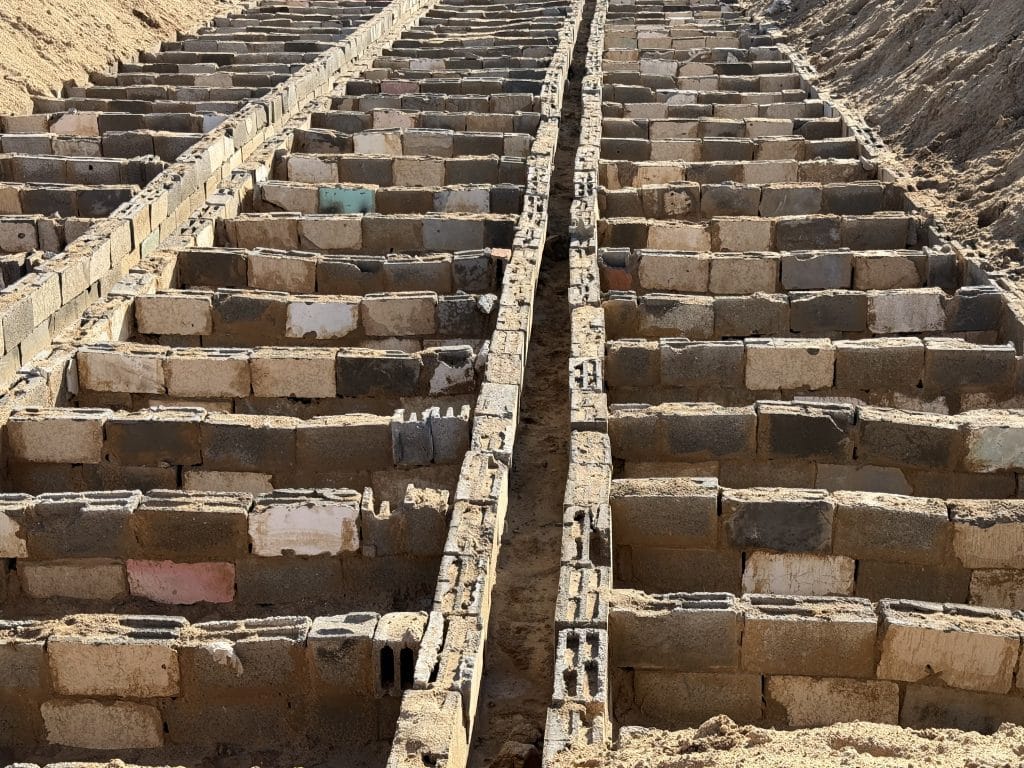
For the past two months since the ceasefire was announced, Huda said she would pass by the rubble of the home often, even if just to recite a prayer for her family still trapped beneath the rubble, hoping that they would be rescued soon.
“Now I can honor my martyred family by burying them, and we can move them to graves and make visiting them a habit,” Huda said.
Tareq S. Hajjaj
Tareq S. Hajjaj is the Gaza Correspondent for Mondoweiss and a member of the Palestinian Writers Union. Follow him on Twitter/X at @Tareqshajjaj.

From a month ago:
New Research Shows True Death Toll From Israeli Genocide in Gaza Could Be 126,000 or Even Higher…. researchers estimate that the total death toll from the war among Palestinians in Gaza is between 99,997 and 125,915, with a median estimate of over 112,000 killed. Even the lowest death toll estimate in the study is significantly higher than the death toll estimates in most media reports, which as of this week totaled roughly 70,000 Palestinians killed….
New Research Shows True Death Toll From Israeli Genocide in Gaza Could Be 126,000 or Even Higher | Common Dreams
Quick Hasbarist, this is to awful.
I urge you to convince the world that Israel would end this situation immediately, if only Chhhhamas would return the dead corpse of the innocent civilian bystander Gvili, who served in the counter‑terrorism unir Yasam, wore his uniform on October the 7th and killed 14 attackers. And that the question to ask for any evidence that Chhhamas has found and his withholding his corpse means either supporting Chhhaamas or being antisemitic, because his fingernail alone is more worth than a millon ‘Arabs’ according to a Rabbi and it is very likely that he still has two.