
Editor’s Note: The following paper was presented during the online seminar, “Is Zionism fascist? What will judges think?” hosted by Riverway Law on December 9, 2025.
Despite the mutual admiration of Zionists and fascists, both historically and in the present, it is generally considered unhelpful to characterize Zionism as fascism. However, viewing fascism from the perspective of the Black radical tradition, with its emphasis on racialism, colonialism and imperialism, rooted in supremacist ideas of western civilization, helps make fascism a useful concept for understanding Zionism.
In popular definitions of fascism it is detached from nationalism and associated most strongly with authoritarianism. Israel’s self-presentation as a liberal democracy, the result of a national self-determination project, and even an anticolonial Indigenous manifestation, conflicts with dominant ideas of what fascism is. But this approach to fascism is elusive by design.The history of fascism is dominated by liberal historians who mainly do not see racialism, colonialism and imperialism as central to it. Rather, they tend to see fascism as an aberration of the European/western political project.
In contrast, the revolutionary Black imprisoned intellectual, George Jackson, wrote in 1972 that the definition of fascism is not settled because of ‘our insistence on a full definition… looking for exactly identical symptoms from nation-to-nation.’ In fact, fascism is still under development. For the Black radical political scientist, Cedric Robinson, speaking in 1990, because Black political thought is treated as derivative, Black theories of fascism have generally not been considered ‘worthy of investigation’. Rather, popular culture and mass media are informed by mainstream academic fascist studies which constructs fascism as ‘right-wing extremism’ and ‘neurotic authoritarianism’, and ‘fascism proper… restricted to Europe between the First and Second World Wars.’ These western theorists found it very difficult to see fascism as anything other than the ‘dark side of Western civilization’, briefly flirted with but ultimately rejected.
Black theorists, Robinson goes on to say, based themselves on the experiences of the Black masses. They therefore did not see fascism as the ‘inherent national trait’ of Spain, Italy or Germany, but as ‘composed from the ideological, political and technological materials’ of the entirety of Western civilization. Their approach to fascism was shaped by the ‘crushing defeats’ Black people had already sustained in Cuba, Haiti and Liberia well before Mussolini invaded Libya and East Africa. Indeed, they mobilized en masse against Mussolini’s invasion of Ethiopia in 1935 because, as the Black radical intellectual, W.E.B. Du Bois wrote they recognized that ‘other nations have done exactly what Italy is doing’. Italy wanted a slice of the colonial pie that other European powers had kept for themselves. Italian colonization of East Africa was seen as the latest in a litany of attacks on Black life up to and including enslavement which many descended from directly. ‘Anti-fascism,’ Robinson remarks, ‘was thus spontaneously extended throughout the Black world.’
Not all Black intellectuals took the same approach to fascism. For example, C.L.R James tended to side with Marxists who saw fascism as the result of the clash between capitalism and Communism. Fascism was seen by capitalists as their salvation from a workers’ movement with revolutionary potential. But when the Trinidadian intellectual George Padmore returned to the question in 1956, he saw that something more than the crisis of capitalism within Europe was at stake: fascism was the sign of ‘a new aggression of Europeans in Africa.’
W.E.B. Du Bois already saw this in the early 1930s writing later, ‘I knew that Hitler and Mussolini were fighting Communism, and using race prejudice to make some white people rich and all colored peoples poor. But it was not until later that I realized that the colonialism of Great Britain and France had exactly the same object and methods as the fascists and the Nazis were trying clearly to use.’ This echoes Aimé Césaire’s famous remark that Nazism was the manifestation of what had already been done to non-Europeans before being brought to the Continent and turned inwards.
What Dan Tamir calls, a ‘genuine fascist movement’ also existed in Palestine in the 1920s and 30s, especially within the virulently anti-Communist Revisionist Zionist movement’ of Jabotinsky which opposed the supposedly more gradualist approach of Labor Zionism. Tamir suggests that because fascism emerges in periods of crisis, it is unsurprising that it also emerged in what he calls ‘modern Hebrew society’ in Palestine in the 1920s and 30s, a society riven by deep in crisis. However, like most mainstream fascism scholars, and from a perspective that almost totally ignores the existence of Palestinians, he sidesteps the emphasis placed by Black radicals on race.
For many, it was – and continues to be – unthinkable that Zionists could be fascists because of the centrality of antisemitism to fascism in Europe. However, Zionist fascists, like Abba Ahimeir, an admirer of the authoritarian philosopher Oswald Spengler, believed that fascism had no inherent connection to antisemitism, and that therefore Zionists could be fascists. However, more consistent with the Black radical approach is that the European Zionists – Christian but also Jewish – were in fact antisemites, in addition to being racists. Theodor Herzl famously declared antisemites Zionism’s ‘most dependable friends’ and opposed Jewish immigration, arguing they carried ‘the seeds of anti-Semitism into England; they have already introduced it into America.’ In 1897 he depicted the anti-Zionist caricature, ‘Mauschel’, ‘a distorted, deformed and shabby fellow’ who he did not see as belonging to the same race as the Jewish Zionist who must be freed from association with Mauschel.
It is well-known additionally that Zionists actively thwarted the saving of European Jews from the Nazis. Ralph Schoenman documents that ‘From 1933 to 1935, the WZO turned down two-thirds of all the German Jews who applied for immigration certificates’ because they were seen as of little use to the requirements of the Zionist colony.
Despite this, the dominant tendency to exceptionalize antisemitism leads many to downplay the role of race for Zionism. But there is no colonial project that is not founded on racial rule. Thus, Zionism enacts racial domination over Palestinians. The ability to colonize another’s land is based on the belief that the people are inferior at best, less than human and utterly killable at worst. Statements and actions to that effect are made constantly by Zionists throughout the current genocide.
The case of Zionist collusion with Italian fascism demonstrates the centrality of race to both fascism and Zionism. Mainstream interpreters of Italian fascism have tended to downplay race, for example citing the fact that Mussolini did not enact racial laws until 1938, and only to side with Hitler. However, as Robinson shows, Mussolini believed in Italian racial supremacy before this pivot, but more important than his personal attitudes were his ambitions in Africa. Mussolini’s relationship with Zionists, according to an article by Michael Ledeen discussed by Robinson, was because they ‘could be useful agents’ to destabilize the British mandate in Palestine and to ‘enlist Jewish populations in Libya and east Africa in the “pacification” of colonized populations.’ Mussolini kept Jews on side in various ways, for example allowing a rabbinical school to transfer from Germany.
Jews in Italy and beyond were widely favorable to Mussolini. However, this was not only because of the protection offered them up to 1938, but also because Italian Jews believed in Mussolini’s colonial project, considering, as Shira Klein notes, ‘that Italy’s pride and reputation depended on its colonial conquests.’ There was thus no reason why Jewish Zionists would not see Italy’s ambitions in East Africa and the Levant as consistent with their aspirations in Palestine.
Zionist obsessions with what Max Nordau called ‘muscular Judaism’ echoed Nazi practices, but also the eugenicist beliefs that were widespread among Europeans, US Americans and practiced throughout the colonized world, including by those with ostensibly social democratic views. Medical experiments carried out on Arab Jews were part of the quest to trace the genetic line of Homo Israelensis to Biblical times. Medical experimentation has also been carried out on Palestinian prisoners. Zionist eugenics cannot be detached from its aim to ‘form a portion of a rampart of Europe against Asia, an outpost of civilization as opposed to barbarism’ as Herzl put it in The Jewish State, as European is synonymous with whiteness. This is expressed in Palestine via the appeal to a messianic Jewish destiny, but contra the worrying trend of white nationalist attempting to capture the Palestinian liberation struggle in the west, this should be seen as consistent with all settler colonial visions of manifest destiny.
Indeed, it was the ambition of Zionist founders such as Arthur Ruppin to be accepted as wholly European, something they could only achieve by emulating European Herrenvolk nationalism in Palestine.
Zionism is fascist because it is the tip of the spear of European, western, white supremacist racialism, settler colonialism, and imperialism in the current conjuncture. But it is not unique in that regard. In the context out of which it emerged and of which it is a product – European civilizational supremacism, driving colonialism and imperialism – it is no surprise that Zionists admired and emulated fascism and continue to do so, building ever stronger ties to fascist movements globally, from Trump to Millei and Orban. It is also no surprise that Zionism embodies the ambitions of white supremacist nationalists everywhere.
Fascism’s global nature was remarked upon by George Jackson who noted that ‘we have been consistently misled by fascism’s nationalistic trappings. We have failed to understand its basically international character.’ Zionism can be seen as part of an international movement whose acute manifestations resulted from the crisis of capitalism. But as Black radicals showed, it never developed without its core defining feature: racial supremacism.
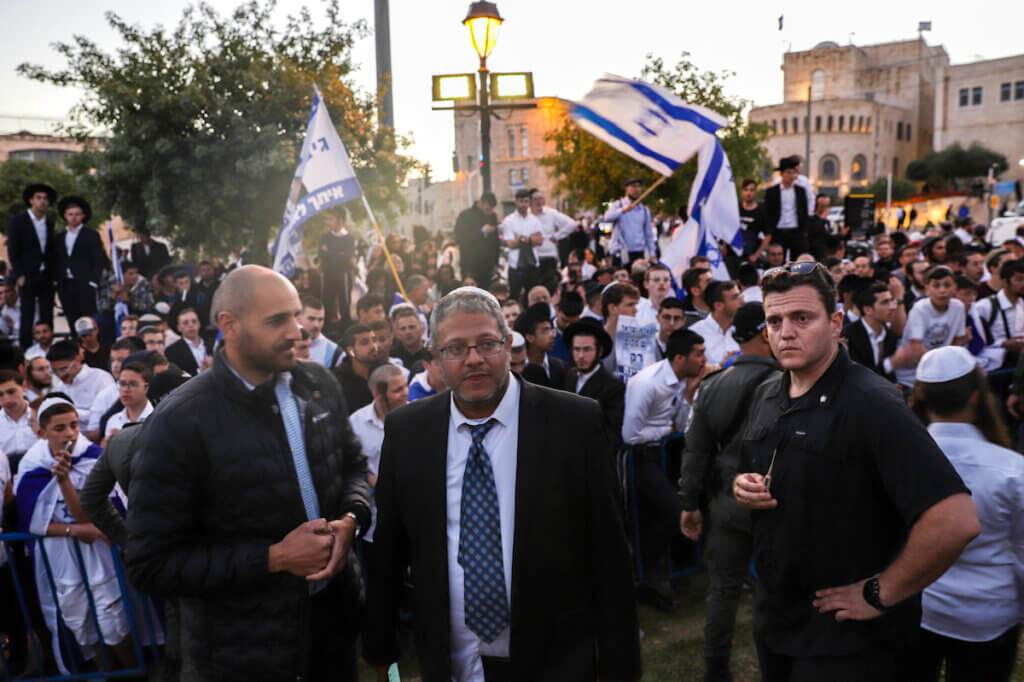
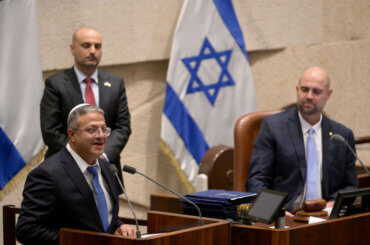
Just as Black radicals identified that fascism was a manifestation of their everyday experiences under colonialism and slavery, Zionism’s fascism goes far beyond its most extremist proponents, from Jabotinsky to Kahane to Ben-Gvir. From the perspective of the Black radicals, beyond these figures, it is the fact that almost the entire Israeli population is in lockstep with its genocidal colonial project which makes Zionism fascist in all its dimensions.
More concretely, one of the hallmarks of fascism is groupthink accompanied by restrictions on speech and the right to express dissenting viewpoints. In that regard Israel is pretty far along. Consider: First, a story from Ha’aretz and picked up by the msn newsfeed: an Israeli-Palestinian lawyer is sanctioned by the Israeli Bar Association:
The Bar Association itself initiated the complaint against me, in response to two Facebook posts I published on October 7 and 8, 2023. The first, posted at 7:30 A.M. on October 7, was short, and I never imagined it would provoke the Bar Association’s wrath. I simply wrote in Arabic, “Good morning, Gaza.”…The second post, written in Hebrew, was longer and unapologetically addressed to my followers, and my Jewish Israeli friends. One sentence in particular was deemed problematic by the Bar Association: “I will always stand on the side of my people, wherever it is and whatever means of resistance it chooses as a legitimate response to the occupation, siege and apartheid.”
Why can a Jew call for mass killings but I can’t say ‘Good morning, Gaza’?
Second, the Israeli government is shutting down ‘Army Radio’:
The Israeli government has taken another alarming step in its efforts to crack down on the press by moving toward shutting down Army Radio, which reaches some 900,000 listeners a day. A unanimous Monday cabinet vote to close the station is being sold as a matter of logic, efficiency and principle. Why, after all, should a military institution operate what has long functioned as a national news outlet? Why should soldiers be involved in journalism? Why should the army run a radio station that frequently criticizes the government and the defense establishment itself?…Army Radio is a specific institution that plays a role no other outlet can fully replace. Its shuttering would be devastating. And the move to shut it down cannot be understood in isolation. It fits neatly into the broader campaign led by Prime Minister Benjamin Netanyahu to weaken, intimidate or take over every independent institution capable of producing criticism, accountability or resistance.
Netanyahu’s latest authoritarian move targets the press – The Forward
Ah’d written Ahed in english Tamimi speaks to Jews
Earlier this year, world-renowned Palestinian activist Ahed Tamimi delivered a speech in which she questioned the distinction between Judaism and Zionism and criticized anti-Zionist Jews for failing to defend their religion from Zionism.
In recent months, Tamimi’s critique has been echoed by some other defenders of the Palestinian cause.
Are anti-Zionist Jews doing enough to defend Judaism from Zionists? Could they do more? Should they do more?
To explore these questions, Dimitri Lascaris speaks to Karim of BettBeat Media. Karim is a Professor of Political Economy and a social psychologist. His research focuses on the intersection between global political economy and human psychology.
https://youtu.be/OzNYShXEWaM?si=RpWJo_oo_QvUj0Xz&t=1
The Doctrine of Fascism by Mussolini is available online. Mussolini only loosely applied his doctrine and quickly allied himself with the existing Italian power structure.
I read Sternhell in college. His analysis was persuasive with respect to Western European fascism, but because he was a true believer Zionist, he was unable to use his framework to analyze “left” Zionism.
For Sternhell, fascism’s main characteristics were:
A nationalist revision of Marxism (anti-materialist socialism redefined in national terms).Anti-liberal and anti-democratic rejection of individualism and parliamentary institutions.A synthesis of revolutionary and nationalist ideas aimed at creating a unified, regenerated national community through struggle and authoritarian leadership.A loss of faith in the ability of labor to create revolutionary political change.While the Strasser faction of the Nazi party can be credibly called fascist, Hitler espoused politicized ethnic fundamentalism or ethnic monism that differs little from the ideology of the Jabotinskian Zionist “right’.
Today’s modern Zionism whether “left” or “right” should probably be understood from this sort of politics, and there is no real difference today between the Zionist “left” and the Zionist “right” within the Zionist state.
When I worked with Martin McMahon on al-Tamimi v. Adelson, I concluded
that the ideological details of Zionism constitute a sideshow andthat Zionism is best understood by analyzing the Zionist billionaire class of N. America and the UK.The Zionist billionaire class controls the politics of the Zionist state and has tremendous influence over the politics of white states.
Fascist ideologies often merge state and people into a single entity. Criticizing the state is then treated as defaming the people themselves.
My understanding is that Zionism has a range of types, and so it isn’t necessarily Fascist. On the right wing end there is a Fascist right wing version like Jabotinsky was involved in, whereas on the left wing end there is a Binational version like Noam Chomsky was involved in during the mid-20th century.
Austria before the end of WW1 had a weird dichotomy. It was pretty progressive domestically in some ways, like with a parliament, a major social democratic party, and laws protecting human rights. But for Serbs and Slavs, things could be harsh. There was a concentration camp called Thalerhof with executions. It held Eastern Slav nationalists, pro-Russians, revolutionaries. A Rusyn-American priest from my parish in the mid-20th century kept a poem comparing Thalerhof to Golgotha.
( https://en.wikipedia.org/wiki/Thalerhof_internment_camp )
The Isr. State, especially in its early period reminds me of that dichotomy, where it has been very progressive domestically, with a major Left Wing Labor party, communes (kibbutzes), national land ownership, but harsh treatment of the Pal. population. I don’t know how much of a coincidence it is that Herzl was from pre-WW1 Austria.