
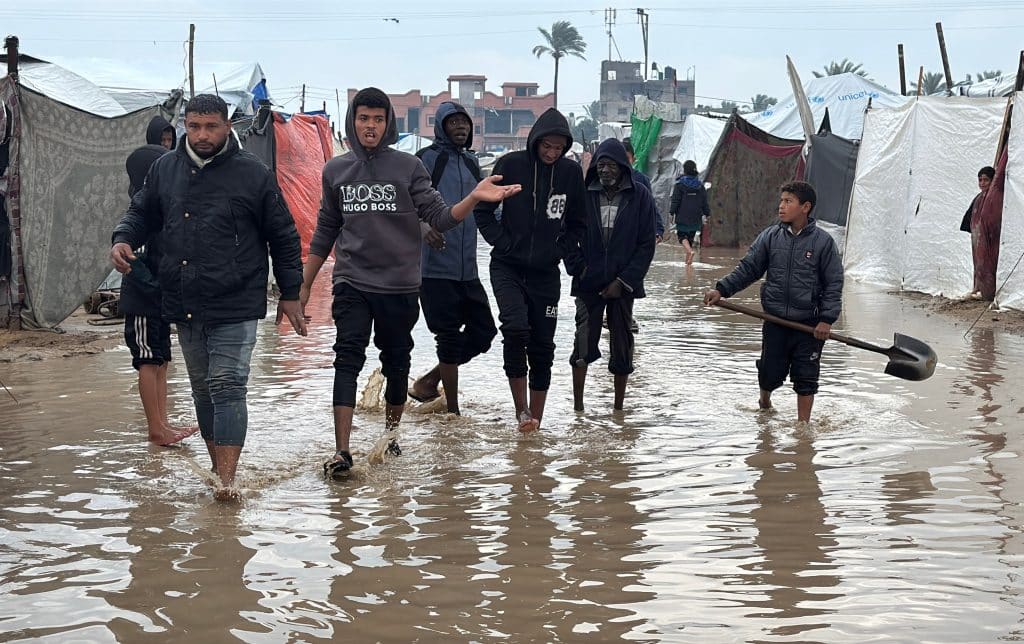
When Yahya Oweis, 28, learned that severe weather was expected to hit the Gaza Strip, including heavy rain and strong winds, he did everything he could to secure his tent to prevent it from being torn from the ground or collapsing on him and his family of five. But within the first hours of the storm on Sunday evening, his tent was uprooted. Oweis and his children were forced to seek shelter in a relative’s tent to ride out the storm.
For the third consecutive time this winter, the tents of displaced Palestinians across the Gaza Strip have been battered and flooded by strong winds and rain. With tens of thousands forced to live in makeshift shelters, the rainfall has come to mirror the violence of Israel’s genocide, which Palestinians in Gaza say has continued in a new form during the ongoing ceasefire between Israel and Hamas.
Oweis says that he hadn’t expected the severe cold front that arrived in Gaza early last week would be this bad. “At the start of the cold front, I thought it would be mild and that we would be able to stay in our tent without having to seek shelter elsewhere,” he told Mondoweiss. “I thought I could keep my family and children safe. But within the first hours, the wind tore the tent from the ground, and rain poured down on my children. I didn’t know what to do or how to protect my family.”
He said he spent several hours trying to re-erect and secure the tent, but his children’s cries from the cold and rain ultimately forced him to abandon it and move to nearby family tents.
What is unfolding across Gaza is not simply the result of winter storms, but the product of Israel’s continued policy of denying access to humanitarian aid meant to provide Palestinians with shelter, food, medicine, and other forms of relief. Now Israel is also curtailing the work of 37 international humanitarian organizations attempting to provide relief to the people of Gaza, who have endured over two years of genocidal war and live in conditions designed to bring about their destruction.
Israel’s continued closure of border crossings, its restrictions on the entry of aid needed for reconstruction, and its ban on prefabricated homes and tents are the primary drivers of the recurring disasters that continue to result from severe weather in Gaza. In addition, local aid workers in Gaza told Mondoweiss that the Israeli army deliberately opened dams inside Israel that ended up flooding Gaza, further exacerbating humanitarian conditions.
“For many years, the occupation has opened dams and water-collection areas on the Israeli side toward the Gaza Strip,” said Amjad Al-Shawa, head of the Network of Local NGOs in the Gaza Strip. “In recent days, during the heavy rains that hit Gaza, and as reservoirs inside Israel filled up, the Israeli army opened the dams toward the Wadi Gaza area, which is home to thousands of tents. This triggered a new wave of displacement, leaving many families without their belongings or shelter.”
Al-Shawa explains that displaced Palestinians are concentrated primarily in Gaza’s western coastal areas, while Israeli forces control the higher-elevation eastern regions, from which floodwaters naturally flow westward.
“In the absence of equipment and materials to prevent flooding, combined with the destruction of sewage networks and Israel’s ban on the entry of tents and caravans, the Gaza Strip still needs around 300,000 tents,” Shawa added. “Only 60,000 tents have been allowed to enter.”
Shawa stresses that tents in and of themselves are not sufficient solutions, yet Israel continues to block even these minimal forms of shelter to Gaza’s population.
Shawa explains that the Israeli army also restricts the entry of heating materials needed by residents living in their makeshift shelters. “There is a complete lack of heating in Gaza. There is no electricity or gas to cope with the severe cold,” he said. “Many families have lost their clothes and blankets and have no alternatives. A large number of children have already died because of the drop in temperatures.”
“This scene will continue to repeat itself as long as Israel prevents the entry of essential aid and maintains control over the crossings,” he added.
New restrictions on international organizations
On the first day of 2026, Israel barred 37 international humanitarian organizations from obtaining permits to operate in the West Bank and Gaza. All of the affected organizations provide humanitarian services, delivering essential and, in many cases, life-saving services to the population of Gaza. Even before the genocide, roughly 80 percent of Gazans depended on aid to fulfill basic needs, according to pre-war figures.
But since last March, Israel has attempted to impose a new regime for registering international organizations through what it describes as the “security screening” of Palestinian staff employed by these institutions, Shawa says.
According to a mid-December statement by the United Nations Office for the Coordination of Humanitarian Affairs (OCHA), this new registration system “relies on vague, arbitrary, and highly politicized criteria and imposes requirements that humanitarian organizations cannot meet without violating international legal obligations or compromising core humanitarian principles.”
“This constitutes a violation of humanitarian work and international law,” Shawa said. “It endangers the lives of local staff and represents blatant interference in the work of these institutions, as the criteria imposed by the occupation are security-based rather than professional. Requiring the sharing of this information is also a violation of employees’ privacy.”
Al-Shawa noted that the decision coincides with the implementation of the second phase of the ceasefire announced by U.S. President Donald Trump, further constraining humanitarian operations in Gaza and compounding an already catastrophic situation.
“This will also lead to Israel blocking dozens of aid trucks belonging to these organizations at a time when Gaza’s population is already facing multiple and severe crises,” Shawa said, adding that international organizations have largely refused to comply with Israeli demands. Israel is now moving to silence them and shut down their offices in Jerusalem, he explains.
The consequences, Shawa maintains, are life-threatening, since international organizations operate core medical and relief systems across Gaza. According to OCHA, “INGOs run or support the majority of field hospitals, primary healthcare centers, emergency shelter responses, water and sanitation services, nutrition stabilization centers for children with acute malnutrition, and critical mine action activities.”
Shawa says that their removal would severely undermine efforts to address widespread malnutrition, with new cases detected daily as the long-term effects of the famine Israel imposed on Gaza over the better part of a year continue to reverberate into the present.
“Without these centers and institutions, tens of thousands of people in the Gaza Strip would face a direct threat to their lives,” Shawa warned.

B’tselem’s statement on X regarding Israel’s ban on multiple humanitarian agencies:
As of today, Israel is barring 37 humanitarian organizations from entering the Gaza Strip. This is the latest in a long series of obstacles and restrictions imposed on the delivery of aid to Gaza, in violation of Israel’s commitments under the so-called “ceasefire” agreement. It is fully consistent with Israel’s policy of worsening the inhumane conditions in Gaza by deliberately harming a civilian population that remains under blockade and attack….Despite the declared “ceasefire,” Israel continues to kill Palestinians in the Gaza Strip. Since the beginning of the “ceasefire”, 405 people have been killed and 1,114 injured by Israeli fire…
https://x.com/btselem/status/2006716224634310861
Also relevent: a few weeks ago a number of Israeli NGO’s** posted a report titled “JOINT SITUATION REPORT – 58 Years of Occupation, The Two-Year War in Gaza”:
In these challenging times, practices Israel employed even before the war have intensified to the point where they have become routine and unprecedented in scale. They include: the widespread killing of civilians, including children and the elderly; mass destruction of homes, neighborhoods, and essential infrastructure that has left hundreds of thousands of Gazans displaced, homeless, and without access to basic necessities such as water and shelter; and the broad use of Palestinians as human shields, as they are exploited, placed in harm’s way, and denied their liberty. Palestinians held as security detainees and prisoners have seen their prison conditions deliberately and extensively worsened…
JOINT SITUATION REPORT: 58 Years of Occupation, The Two-Year War in Gaza
**
The Association for Civil Rights in Israel; Bimkom – Planners for Planning Rights; Breaking the Silence; Combatants for Peace; Emek Shaveh; Gisha – Legal Center for Freedom of Movement; HaMoked: Center for the Defence of the Individual; Ir Amim; MachsomWatch; Physicians for Human Rights Israel; The Public Committee Against Torture in Israel; Torah of Justice; Yesh Din
Even some the most conservative, pro-Israel, anti-Hamas self-proclaimed Zionists who believe in their bones that Israel has the right to defend itself have come to the conclusion that Israel is committing war crimes. For example, Michael Walzer** . This Haaretz article was picked up by the MSN newsfeed:
“When Joe Biden and his advisers came to Prime Minister Netanyahu and said, you’ve caused enough damage, now you can continue the struggle against Hamas diplomatically. As someone who studies war and morality, I can say that at the moment when there was a political path to defeat Hamas and release the hostages, the war became unjust…..“The effort to win when there was no way to win without destroying Gaza was a criminal effort. Wars are sometimes necessary, but they must have an end and a goal. Your government refused to commit to any end or goal, except for conquering the Strip and expelling all or most of its residents – but a better end was possible….the war, he said, “was a joint production,” and Israeli citizens “must recognize their responsibility for the destruction and the killings in Gaza.
War ethicist Michael Walzer, a Zionist to his core, cautiously joins Israel’s critics
**
Michael Walzer | School of Social Science | Institute for Advanced Study
Even worse, Israel is releasing vital supplies to profiteers instead of aid organisations:
https://www.theguardian.com/world/2026/jan/01/israel-allowing-traders-to-bring-into-gaza-dual-use-items-barred-from-aid-organisations
Israel Bans Aid Groups For The Same Reason It Bans Journalists, And Other Notes
Caitlin Johnstone
Dec 31, 2025
“Israel has banned 37 aid groups from working in the Palestinian territories, citing plainly spurious reasons. Among the aid groups banned are Doctors Without Borders (MSF) and Oxfam.
Israel banned the aid groups from Gaza for the same reason it continues to ban journalists. Of course it’s about eliminating aid itself, but it’s also about eliminating witnesses. Doctors and aid workers largely became the de facto journalists on the ground in Gaza when Israel banned international news media and began systematically assassinating Gaza-based Palestinian journalists. So Israel wants to get rid of those de facto reporters to hide its crimes.
Doctors Without Borders was one of the top humanitarian groups publicly accusing Israel of committing genocide in Gaza in 2025. A lot of what we learned about the Israeli massacres of starving civilians at “Gaza Humanitarian Fund” sites came from MSF doctors describing the gunshot wounds they’d been seeing at medical facilities. MSF were the first to report the horrifying story of IDF soldiers entering hospitals they’d attacked in Gaza and destroying individual pieces of medical equipment to make them unusable, providing unassailable proof that Israel was actually targeting
Gaza’s healthcare system itself rather than “Hamas bases in hospitals” as Israel falsely claimed. Doctors Without Borders were constantly putting out reports condemning Israel’s attacks on medical facilities where it had staff, and its doctors often spoke to the western press about the horrors they’d seen in Gaza.
And now they’ve been taken out, one of dozens of aid groups who Israel will no longer allow to operate in the occupied Palestinian territories. They took them out for the same reason they took out the journalists, and for the same reason Israel and its supporters try to stomp out speech that is critical of the Gaza holocaust throughout the western world, and for the same reason witnesses who try to tell law enforcement about the crimes of the Mafia tend to go missing.
They want to keep their crimes in the dark.”
https://www.caitlinjohnst.one/p/israel-bans-aid-groups-for-the-same
Mearsheimer’s analysis suggests it’s time to file ATS genocide lawsuits against US Zionist plutocrats.
If the plutocrats squeal, Israel will notice, and the Zionist plutocrats are not well-liked by the US public.
BTW, Mearsheimer is AI generated in the video.
https://youtu.be/EsBB055vG-g?si=_5_qcOoPHTiNi0zO