
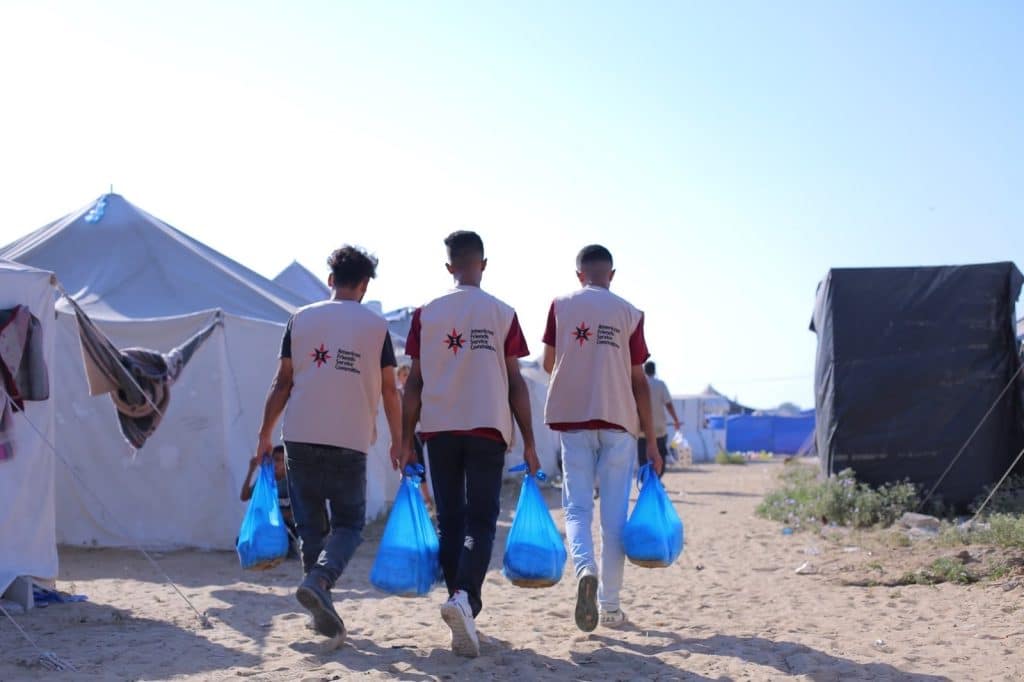
The Israeli government has put in place new, prohibitively restrictive registration procedures for international organizations, including those providing humanitarian aid in Gaza. Last month, we learned through news reports that my organization – the American Friends Service Committee (AFSC) – and 36 others will lose our registration from Israel.
Organizations can be denied registration if the organization or anyone affiliated with it has spoken out against the actions of the Israeli government. Rather than simply regulating the presence of international organizations, these rules are part of a long and increasingly drastic effort to restrict access to the occupied Palestinian territory for organizations that advocate against human rights abuses or for an end to occupation and apartheid. Compliance with these far-reaching and invasive procedures is not compatible with core humanitarian principles and would jeopardize the safety of our staff and partners.
Over the last two years, AFSC’s staff in Gaza have provided hot meals, food parcels, fresh vegetables, hygiene kits, and other essential supplies to over one million people displaced by Israel’s genocide. Our staff have done their work while facing displacement and food scarcity themselves. While doing this work they have built and continued relationships with farmers, teachers, and people eager to help their community survive.
Our operations in Gaza are independent, impartial, and guided by the needs of the people we serve. All our staff, vendors, and partners are already vetted through established U.S. and international sanctions mechanisms. Our work is guided by our belief in the divine Light in every person, and our belief that it is both our right and our responsibility to work against violence and hate. This is a principled legacy that we at AFSC have upheld since our founding as an organization in 1917.
The consequences of Israeli restrictions on humanitarian aid and the organizations that provide it are deadly and devastating. Palestinians in Gaza continue to die from cold, hunger, and preventable illness while Israel blocks trucks full of food, shelters, and medical supplies from reaching them.
When I heard the news that organizations like mine that provide humanitarian assistance would no longer be able to send international staff into Gaza, I was devastated. Israel controls all access into the strip and will block anyone from a de-registered organization. This announcement also meant I will not be able to go back.
My thoughts turned to the moment I entered Gaza in 2015.
It was one year after Israeli forces had carried out a 52-day military assault on the Gaza Strip, killing over 2,200 people and demolishing the neighborhoods where some of my Palestinian colleagues from AFSC lived. After hours of interrogation and inspection by Israeli soldiers at the Erez crossing, I remember the moment I saw my colleagues waiting for me at the end of the tunnel. As they welcomed me to Gaza, my heart raced, and my eyes filled with tears of joy at seeing them alive.
Volunteers and staff connected to the Quaker organization I work for have been crossing into Gaza since 1948, when the United Nations asked us to organize relief efforts for Palestinian refugees who had been expelled from their land by Israel at its founding. For two years, AFSC’s Gaza staff helped set up and run ten refugee camps in Al Faluja, Bureij, Deir al-Balah, Gaza City, Jabalia, Maghazi, Nuseirat, Khan Younis, and Rafah. That staff worked to provide food, shelter, and sanitation for refugees, while setting up educational programs for the children of Gaza.
Many of our staff from the U.S. and around the world came to visit Gaza. From these visits, important bonds were formed. Indeed, I still occasionally meet elderly people who recall volunteering in schools and clinics in Gaza during the 1950s. In more recent decades, AFSC delegation members who met with Palestinian youth were inspired by how young people led community service projects and brought that model with them back to the U.S. We visitors to Gaza supported Palestinians by breaking their isolation, affirming the critical work they were doing to keep their communities alive, and offering international solidarity with the Palestinian struggle. And Palestinians in Gaza supported and inspired us, leading lives in which they faced adversity with compassion, courage, and commitment.
On our trips to Gaza we learned to love their spicy shrimp dishes, the alleyways filled with children playing, the couples and families walking along the beach while fishers unloaded nets full of fish, the music projected from car radios and blasted from speakers in seaside restaurants, the farmers bringing their fruits and vegetables to crowded markets, and the endless cups of sugary tea and cardamon black coffee served at every occasion. We learned their stories and vowed to bring to the world a view of Gaza that countered stereotypes and simplistic representations.
For over 20 years, the people of Gaza have lived under an Israeli-imposed blockade that severely limited travel, trade, and everyday life for its two million residents. Access to Gaza was never easy. Unfortunately, neither were the efforts to open Gaza to the world by changing harmful policies that kept Palestinians caged, including the efforts to end the Israeli military occupation.
Long before October 2023, the Israeli government sought to criminalize humanitarian aid organizations and to dismantle aid infrastructure in Gaza. Over many years the attacks seeking to delegitimize the United Nations Relief and Works Agency (UNRWA) — which has provided critical lifesaving infrastructure support to aid delivery in Gaza and the West Bank — are a significant example of this profoundly destructive effort. International non-governmental aid organizations (including AFSC) have faced restrictions on our ability to provide assistance to Palestinians in Gaza since the Israeli blockade was imposed in 2007.
Now, Gaza has endured two years of genocide. Israel has blocked all international journalists and media organizations from entering, along with almost anyone else who could bear witness to the atrocities. With most of the world unable to access Gaza (even by flotilla) to offer relief, reconstruction, protection, and solidarity, Palestinians are forced to face this brutal destruction alone.
Now it will be almost impossible for us to help provide a comprehensive reconstruction that could restore Gaza’s health system, education sector, and critical infrastructure. International staff cannot join our colleagues on the ground in Gaza to participate in reconstruction efforts, provide food and medical supplies, or even to grieve together.
Israel’s cruel registration policies force organizations to submit complete staff lists (and other sensitive information about staff and their families) to the Israeli government. Disclosing operational information to a government credibly accused of genocide and apartheid endangers the lives of our staff and partners. Israel has already killed more than 500 aid workers since October 2023. Because we are unwilling to compromise our values or further endanger our colleagues, we will no longer be able to walk alongside them and physically support their lifesaving work.
I’m not sure when the day will come that I or other international staff will be able to connect again with our colleagues in Gaza. Until then, I hope that people will advocate for concrete political and diplomatic action to ensure unhindered humanitarian access and bring an end to the intolerable and ongoing suffering of the Palestinian people.

“Now, Gaza has endured two years of genocide. Israel has blocked all international journalists and media organizations from entering, along with almost anyone else who could bear witness to the atrocities.” A comment on that: the Committee to Protect Journalists had an editorial about that last December:
Two years into Israel’s genocide in Gaza, press freedom inside the country has reached a breaking point. Journalists report escalating censorship, harassment, and self-censorship that, they say, now functions as “part of the war effort.”….Independent reporting has sharply declined, leaving the Israeli public with a distorted view of the conflict. An October 2025 report by the Israeli think tank Molad found that only 3% of Channel 12’s coverage in the first six months of the war referenced the humanitarian crisis in Gaza, and only two of 206 war-related visuals showed Palestinian civilian casualties….“The Israeli media decided, and decides anew every day, that we will not report on the humanitarian situation,” Haaretz reporter Nir Hasson told CPJ. “The Israeli media is part of the war effort.”….Since October 7, these pressures have only intensified. Ministers have sought to permanently ban media outlets seen as critical of Israel’s military operations, privatize and weaken public broadcasting, and direct government advertising towards politically aligned platforms….
Under the radar: Israel steps up censorship and suppression of independent reporting – Committee to Protect Journalists
The American-Arab Anti-Discrimination Committee (ADC) announced today it had launched the IHRA Legislative Tracker—a public tool that tracks IHRA-related legislation across the country in one place. Here you can see what’s been introduced, what’s moving, and what’s becoming law.
They also said “To our knowledge, ADC is the only organization with a public IHRA tracker that exists. View the tracker on our website here.
Under Nazi rule, food and medical aid to Jewish ghettos was made dependent on German permits that were routinely delayed, denied, or revoked, producing starvation, disease, suffering, and premature death through administration. Aid remained technically legal but practically unattainable, allowing authorities to claim legality while systematically enforcing mass deprivation. Officials justified their actions as mere rule enforcement, turning paperwork into a mechanism of genocide rather than a neutral procedure.
It is time to launch a new flotilla to Gaza.
It takes a certain kind of inhumane mindset to obstruct or justify the obstruction of humanitarian aid which is legally a crime against humanity and in this case a violation of the ICJ’s orders to prevent the risk of genocide.