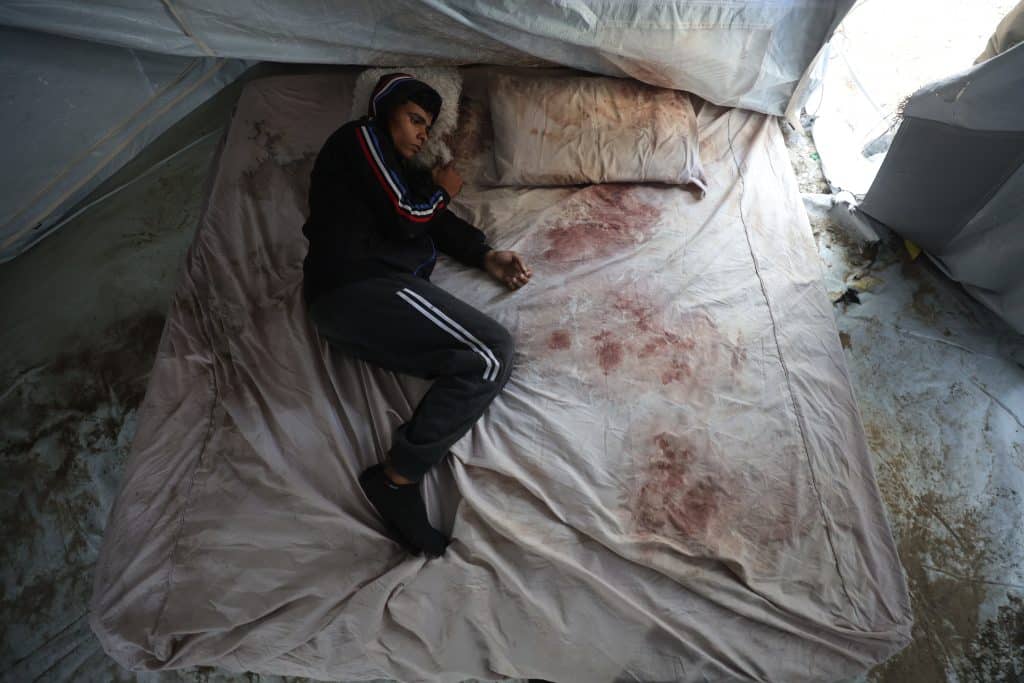
Ahmad Abu Saada, 21, refuses to clean the blood from his mattress. He lies down beside it, pale red against white. Ahmad sleeps here every night, refusing to leave the tent. The mattress is large, made for two, but he only lies down on one side, the other still decorated with Walaa’s dried blood.
Ahmad and Walaa had been married for only three days when it happened. Strong winds and heavy rain dislodged a section of a wall from one of the neighboring buildings. Dilapidated from war, the wall section came loose and fell on top of them, crushing Walaa to death.
Ahmad and Walaa were married on December 25, celebrating the occasion with a humble ceremony that brought together their loved ones in the displacement camp west of Gaza City. The engagement had lasted for six months, during which time Ahmad’s family had borrowed money from their relatives to support the marriage and cover the newlyweds’ expenses.
In previous weeks, the Gaza Government Media Office had already announced the collapse of 13 homes across the Gaza Strip due to successive cold fronts and winter storms. Most of these buildings had either been bombed during the war or were adjacent to houses that were targeted, compromising their structural integrity and making them prone to collapse.
The number of collapsed homes has since continued to rise with each renewed rainfall. The latest was on January 5, when a five-story building caved in and killed a child and his father in the al-Maghazi refugee camp in central Gaza.
As of the time of writing, a severe winter storm is battering the Strip, and the number of casualties from the deadly winter conditions is expected to rise. Also expected to rise are the number of infant deaths from hypothermia due to inadequate shelter and frequent tent flooding amid a lack of sufficient aid and reconstruction material, all in violation of the terms of Israel’s ceasefire agreement with Hamas.
Ahmad’s family was displaced from the al-Shuja‘iyya area east of Gaza City, and for a while lived in a tent on the seashore before the winter began. When the weather worsened and the winds started ripping tents from the ground, the family moved to western Gaza City in search of an alternative shelter. That was where Ahmad and Walaa’s short-lived marriage came to an end.
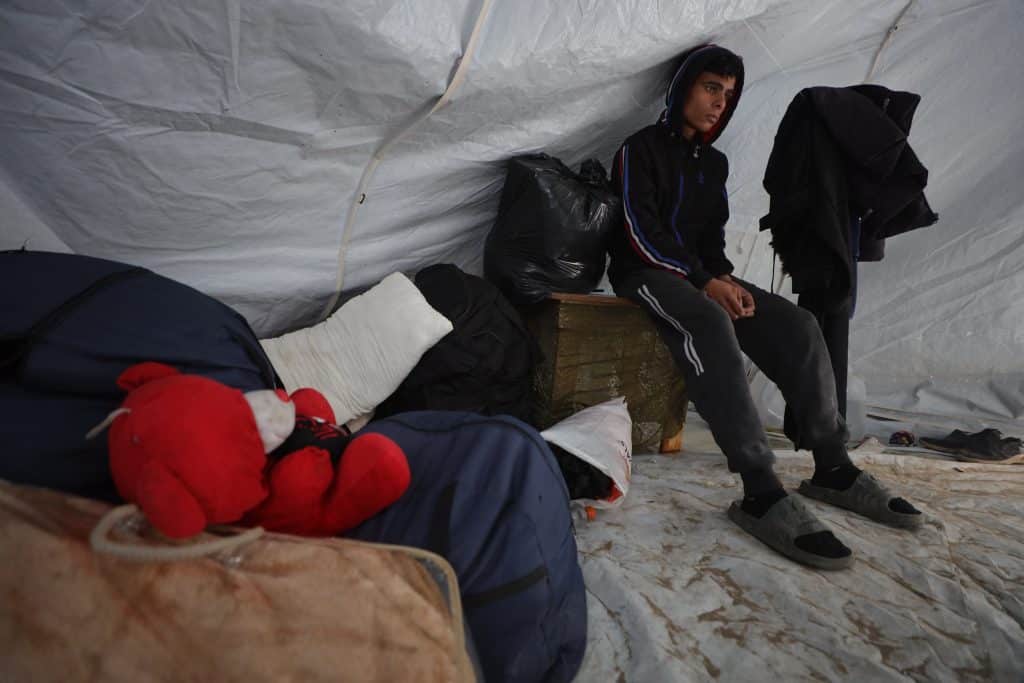
Saad al-Din Abu Saada, Ahmad’s father, recounts his story as Ahmad continues to lie on the same mattress. The father points to the stones that had killed his new daughter-in-law. “These are the stones. They fell from the third floor of the neighboring building and landed on her,” he said. “It left Ahmad in a severe mental state. We don’t know how to help him get out of it.”
“I lost six of my sons,” Saad al-Din continued. “They were martyred during the war, one after another. No one remains except Ahmad.”
Saad al-Din explains that he wanted to replace the sorrow of the past two years with happiness. “But it refuses to leave us,” he says. “It killed the joy we brought into our home. It killed that innocent girl.”
“How can a breeze bring down a building?” Saad al-Din remarked incredulously, stressing that it wouldn’t have collapsed had it not been for Israel’s relentless bombing campaign over the past two years. “The occupation destroyed these buildings. It carried out the bombing, it forced us out of our home, it put us in these conditions.”
Ahmad’s injuries from the incident weren’t serious, but he was left shattered, his father says. They had spent the end of the year receiving congratulations on the joyous union, and now they entered the new year receiving condolences. “He was destroyed by this incident,” Saad al-Din said. “Psychologically, morally, and physically.”
His father describes how, in the immediate aftermath of the accident, Ahmad pulled his wife out from under the rubble and witnessed her crushed and broken body.
“He was screaming for us, his mother and me, asking for help,” he described. “I found him trying to pull her out. The blood was everywhere.”
“Ahmad is no longer able to speak,” the father said. “The horror and the grief made him lose his voice.”
Ahmad remained in the same tent he had set up as a temporary starting point for his life with Walaa. He now lies in it most of the time, silently staring at a picture of Walaa on his phone.
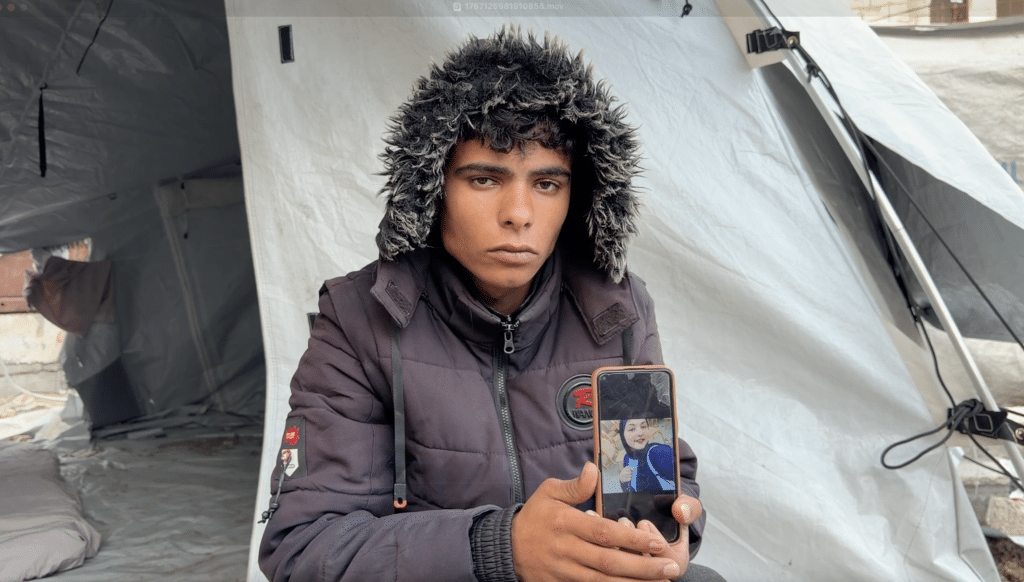
It has been two weeks since that day, and he has yet to utter a word, his mother, Najah Abu Saada, says. Whenever she attempts to enter the tent to coax Ahmad out of it, he refuses and screams at her, entering a state resembling madness, she says. The same happens when she tries to persuade him to change or clean the blood-stained mattress. “Ahmad lost a huge part of himself,” Najah said. “He lost hope of finding even a small measure of joy in this unjust world.”
It has been two years of constant loss for the family, and Ahmad is the last of Najah’s children. Now she isn’t sure he survived either, she says. “I feel I’ve lost Ahmad as well.”
“We thought we could overcome this grief or set it aside and begin anew,” Najah explained. “And we did.” The week before the wedding and the short days that followed were filled with immense joy, Najah admits, despite everything they’ve endured. “But what happened proved to us that nothing around us wants to see us happy — not just the occupation…but even the silent stones.”
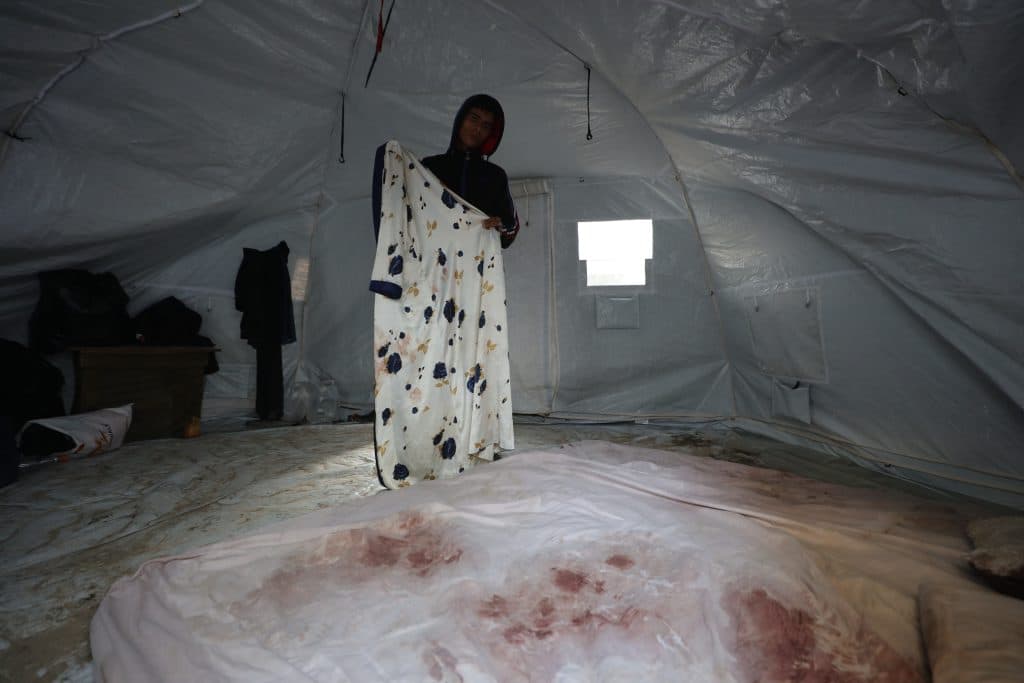
The same silence now hangs over Ahmad, to the point that Najah feels like he isn’t her son anymore. “He sits there but doesn’t speak to us,” she says. “He doesn’t joke like he used to. He doesn’t go to the market to run our errands. He’s become lifeless, crying day and night, touching the dried bloodstains on the fabric as tears mix with blood.”
“Can I really say that my son is still there?” Najah asked. “Can I call out to him and have him rush toward me?”
“No, I can’t say that now,” she answered.
Tareq S. Hajjaj
Tareq S. Hajjaj is the Gaza Correspondent for Mondoweiss and a member of the Palestinian Writers Union. Follow him on Twitter/X at @Tareqshajjaj.